162 - Attitudes of Adolescents Toward Privacy and Topics Included in Clinical Notes Shared Between Clinicians
Friday, April 24, 2026
5:30pm - 8:00pm ET
Publication Number: 1152.162
Joshua Baalman, Cincinnati Childrens Hospital Medical Center, Cincinnati, OH, United States; Tanya L. K.. Mullins, Cincinnati Children's Hospital Medical Center, Cincinnati, OH, United States; Cameron Grollmus, Cincinnati Children's Hospital, Cincinnati, OH, United States; Stephen A. Spooner, Cincinnati Children's Hospital Medical Center, Cincinnati, OH, United States; Lindsey Barrick, Cincinnati Children's Hospital Medical Center, Cincinnati, OH, United States
Adolescent Medicine Fellow Division of Adolescent and Young Adult Medicine, Cincinnati Children's Hospital Medical Center
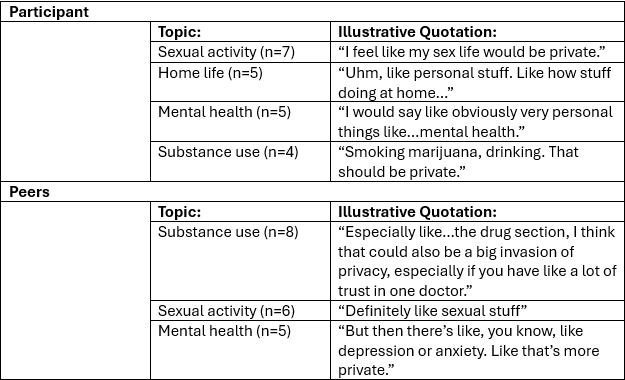
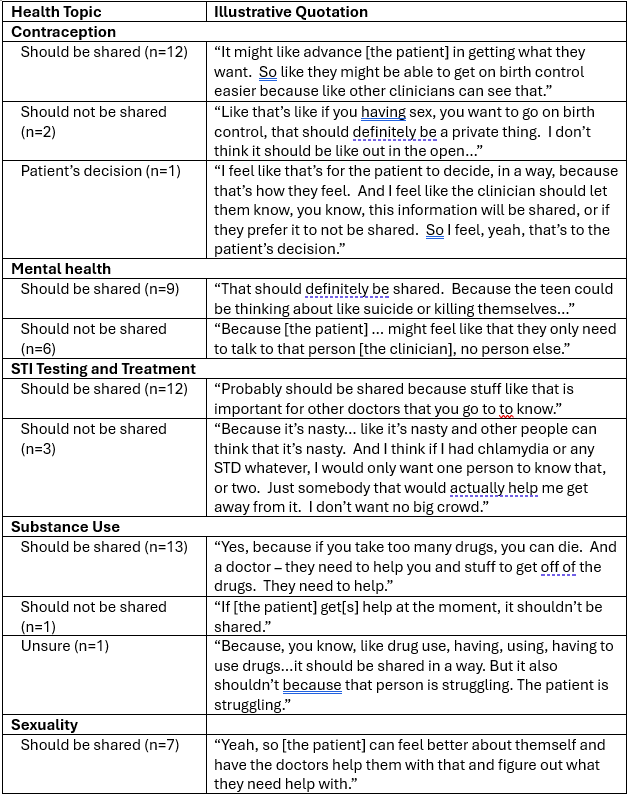
Background: The 21st Century Cures Act encourages connectivity of electronic health records (EHR), such as sharing of clinical notes between clinicians. Little is known about adolescents' attitudes about the sharing of private information between clinicians. Objective: To assess adolescent attitudes toward what information they consider to be private in clinical visits and what topics should or should not be shared between clinicians in clinical notes. Design/Methods: Fifteen 14-17 year-olds were recruited from an adolescent clinic to complete a semi-structured individual interview that included open-ended questions about what topics were considered private and what topics peers would consider private in clinical visits. Eight questions about specific health topics assessed whether participants thought the topic should or should not be shared between clinicians and the rationale for their response. Two researchers independently analyzed transcripts using thematic analysis and discrepancies were addressed through discussion. The study was IRB-approved. Results: Mean age was 15.1 years (SD 1.02). Participants identified as Black (n=8), White (n=5), and Mixed (n=2); 1 was Hispanic. Eight were female; 7 were male. Sexual activity (n=7), home life (n=5), mental health (n=5), and substance use (n=4) were considered by participants to be private topics, while substance use (n=8), sexual activity (n=6), and mental health (n=5) were considered to be private topics for peers. With respect to specific topics, 12 participants reported that seeking contraception should be shared between clinicians in clinical notes. Nine youth reported that mental health should be shared. Twelve youth reported that sexually transmitted infection testing/treatment should be shared. Most participants (n=13) reported that substance use should be shared. Attitudes about whether sexuality should be shared were more varied: 7 reported that it should be shared, 5 reported that it should not, 2 reported that the patient should decide, and 1 did not answer. For routine care, most youth reported that sports physicals (n=13), visits for the flu (n=9), and annual physicals (n=13) should be shared. Illustrative quotes are in Tables 1 and 2.
Conclusion(s): Sexual activity, home life, mental health, and substance use were reported to be private topics, aligning with topics that are asked privately by clinicians. Variability in attitudes toward which topics should be shared between clinicians suggests that clinicians should ensure that youth understand the limits of privacy protections in EHRs.
Table 1: Attitudes Toward What Topics are Private Information
Table 2: Attitudes Toward Whether Specific Health Topics Should Be Shared Between Clinicians