163 - Extracurricular Activities and Sleep Delay: A Survey of Youth in Wisconsin
Friday, April 24, 2026
5:30pm - 8:00pm ET
Publication Number: 1153.163
Carey Wagoner, University of Wisconsin School of Medicine and Public Health, Madison, WI, United States; Qianqian Zhao, University of Wisconsin at Madison, ANN ARBOR, MI, United States; Karen Pletta, University of Wisconsin School of Medicine and Public Health, Madison, WI, United States
Assistant Professor University of Wisconsin School of Medicine and Public Health Madison, Wisconsin, United States
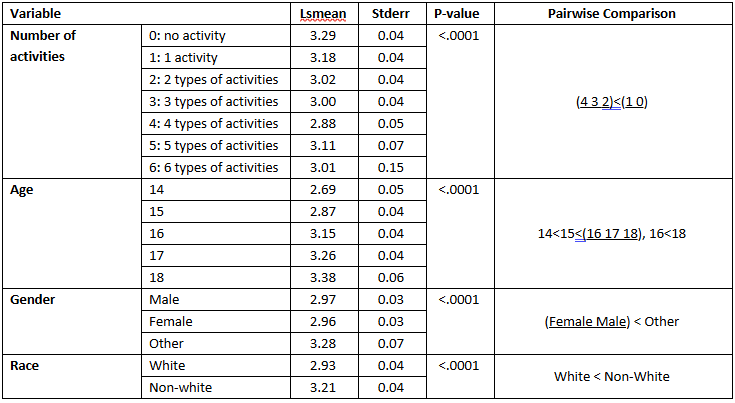
Background: Both good sleep and participation in extracurricular activities have a positive effect on physical and mental health and overall quality of life for adolescents. However, these two components may compete for time in the life of a busy teenager. Objective: To characterize the relationship between the number of extracurricular activities and the effect on sleep delay. Design/Methods: The Dane County Youth Assessment was a cross-sectional survey distributed to students in Dane County high schools in 2024. Measures included sleep and extracurricular activities. Sleep data included sleep delay, defined as number of days per week awake past 11 pm on school nights. Extracurricular activity data included total number of extracurricular activities per week, which was categorized as 0-1, 0-4, and 5-6 for comparisons. The relationship of sleep delay and the number of different types of activities in a week were investigated using analysis of covariance (ANCOVA) adjusting for age, gender and race with Tukey method for multiple comparisons. Results: A total of 15,488 participants participated in the survey including 49% male and 66% white. The average sleep delay was 2.91 (SD 1.77). The average activities per week was 2.09 (SD 1.43). We found that those who did 2-4 activities per week had a greater sleep delay on average than those who did 0-1 (p < .0001, Table 1). No significant difference was found between 0 and 1, between 2, 3, and 4 activities, or any other pairwise comparisons.
Conclusion(s): We found that more involvement in activities correlated with more nights awake past 11 pm on school nights. A possible explanation for this is less time available after school when under the scheduled extracurricular activity time commitments. Further study can be done to determine if the type of extracurricular activity has an impact on nights awake past 11 pm and if/what affects this may have on other factors such as grades and mental health.
Table 1: Number of activities, age, gender, and race compared to sleep delay