587 - Reliability of History and Physical Examination Findings in Children with Headaches
Friday, April 24, 2026
5:30pm - 8:00pm ET
Publication Number: 1564.587
Daniel S. Tsze, Columbia University Vagelos College of Physicians and Surgeons, New York, NY, United States; Nathan Kuppermann, Children's National Health System, Washington, DC, United States; Bradley J. Barney, University of Utah, Salt Lake City, UT, United States; Chella Palmer, University of Utah, Salt Lake City, UT, United States; Pamela J.. Okada, University of Texas Southwestern Medical School, Dallas, TX, United States; Wendalyn K. Little, Emory University School of Medicine and Children's Healthcare of Atlanta, Atlanta, GA, United States; Sage Myers, Baylor College of Medicine, Houston, TX, United States; Kimberly Quayle, Washington University in St. Louis School of Medicine, St. Louis, MO, United States; Jane K. Soung, University of Pittsburgh School of Medicine, Pittsburgh, PA, United States; Andrea T. Cruz, Baylor College of Medicine, Houston, TX, United States; Sandra Spencer, Children's Hospital Colorado, Aurora, CO, United States; Aarti Gaglani, Nationwide Children's Hospital, Columbus, OH, United States; Dale W. Steele, The Warren Alpert Medical School of Brown University, Providence, RI, United States; Alexander Rogers, University of Michigan Medical School, Ann Arbor, MI, United States; Michael D. Johnson, University of Utah School of Medicine, Bountiful, UT, United States; Danica B. Liberman, USC, Children's Hospital Los Angeles, Los Angeles, CA, United States; Lynn Babcock, Cincinnati Children's Hospital Medical Center, Cincinnati, OH, United States; Shruti Kant, University of California, San Francisco, School of Medicine, San Francisco, CA, United States; Kaileen Jafari, University of Washington School of Medicine, Seattle, WA, United States; Tiffani Johnson, University of California, Davis, School of Medicine, Sacramento, CA, United States; Danny Thomas, Medical College of Wisconsin, Brookfield, WI, United States; Lawrence A. Richer, University of Alberta, Edmonton, AB, Canada; Peter Dayan, Columbia University, Hastings on Hudson, NY, United States
Professor of Pediatrics in Emergency Medicine Columbia University Vagelos College of Physicians and Surgeons New York, New York, United States
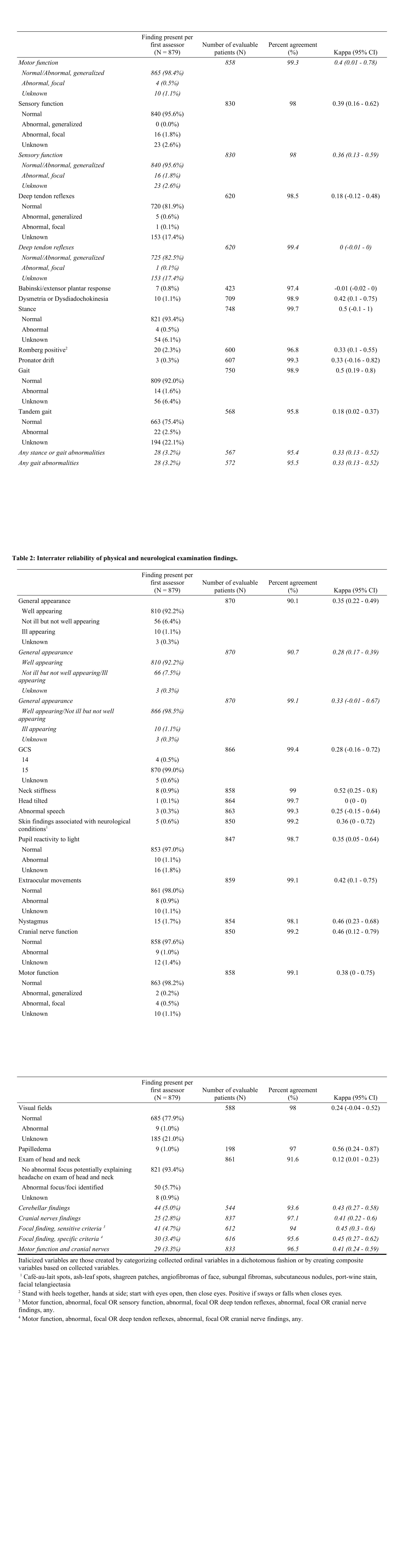
Background: Clinicians require reliable patient history and physical examination findings to accurately determine which children with non-traumatic headaches are at high risk of having emergent intracranial abnormalities (e.g., brain tumors, intracranial bleeds) and warrant prompt neuroimaging. Little is known about which findings have adequate reliability for evaluating children with headaches and, therefore, are appropriate for clinical decision-making. Objective: To determine the interrater reliability of patient history and physical examination findings commonly used to assess children presenting to emergency departments (EDs) with headaches. Design/Methods: We conducted a prospective, multicenter cohort study in the Pediatric Emergency Care Applied Research Network (PECARN) of children aged 2-17 years with non-traumatic headaches evaluated at one of 18 academic pediatric EDs. In a subset of participants, two clinicians performed independent standardized assessments of patient history and physical examination variables, recommended to be conducted within 60 minutes of each other. The interrater reliability of each finding was determined using the kappa statistic or weighted kappa, as applicable, with 2-sided 95% confidence intervals. Results: We analyzed 882 paired assessments of children with headaches; median (IQR) age was 13 (9.7, 15.6) years, with 103 (11.7%) younger than 7 years. The kappa estimate was at least moderate (κ≥0.41) for 110 of the 151 (72.8%) total variables analyzed, including [97 of 116 (83.6%) patient history variables and 13 of 35 (37.1%) physical examination variables]. Patient history and physical examination variables with the highest kappa estimates were vomiting and papilledema. Variables with the lowest kappa estimates were maximum headache pain intensity (categorized as mild versus moderate/severe), head tilt, and deep tendon reflexes.
Conclusion(s): We identified the interrater reliability for a comprehensive group of patient history and physical examination findings in children with headaches presenting to EDs. These data can be used by clinicians and investigators to choose variables for clinical decision-making and consideration for incorporation into clinical prediction rules.
Interrater reliability for headache history findings.
Interrater reliability of physical and neurological examination findings.










.jpg)