Session: Medical Education 1: Diversity, Equity, and Inclusion
261 - Caring for Vulnerable Populations: A Needs Assessment of Neonatal Providers to Improve Communication with LGBTQ+ Families.
Friday, April 24, 2026
5:30pm - 8:00pm ET
Publication Number: 1247.261
Russell D. Himmelstein, Yale-New Haven Children's Hospital, Hamden, CT, United States; Lindsay Johnston, Yale-New Haven Children's Hospital, New Haven, CT, United States; Isabel T. Gross, Yale School of Medicine, New Haven, CT, United States; Andres Martin, Child Study Center, School of Medicine, Yale Unive, NEW HAVEN, CT, United States; Alexis L. Chang, Yale School of Medicine, New Haven, CT, United States; Olivia Kachingwe, Yale University School of Public Health, New Haven, CT, United States; Juliann Reardon, Connecticut Children's Medical Center, Hartford, CT, United States; Margret Jaeger, private, Vienna, Wien, Austria
Fellow Yale-New Haven Children's Hospital Hamden, Connecticut, United States
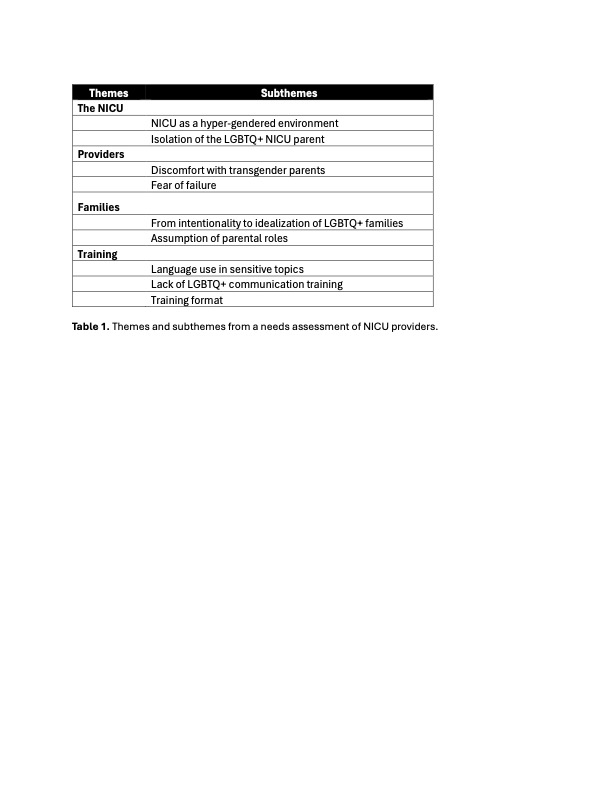
Background: A newborn's admission to the neonatal intensive care unit (NICU) can be a traumatic experience causing significant parental stress. Parents who identify as lesbian, gay, bisexual, transgender, queer, or another sexual and gender minority identity (LGBTQ+) have increased stressors. Despite the well-documented adverse outcomes faced by this community, medical education has been largely devoid of queer health and based on cis-heteronormative assumptions of patients. Additionally, there is a lack of research on the experiences of NICU providers when caring for LGBTQ+ families. Before developing a novel simulation curriculum for NICU providers, it is essential to first assess their prior experiences and specific needs. Objective: The aim of this study was to conduct a targeted needs assessment of NICU staff to identify gaps in existing training, to be used in creation of a novel curriculum to increase NICU staff comfort and knowledge in caring for LGBTQIA+ parents. Design/Methods: This qualitative study was conducted at a single level IV academic NICU in New England between October 2024 and January 2025. Using convenience sampling, we recruited NICU-based nurses, advanced practice registered nurses (APRNs), physician assistants, fellows, and attending physicians. Semi-structured interviews were conducted virtually by a non-affiliated, trained research team to minimize bias. Interviews focused on previous experiences with LGBTQ+ families, prior training, communication challenges, and suggestions for future education. Interviews were transcribed and analyzed using iterative thematic analysis. Recruitment continued until thematic saturation and representation across years of experience were achieved. Results: Twenty participants were recruited and interviewed. Five major themes and nine subthemes were identified (Table 1). Participants frequently reported discomfort and uncertainty, particularly when caring for transgender birthing parents, largely due to a lack of training and concern about misgendering or causing harm.
Conclusion(s): Findings highlight critical gaps in LGBTQ+-inclusive training among NICU providers. Addressing these needs through targeted educational interventions is essential to improving confidence, communication, and culturally competent care for LGBTQ+ families in the NICU setting. The results of this study will be used to develop a novel curriculum to improve communication with LGBTQ+ families. To our knowledge, such a curriculum has not been developed and may aid providers as they care for this vulnerable population.
Table 1. Themes and subthemes from a needs assessment of NICU providers.