500 - Resilience in Caregivers of medically Complex Children: The role of shared caregiving and community belonging
Friday, April 24, 2026
5:30pm - 8:00pm ET
Publication Number: 1480.500
Nicholas R. Mulvihill, University of Kansas School of Medicine, Andover, KS, United States; Xinyu Zhang, KUMC, Wichita, KS, United States; English Evelyn, University of Colorado Anschutz, Chicago, IL, United States; Debra Birdwell, KU Wichita Pediatrics, Wichita, KS, United States; Carolyn Ahlers-Schmidt, KUSM-W CRIBS, Wichita, KS, United States; Melissa T. Hopper, KU School of Medicine Wichita, Wichita, KS, United States
Pediatric resident University of Kansas School of Medicine Andover, Kansas, United States
Background: Caring for a child with medical complexity (CMC) creates additional financial, physical, and social strain on caregivers. Resilience can buffer related stress, promote growth, and improve quality of life, however, few studies examine resilience in this population. Objective: To measure resilience and identify associated factors in caregivers of CMC in a rural state. Design/Methods: This study was approved by KUMC IRB (STUDY00160272). Caregivers completed anonymous paper/online surveys through the Medically Complex and Cystic Fibrosis Clinics, and via social media advisory board. Data included demographics, patient information and caregiving hours. The 17 item Adult Resilience Measure-Revised (ARM-R; total score range 17-85, personal subscale: 7-35; caregiver subscale: 10-50) was used. Chi-square, Spearman correlation, Kruskal-Wallis, and Dwass Steel-Critchlow-Fligner were used for statistical analysis. Alpha was set at 0.05. Results: Of 200 surveys, 187 were analyzed; 13 removed due to missing data. Participants were predominantly female (91%), biological parents (81%), and aged 40-49 years (36%). Mean total, personal, and caregiver resilience scores were 68.1 (SD=12.4), 39.8 (SD=7.3), and 28.3 (SD=6.1), respectively. Total and caregiver resilience scores differed significantly by hours spent sharing caregiving task with family (p=0.008); post hoc tests revealed significant difference between none and 10-14 hours (p=0.05). There was a positive and statistically significant correlation between hours spent sharing caregiving task with family with total (ρ=0.26, p< 0.001) and caregiver resilience scores (ρ=0.26, p< 0.001). Significant differences in total (p < 0.001) and personal resilience scores (p < 0.001) were also observed across categories of perceived belongingness (Tables 2, 3). A positive and statistically significant correlation was found between perceived belongingness and total (ρ=0.80, p< 0.01) and personal resilience scores (ρ=0.84, p< 0.01). Fair treatment ("I am treated fairly in my community") and interpersonal relationships ("People like to spend time with me") were both found to be positively correlated with perceived belongingness (ρ=0.73 and ρ=0.59; p< 0.01).
Conclusion(s): Factors influencing resilience for caregivers of CMC are hours spent sharing caregiving tasks with family and feelings of belonging. Perceived fair treatment and interpersonal relationships correlated positively with total resilience. Future interventions should enhance family involvement and foster community belonging to strengthen caregiver resilience.
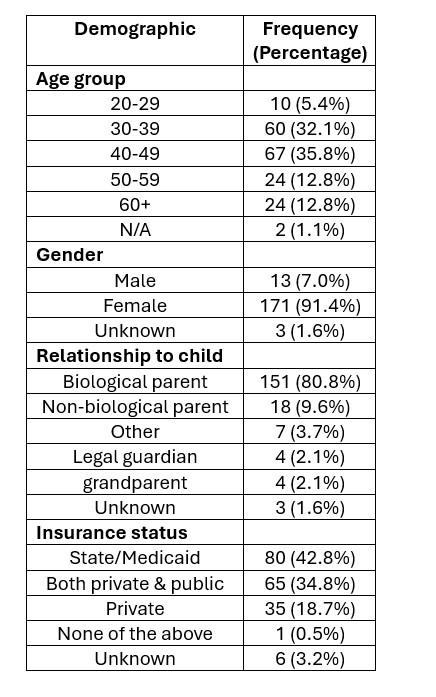
Table 1. Characteristics of Caregivers of Children with Medical Complexity (CMC)
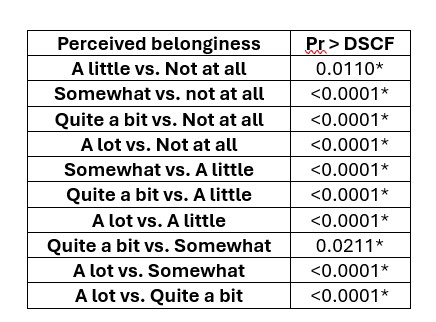
Dwass Steel-Critchlow-Fligner test between perceived belongingness (measured by the Likert style question “I feel that I belong in my community” and total resilience scores
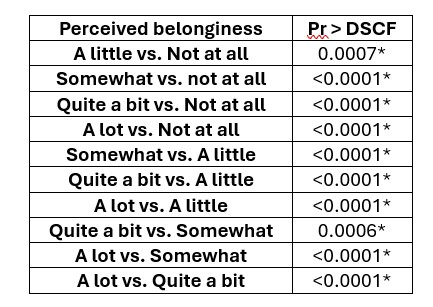
Dwass Steel-Critchlow-Fligner test between perceived belongingness (measured by the Likert style question “I feel that I belong in my community” and total resilience scores