Session: Developmental and Behavioral Pediatrics 3: ADHD/Behavior
118 - Project ECHO Case Consultations on MEDB Disorders: A Lesson in Comorbidity
Friday, April 24, 2026
5:30pm - 8:00pm ET
Publication Number: 1108.118
Mary L. Leppert, Kennedy Krieger Institute, Baltimore, MD, United States; Jennifer L. Crockett, Kennedy Krieger Institute and Johns Hopkins University School of Medicine, Baltimore, MD, United States; Janna Steinberg, Kennedy Krieger Institute, Baltimore, MD, United States; Mallory Legg, Kennedy Krieger Institute, Baltimore, MD, United States; Amie Bettencourt, Johns Hopkins University School of Medicine, Baltimore, MD, United States; Megan Bone, Johns Hopkins University School of Medicine, Baltimore, MD, United States; Andrea Israel, Kennedy Krieger Institute, Baltimore, MD, United States; Belinda Chen, Kennedy Krieger Institute, Baltimore, MD, United States; Joyce Harrison, Kennedy Krieger Institute, Lusby, MD, United States
Neurodevelopmental Pediatrician Kennedy Krieger Institute Baltimore, Maryland, United States
Background: One in four children in the U.S. has a disorder of mental health/emotion, development, or behavior (MEDB), and many present in early childhood with disruptive behavior. There is a twofold challenge for addressing MEDB disorders in early childhood; disruptive behavior may stem from any of the MEDB domains, and care access is limited by the paucity of specialists that care for this vulnerable group. Objective: To determine the most common MEDB concerns, or suspected diagnoses presented during case-based learning, and patterns of concerns or suspected diagnoses that occur in an early childhood developmental and behavioral consultation setting. Design/Methods: Between 2016 and 2025, the Extension for Community Healthcare Outcomes (ECHO) model was implemented to support early identification and management of MEDB disorders in early childhood. Participants included community-based stakeholders in early childhood care: medical professionals, physicians, nurse practitioners, behavioral health specialists, therapists, educators, and administrators. Seven ECHO programs were delivered to providers within a single state, while four programs were offered to providers serving military-connected children across the United States and at U.S. military installations in Europe. Across the 278 ECHO sessions, a total of 167 de-identified cases were presented.
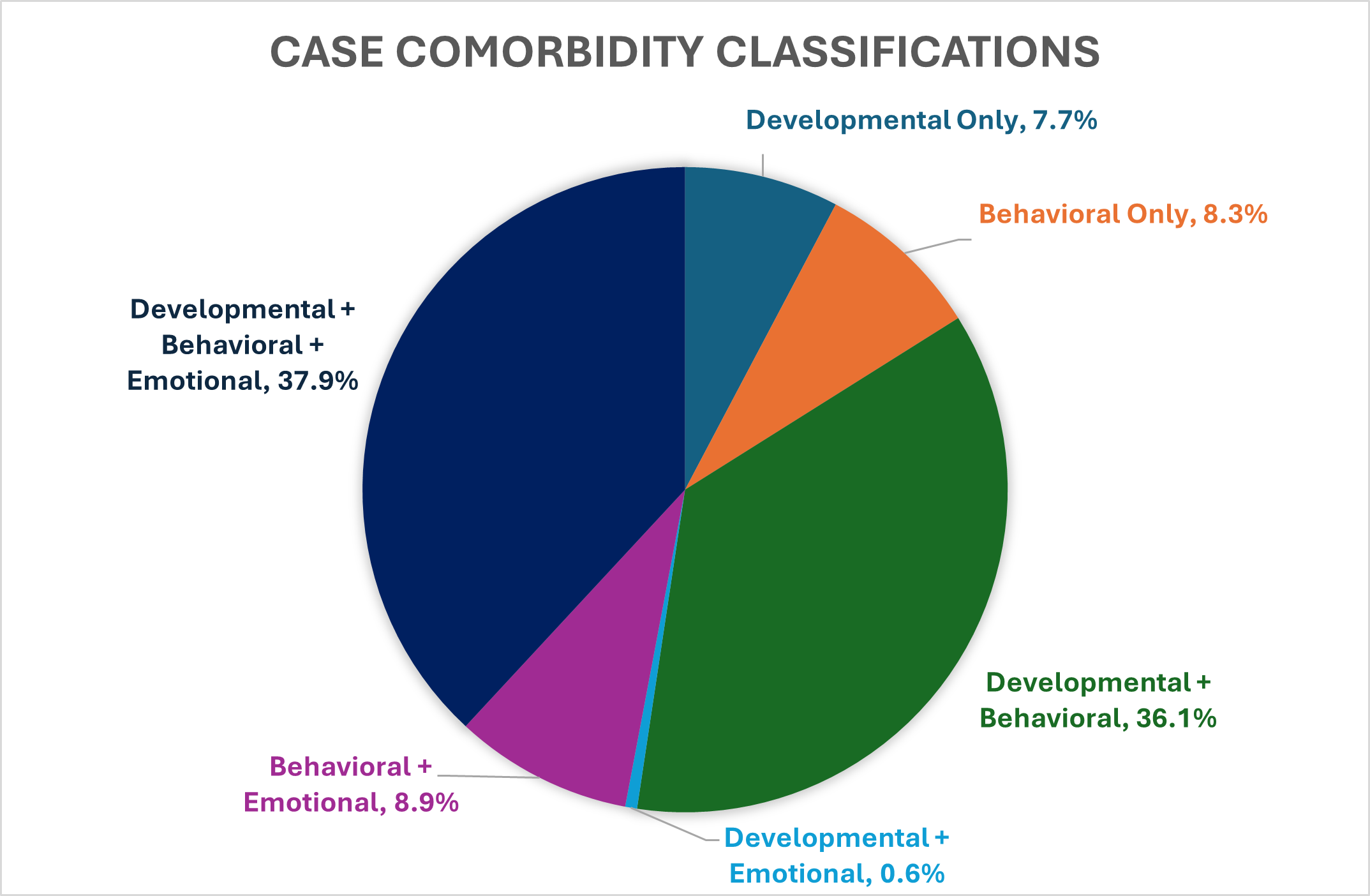
Cases were consensus coded by all ECHO hub team members after each ECHO session to determine suspected diagnoses, associated MEDB domains, presence and type of adverse childhood experiences (ACEs), and the rates of MEDB co-occurrence. Results: Across all ECHO cases, behavior disorders were present in 91% of cases. The highest frequency of MEDB concerns in each domain were anxiety, speech and language delays, and aggressive behavior. The top adverse childhood experience was parental separation/divorce. Remarkably, 83% of cases had comorbid MEDB disorders; 45% of cases had comorbidity in 2 MEDB domains and 38% had comorbidity in all three MEDB domains.
Conclusion(s): Community providers are more likely to seek consultation on young children with co-occurring MEDB disorders, as only 16.5% of cases had a single suspected MEDB diagnosis, indicating that they are adept at identifying and managing children with single diagnoses. The ECHO model may be an efficient consultative approach to improve the capacity of community providers to care for children with comorbid MEDB disorders where there is limited access to, or long waitlists for specialists.