482 - A Qualitative Analysis of Amish Families' Experiences in Caring for Medically Complex Children with Ellis-van Creveld Syndrome
Friday, April 24, 2026
5:30pm - 8:00pm ET
Publication Number: 1462.482
Mallika Kodavatiganti, Sidney Kimmel Medical College at Thomas Jefferson University, Philadelphia, PA, United States; Hannah J. Chidekel, Boston Children's Hospital, Brookline, MA, United States; Kimberly Canter, Nemours Children's Hospital, Wilmington, DE, United States; Devyani Chowdhury, University of Maryland School of Medicine, Lancaster, PA, United States; Aaron Chidekel, NemoursAlfred I. duPont Hospital for Children, Wilmington, DE, United States
Chief, Division of Pulmonology and Sleep Medicine Nemours Children's Health Wilmington, Delaware, United States
Background: Ellis-van Creveld Syndrome (EVC) is a rare skeletal dysplasia characterized by short stature, polydactyly, congenital heart disease, thoracic dysplasia, and respiratory distress or failure in the neonatal period. EVC is prevalent in Lancaster County, PA, USA, specifically in the Old Order Amish population. Amish faith guides culture and decision-making, including limited use of electricity and technology. The Amish prefer natural medicine but may engage with allopathic medicine. In caring for Amish patients with EVC, considering cultural values to guide medical decision-making is critical. Objective: This study employed qualitative methodology to describe healthcare experiences of Amish families who have children with EVC (CWEVC). Design/Methods: After IRB approval, 10 Amish families with CWEVC participated in structured interviews. By families' request, interviews were hand-transcribed rather than recorded. The team's primary coders independently reviewed the detailed interview summaries, assigned inductive codes to interview excerpts, and developed a codebook organized into domains through consensus. The team analyzed the detailed interview summaries using the codebook, and a consensus process was used to finalize the code analysis. The team reviewed the final analyzed interview excerpts and developed themes. Results: Ten families participated: 4 interviews with both parents, and 6 with mothers. 6 families have 1 CWEVC, 1 family 2 CWEVC, 2 families 3 CWEVC, and 1 family 4 CWEVC. This produced 10 detailed interview summaries, representing 14 parents and 18 CWEVC. All children had complex cardiopulmonary disease. A codebook consisting of 5 domains with 26 codes was generated. Domains cover parents' relationships with allopathic medicine; decision-making; experience with EVC; and familial, community, and cultural dimensions of raising CWEVC (Table 1).
Conclusion(s): This unique study provides insight into care delivery in the Amish community and illustrates that it is possible to deliver high quality, complex care through trusting relationships built on consistency, long-term communication, social support, cultural sensitivity and respect. Trust sits at the core of these families' ability to make healthcare decisions for their children and navigate complex healthcare systems. Families did not focus on cost of care or burdens of CWEVC, but on the importance of trust with the medical team and the value these medically complex children bring to the family. Through these families' experiences, we can further understand Amish values and how providers can be more inclusive when caring for the Amish community.









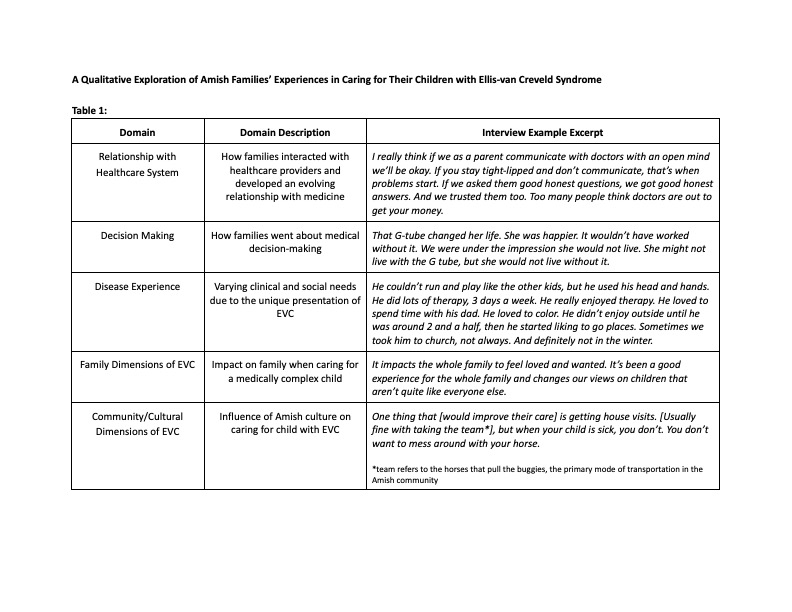 Thematic Domains