Session: Developmental and Behavioral Pediatrics 1: Autism
81 - An Opportunity Cost Analysis of Primary Care Clinicians in Oregon Conducting Autism Assessments
Friday, April 24, 2026
5:30pm - 8:00pm ET
Publication Number: 1073.81
Carolyn Ngo, Oregon Health & Science University School of Medicine, Hillsboro, OR, United States; Veronica I. Underwood Carrasco, Oregon Health & Science University, Portland, OR, United States; Katharine E. Zuckerman, Oregon Health & Science University School of Medicine, Portland, OR, United States; Deborah Rumsey, Children's Health Alliance, Portland, OR, United States; Katrina Luthy-Kaplan, Oregon Health & Science University, Portland, OR, United States; Lindsay L. Blankenship, Oregon Health & Science University, Portland, OR, United States; Benjamin Hoffman, Doernbecher Children's Hospital at Oregon Health & Science University, Portland, OR, United States
Medical Student Oregon Health & Science University School of Medicine Hillsboro, Oregon, United States
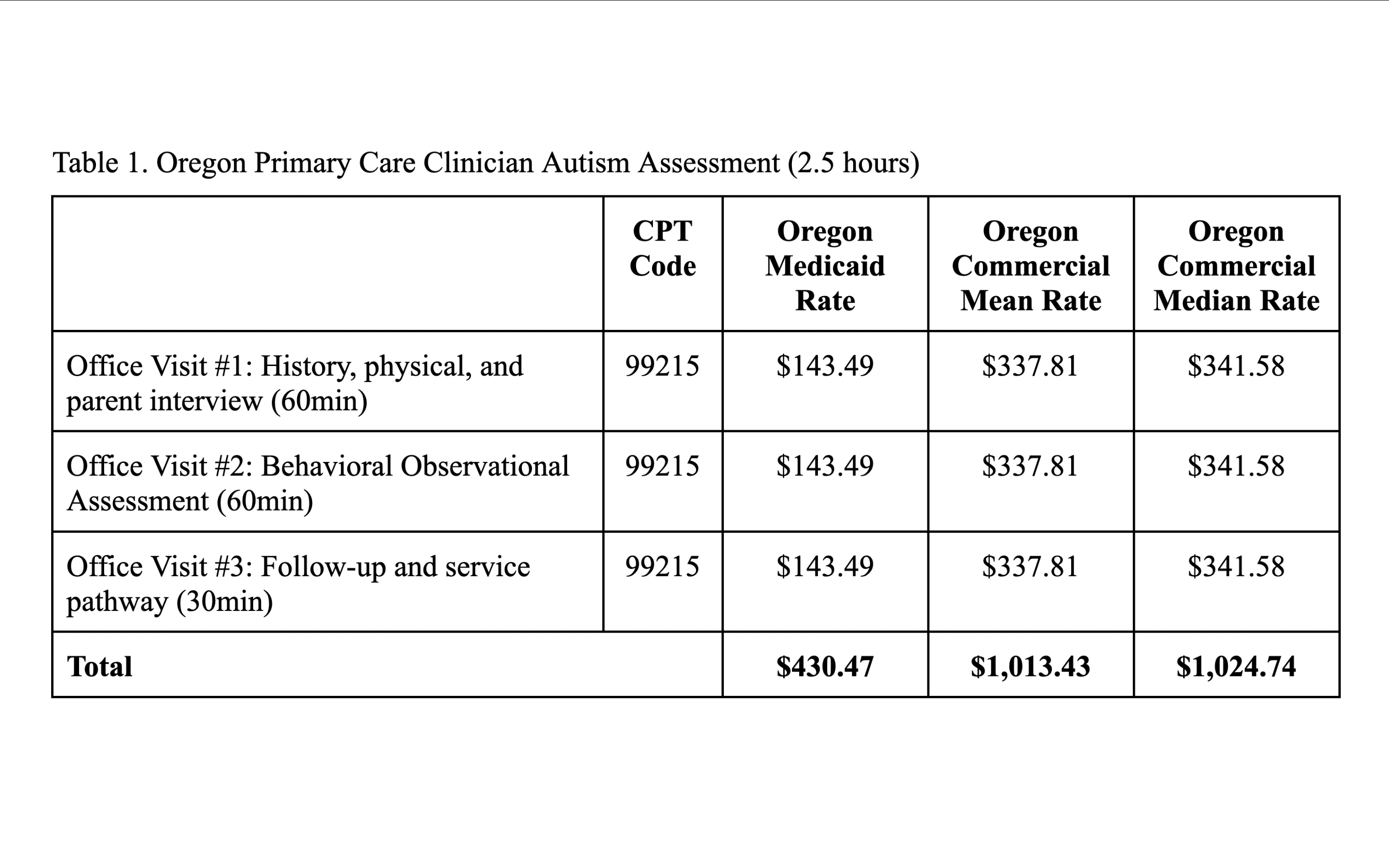
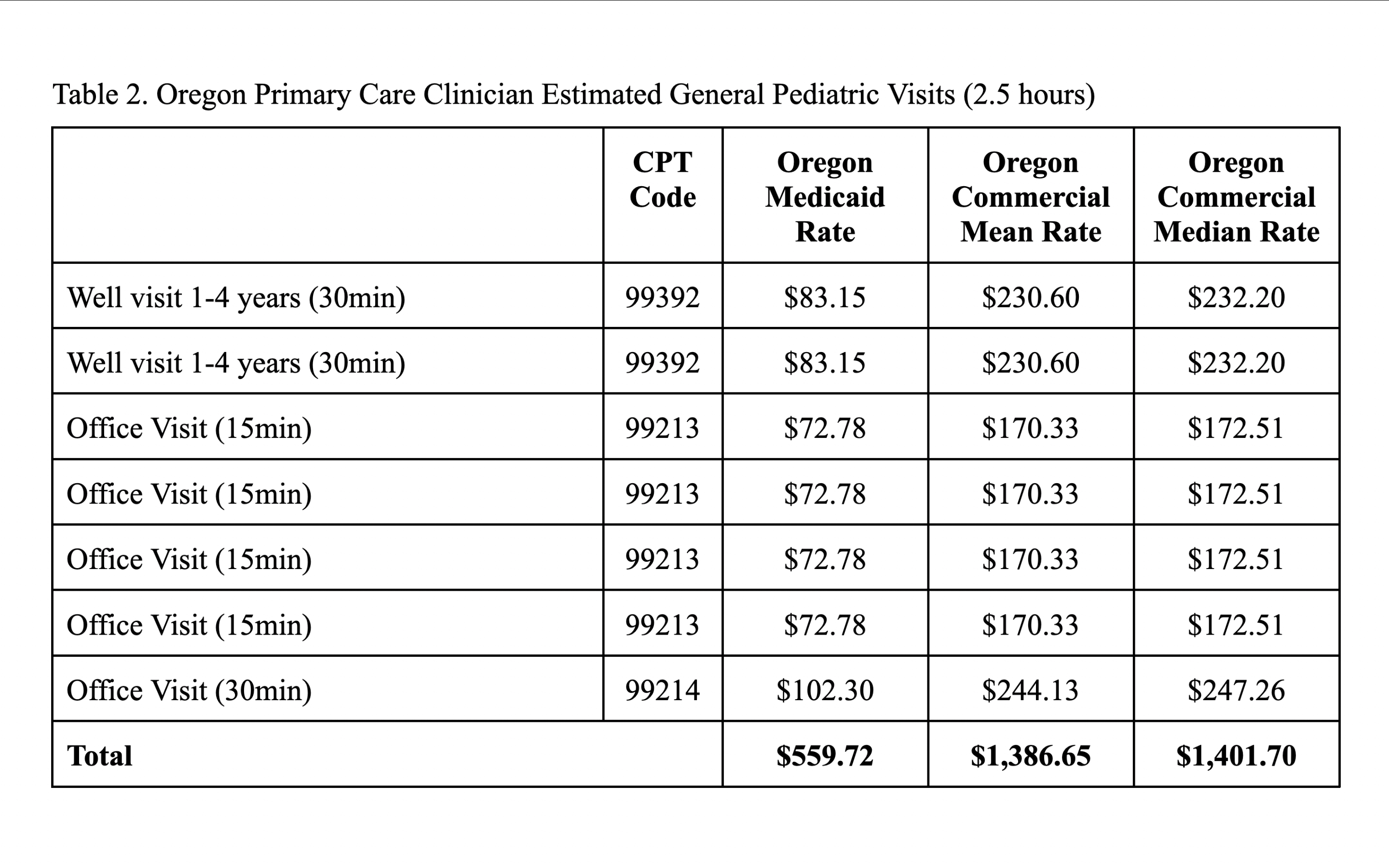
Background: Autism diagnosis has traditionally been the domain of pediatric behavioral health specialists and developmental-behavioral pediatricians, but workforce limitations cause long wait times and delayed diagnoses. Primary care clinicians can be trained to accurately diagnose autism, reducing wait times and promoting early service initiation. However, many barriers exist to sustainably conducting autism assessments, chief among them being financial disincentives. To enhance the sustainability of primary care autism diagnosis, it is critical we understand and mitigate these financial barriers. Objective: To analyze the fiscal landscape for primary care clinicians in Oregon (OR) conducting pediatric autism assessments. Design/Methods: Using 2025 published payment rate data for OR Medicaid fee-for-service rates and mean and median commercial rates, we estimated current costs of autism evaluation versus usual primary care activities to approximate opportunity costs for primary care clinicians. We estimated each autism evaluation to take 2.5h total over three visits, with providers billing on time spent (CPT 99215) per usual practice. We compared this to 2.5h of general primary care work, estimated as 2 well-child, 4 low complexity, and 1 moderate complexity visit. OR Medicaid fee-for-service rates were used to calculate per-visit compensation for autism evaluations compared to typical visits based on the configuration above, with opportunity costs being the difference between the two. This was repeated with mean and median OR rates to account for variable commercial insurance payments using American Academy of Pediatrics/Pediatrics Management Institute published rates. Results: With OR Medicaid rates, payment for an autism evaluation was $430.47, and payment for usual primary care activities was $559.72 (Table 1 and 2). Therefore, primary care clinicians in Oregon lose $129.25 for an autism evaluation paid for by Medicaid - a 23.1% payment deficit. Using a similar calculation for commercial insurance rates, primary care clinicians lose mean and median payments of $373.22 and $376.96, respectively, which both amount to payment deficits of 26.9%.
Conclusion(s): Primary care clinicians in Oregon lose money performing autism assessments, for both publicly and privately insured patients. As the traditional pediatric specialist workforce remains inadequate to meet clinical demand, primary care clinicians remain an underutilized resource. In order to improve access to high quality autism assessment services, we should identify and implement alternative payment models to support sustainable autism assessments in primary care.
Table 1. Oregon Primary Care Clinician Autism Assessment (2.5 hours)
Table 2. Oregon Primary Care Clinician Estimated General Pediatric Visits (2.5 hours)