544 - Efficacy of a Nurse USGIV program in a Pediatric Cardiac Intensive Care Unit
Friday, April 24, 2026
5:30pm - 8:00pm ET
Publication Number: 1523.544
Amanda Alvarado, University of Texas at Austin School of Nursing, Austin, TX, United States; Angie Englert, Dell Children's Medical Center of Central Texas, Austin, TX, United States; Alan Groves, University of Texas at Austin Dell Medical School, Austin, TX, United States
Clinical Assistant Professor University of Texas at Austin School of Nursing Austin, Texas, United States
Background: Vascular access remains a significant clinical challenge in the pediatric inpatient environment where nurses currently perform the majority of procedures with the standard "blind" approach. Ultrasound guided vascular access has historically been driven primarily by PICC and vascular access teams. Expansion of ultrasound imaging support to a greater number of access procedures has the potential to significantly decrease the number of vascular access attempts. Objective: To describe the effectiveness of a POCUS vascular access program to nurses in a pediatric cardiac intensive care unit. Design/Methods: We implemented a vascular access training program to nurses in the Pediatric Cardiac ICU at Dell Children's Medical Center. Learners completed a four-hour didactic training including a pre- and post-knowledge based exam, and hands on practice in vascular access models. To complete the didactics, learners needed to score at least 75% in the knowledge exam and complete at least ⅘ successful USGIV vessel cannulation in a pediatric model. To graduate from the full program, learners then need to complete five successful proctored vascular access procedures. Proctored attempts were supported by a specialist vascular access nurse with dedicated time for training (Figure 1). All ultrasound guided vascular access attempts were tracked using a HIPPA compliant GoogleForm. Results: Twenty nurses completed the four-hour didactic session. One hundred percent of learners successfully performed at least ⅘ access procedures in the vascular model and passed the knowledge assessment. Eighteen nurses reached independent practice, two nurses left the program at the time of submission. Children in whom the vascular access procedures were performed had a median weight of 8.2kg, (IQR 4.8,24.5kg) and median age of 397 days (IQR 83 days, 10.3 years). Procedural percentage success rates for proctored attempts were 57.1% in one attempt and 73.5% (n=90) in two attempts. Procedural percentage success rates for independent attempts were 82.0% in one attempt and 89.9% in two attempts (n=139) (Figure 2). There was an average wait time of 17.6 minutes for the procedure.
Conclusion(s): A targeted vascular access training program for experienced pediatric cardiac ICU nurses is feasible and can drive high rates of procedural success. Our program provides support for a cost effective, impactful approach to expanding ultrasound guided vascular access in the pediatric hospital environment.









.png) Steps to Independent Practice
Steps to Independent Practice 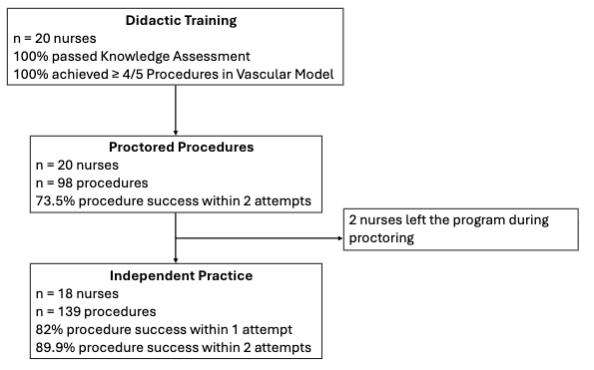 Nursing training process