








Neonatal-Perinatal Health Care Delivery
Session: Neo-Perinatal Health Care Delivery: Practices and Procedures 3

Sara Manetta, MD (she/her/hers)
Neonatology Fellow
University of Virginia School of Medicine
Charlottesville, Virginia, United States
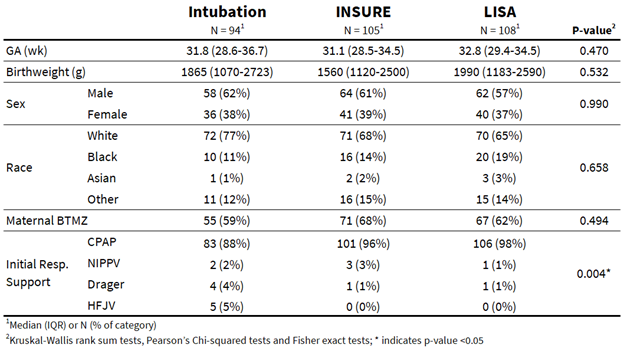 Patient demographics grouped by surfactant administration method. Categorical variables are summarized as N (%) and continuous variables as median (IQR). Groups were compared using Kruskal-Wallis rank sum tests, Pearson's Chi-squared tests and Fisher exact tests. *indicates p-values of statistical significance ( <0.05).
 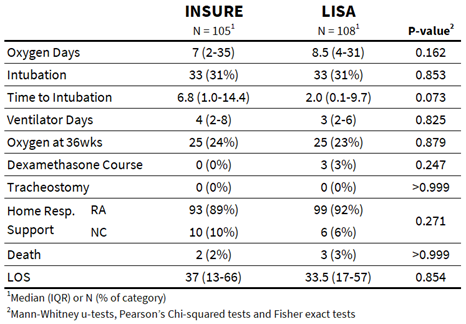 Patient outcomes comparing INSURE versus LISA surfactant administration method. Categorical variables are summarized as N (%) and continuous variables as median (IQR). Groups were compared using Kruskal-Wallis rank sum tests, Pearson's Chi-squared tests and Fisher's exact tests.
.png) Run charts of LISA success (1A), number of attempts (1B), and first-pass successes (1C) over time by patient groupings. 1A and 1B included all LISA occurrences regardless of success, while 1C included only successful LISA. Charts 1A and 1C were grouped by 3 occurrences per patient group. Chart 1B was grouped by number of successes. "Success" was defined as the administration of surfactant without need to abort the procedure or convert to another method, "attempt" as number of laryngoscope blade passes for successful surfactant administration, and "first-pass success" as successful surfactant administration with first blade pass.
Run charts of LISA success (1A), number of attempts (1B), and first-pass successes (1C) over time by patient groupings. 1A and 1B included all LISA occurrences regardless of success, while 1C included only successful LISA. Charts 1A and 1C were grouped by 3 occurrences per patient group. Chart 1B was grouped by number of successes. "Success" was defined as the administration of surfactant without need to abort the procedure or convert to another method, "attempt" as number of laryngoscope blade passes for successful surfactant administration, and "first-pass success" as successful surfactant administration with first blade pass.