Session: Mental Health 2: Provider and Family Perspectives
138 - Impact of Adult Connections on Youth Mental Health
Friday, April 24, 2026
5:30pm - 8:00pm ET
Publication Number: 1128.138
Megan E. Yanny, University of Wisconsin School of Medicine and Public Health, Verona, WI, United States; Becca Warwick, University of Wisconsin School of Medicine and Public Health, Madison, WI, United States; Ellen Selkie, University of Wisconsin School of Medicine and Public Health, Madison, WI, United States; Qianqian Zhao, University of Wisconsin at Madison, ANN ARBOR, MI, United States
Assistant Professor University of Wisconsin School of Medicine and Public Health Verona, Wisconsin, United States
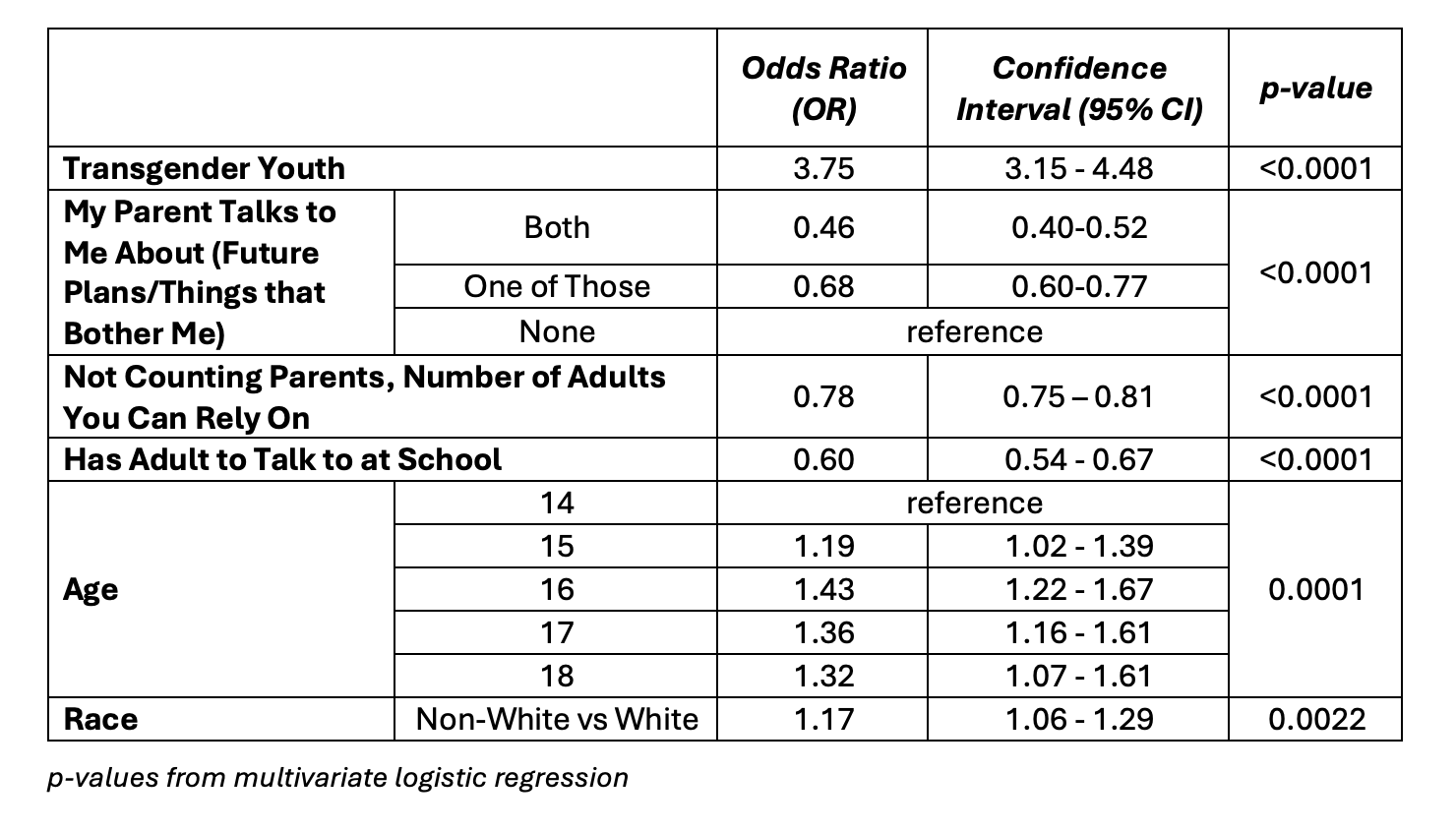
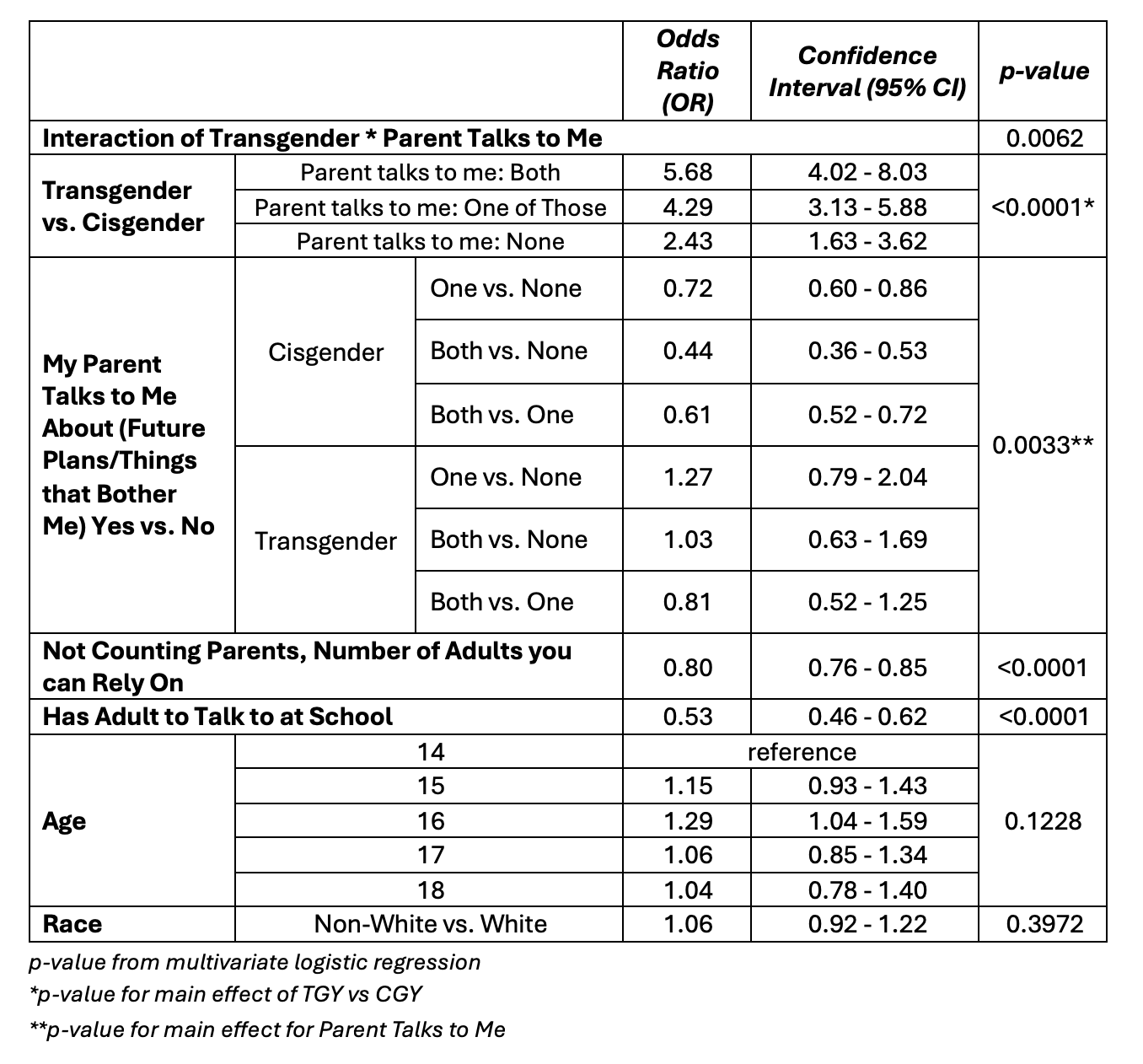
Background: Transgender youth (TGY) have higher rates of depression and suicidality than cisgender youth (CGY), with 59% of TGY reporting depression symptoms and 46% having seriously considered attempting suicide. Teenage depression and suicidality are impacted by adult relationships including parent and school supports. It is not known what factors have the most impact for TGY. Objective: To assess the relationship between adult connections and CGY and TGY depression and suicidality. Design/Methods: High school students in 9th-12th grades completed the 2024 Dane County Youth Assessment (DCYA), a voluntary cross-sectional survey conducted in Wisconsin. This secondary analysis examined responses regarding gender identity (TGY, defined as responding yes or not sure, versus CGY), and outcome measures of suicidality (in the past 12 months have you: thought seriously about killing yourself, made a plan to attempt suicide, or attempted suicide) and depression via the Patient Health Questionnaire-2 (PHQ-2). Analysis variables included measures of adult connections at school and home along with age and race. Multivariate logistical regression assessed the relationship between adult connections and mental health outcomes. Results: A total of 15,448 students completed the DCYA, 683 (4.5%) identified as transgender, and 2418 (15.7%) met criteria for "major depression likely" while 1094 (7.1%) had a positive suicidality measure. Having more non-parent adults to rely on [1] and having an adult to talk to at school [2] were both protective against depression ([1]OR=0.78, 95% CI 0.75-0.81 & [2]OR=0.60, 95% CI 0.54-0.67) and suicidality ([1]OR=0.80, 95% CI 0.76-0.85 & [2]OR=0.53, 95% CI 0.46-0.62) for all youth. Having a parent that "has talked with me about my future plans" [3] and/or "talks about things that bother me" [4] was protective against depression ([3]OR=0.46, 95% CI 0.40-0.52 & [4]OR-0.68, 95%CI 0.60-0.77) for both groups, yet its protection against suicidality was only observed for CGY ([3]OR=0.44, 95% CI 0.36-0.53 & [4]OR=0.72, 95% CI 0.60-0.86) and not TGY (Table 1, Table 2).
Conclusion(s): Adult connections had a protective effect in TGY and CGY. However, the parent discussion measure only moderated CGY suicidality, and TGY were more likely to have depression and suicidality even with adult support. In TGY, other factors like political landscape and discrimination may outweigh this measure of parental support to affect mental health. Future studies could expand on the role of adults at school, investigating screening for adult connections, and ways to build healthy adult connections for youth who lack them.
Table 1: Impact of Adult Connections on Major Depressive Disorder in Cisgender and Transgender High school students in Dane County, WI.
Table 2: Impact of Adult Connections on Suicidality in Cisgender and Transgender High school students in Dane County, WI.