Session: Mental Health 1: Mental Health in Acute Settings
123 - Associations Between Maternal Mental Health and Amygdala and Hippocampus Volumes in Newborns with Antenatal Opioid Exposure
Friday, April 24, 2026
5:30pm - 8:00pm ET
Publication Number: 1113.123
Yao Wu, Children's National Hospital, Washington, DC, United States; Josepheen De Asis-Cruz, Children's National Health System, Bethesda, MD, United States; Kushal Kapse, Developing Brain Institute, Washington, DC, United States; Stephanie L. Merhar, Cincinnati Children's Hospital Medical Center, Cincinnati, OH, United States; Carla M. Bann, RTI International, Apex, NC, United States; Jamie E. Newman, RTI International, Research Triangle Park, NC, United States; Jonathan M. Davis, Tufts University School of Medicine, Boston, MA, United States; Namasivayam Ambalavanan, University of Alabama School of Medicine, Birmingham, AL, United States; Sara DeMauro, Children's Hospital of Philadelphia, Philadelphia, PA, United States; Scott A. Lorch, The Children's Hospital of Philadelphia, University of Pennsylvania, Philadelphia, PA, United States; Deanne Wilson-Costello, Case Western Reserve University School of Medicine, Cleveland, OH, United States; Brenda Poindexter, Children's Healthcare of Atlanta, Atlanta, GA, United States; Nicole Mack, RTI International, Chicago, IL, United States; Myriam Peralta-Carcelen, University of Alabama at Birmingham, Birmingham, AL, United States; Catherine Limperopoulos, Children's National Health System, Washington DC, DC, United States
Developing Brain Institute Children's National Hospital Washington, District of Columbia, United States
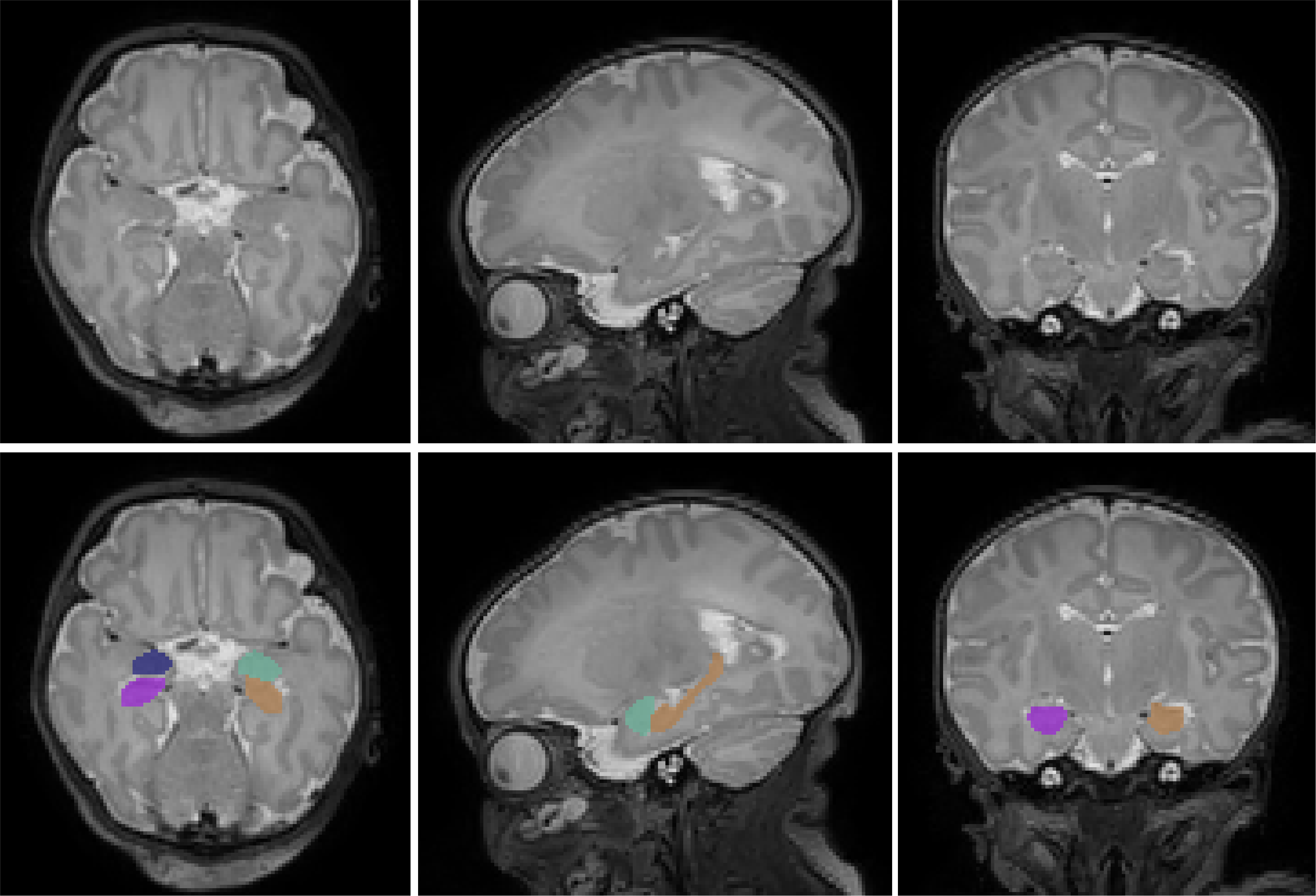
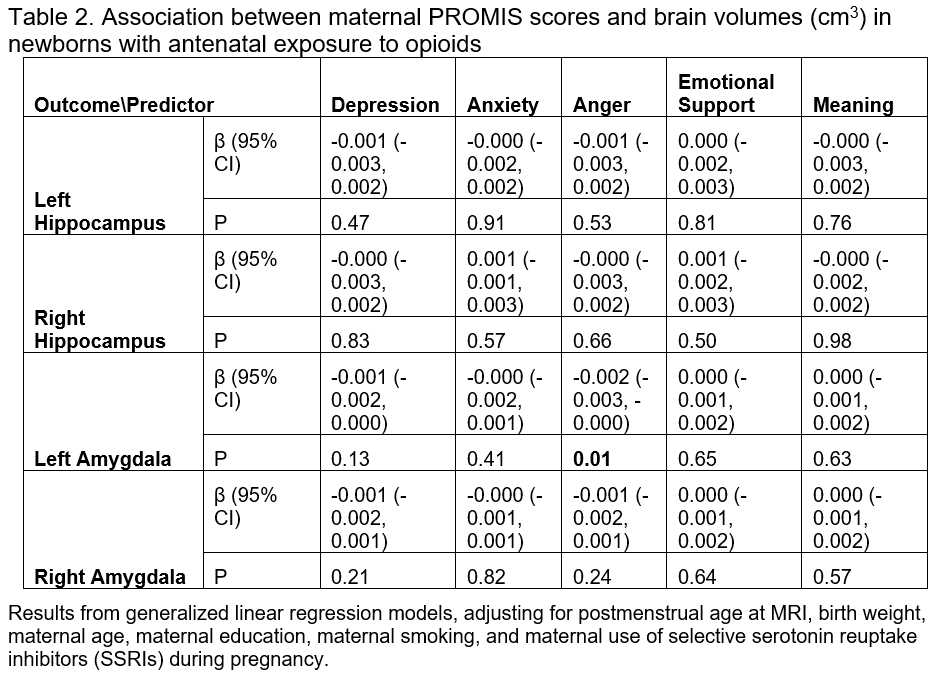
Background: Maternal mental health problems are the most common complications of pregnancy. The amygdala and hippocampus are brain regions known to be vulnerable to stress. Prenatal opioid use is often accompanied by maternal mental health concerns, yet the impact of elevated prenatal psychological distress on neonatal amygdala and hippocampus development in this population remains unknown. Objective: To examine associations between maternal mental health and newborn amygdala and hippocampus volumes in infants with antenatal opioid exposure. Design/Methods: As part of the multi-site Outcomes of Babies with Opioid Exposure study, we performed unsedated 3D volumetric MRI in opioid-exposed newborns. T2-weighted data acquired on Siemens and Philips 3T scanners were harmonized across four sites. Using a 3D U-Net-based segmentation method with manual corrections, left/right amygdala and hippocampus were segmented (Figure 1). Maternal mental health was assessed at newborn visits using the Patient-Reported Outcomes Measurement Information System (PROMIS). Associations between maternal PROMIS scores and newborn brain volumes were examined using generalized linear regression models, adjusting for postmenstrual age at MRI, birth weight, maternal age, maternal education, maternal smoking, and maternal use of selective serotonin reuptake inhibitors (SSRIs) during pregnancy. Results: We studied 173 mother-infant dyads in which the infants were prenatally exposed to opioids. MRI was performed at a mean postmenstrual age of 42.8 weeks (range 37.4-48.0). Higher PROMIS anger scores were associated with smaller left amygdala volume (β = -0.002, p = 0.01) (Table 2); specifically, left amygdala volumes were 0.508 cm³ in the low anger group (score ≤ 55) versus 0.485 cm³ in the mild-to-high anger group (score > 55) (p = 0.04).
Conclusion(s): Elevated maternal anger in women using opioids during pregnancy is associated with reduced amygdala volume in their newborns. Longitudinal follow-up is warranted to determine the impact of these neonatal findings on later child outcomes.
Figure 1. Segmentation of newborn hippocampus and amygdala on 3D MRI. Example from a newborn with prenatal opioid exposure at 40 gestational weeks, showing left amygdala (cyan), right amygdala (blue), left hippocampus (brown), and right hippocampus (purple).
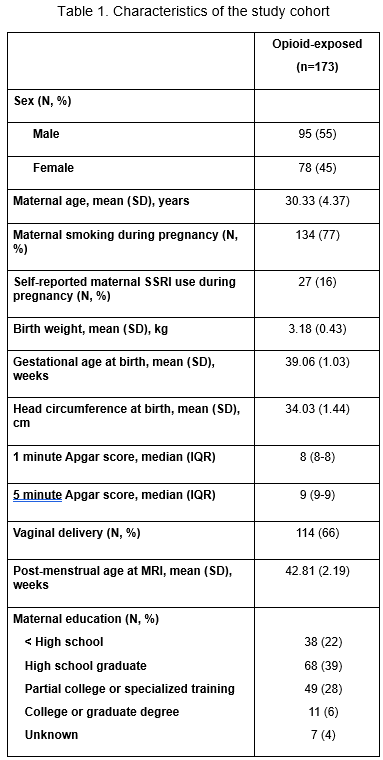
Table 1. Characteristics of the study cohort
Table 2. Association between maternal PROMIS scores and brain volumes (cm3) in newborns with antenatal exposure to opioids