534 - Predictive Value of Early Heart Rate Trends for Respiratory Support De-escalation in Pediatric Intensive Care Patients on High-Flow Nasal Cannula
Friday, April 24, 2026
5:30pm - 8:00pm ET
Publication Number: 1513.534
Alexander Dulla, University of Maryland School of Medicine, Gambrills, MD, United States; Peter Jensen, University of Maryland School of Medicine, Arnold, MD, United States; Hannah Goodwin, El Paso Children's Hospital, El Paso, TX, United States; Siddhartha Dante, University of Maryland Children's Hospital, BALTIMORE, MD, United States
Medical Student University of Maryland School of Medicine Gambrills, Maryland, United States
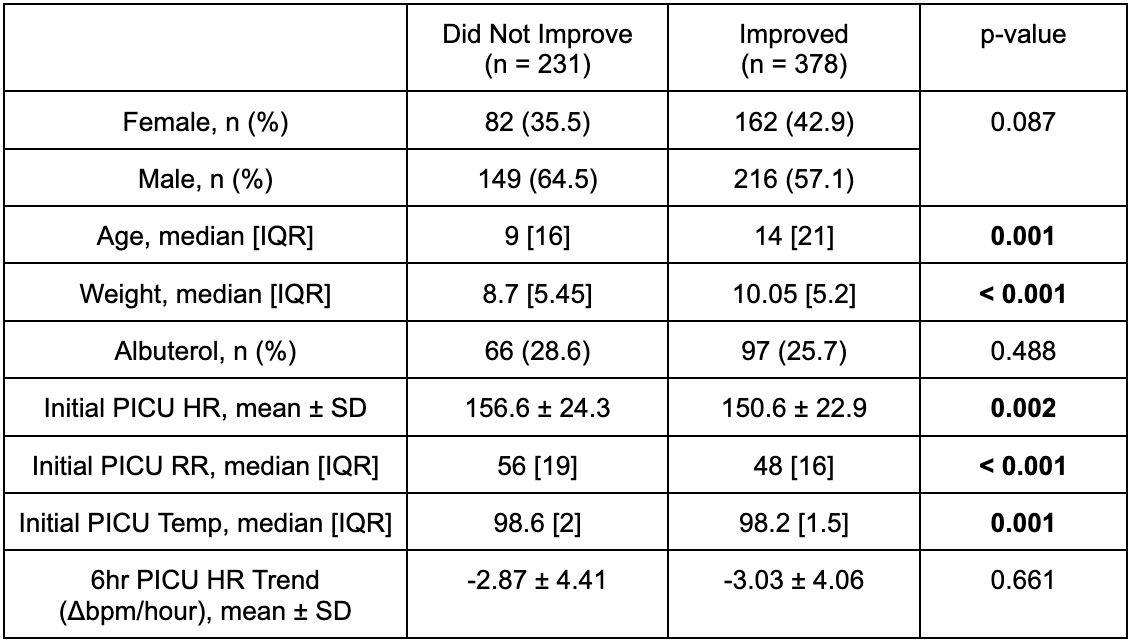
Background: Despite advancements in noninvasive respiratory support, such as high-flow nasal cannula (HFNC), Pediatric Intensive Care Unit (PICU) admissions for respiratory illness continue to rise. With this, it is becoming increasingly important to be able to predict which patients may rapidly de-escalate respiratory support. We hypothesized that heart rate (HR) trends during early PICU admission may be associated with respiratory support trajectory. Objective: This study evaluates whether HR trend over the first 6 hours of PICU admission can predict subsequent improvement in respiratory support. Design/Methods: A retrospective chart review was conducted at an urban tertiary academic medical center. Patients aged 0-5 years old admitted to the PICU on HFNC between 2018 and 2023 for a primary respiratory indication were included. Demographics, albuterol administration, vital signs, and level of respiratory support were collected. The primary outcome was rapid de-escalation of respiratory support defined as at least 25% decrease in HFNC flow (l/kg/min) or transition from HFNC to either nasal cannula (NC) or room air (RA)] within 24 hours of admission. HR trend (Δbpm/hour) from PICU admission to 6 hours was calculated by trendline slope for each encounter. Normalcy was evaluated with Shapiro-Wilk tests. Univariate comparisons were performed using T-tests, Wilcoxon rank-sum, or Chi-square/Fisher tests as appropriate. Multivariate logistic regression was used to identify independent predictors of respiratory support improvement. Results: Among 609 eligible patients, 378 (62.1%) improved respiratory support level in 24 hours. Patients who improved were older (14 [21] months vs 9 [16] months, p = 0.001) and heavier (10.05 [5.2] kg vs 8.7 [5.45] kg, p < 0.001). At PICU admission, they exhibited lower HR (150.6 ± 22.9 vs 156.6 ± 24.3 bpm, p = 0.001), lower respiratory rate (48 [16] vs 56 [19] breaths/min, p < 0.001), and lower temperature (98.2 [1.5] °F vs 98.6 [2] °F, p = 0.001). Multivariate regression revealed independent associations between respiratory improvement and a more negative 6-hour HR slope (p = 0.013) and female sex (p = 0.023).
Conclusion(s): Our preliminary model suggests that heart rate decline during the first 6 hours of PICU admission independently predicts subsequent reduction in respiratory support requirement for patients admitted on HFNC. With this, continuous HR monitoring may serve as a simple marker to identify patients likely to rapidly de-escalate, potentially helping individualize respiratory support care and streamline PICU resource utilization.









.jpg "Alexander Dulla, MHA (he/him/his) photo")
.png)
