Session: Developmental and Behavioral Pediatrics 1: Autism
86 - Identifying Barriers to Equitable Autism Care for Racial Minority Children in Pediatric Primary Settings
Friday, April 24, 2026
5:30pm - 8:00pm ET
Publication Number: 1078.86
Morgan Walls, Atrium Health, Wake Forest School of Medicine, Charlotte, NC, United States; Christine B. Turley, Atrium Health Levine Childrens, Wake Forest University SOM, Charlotte, NC, United States; Sarabeth BroderFingert, UMass Memorial Children's Medical Center, Newton, MA, United States; Allison Chandler, Wake Forest School of Medicine of Wake Forest Baptist Medical Center, Winston Salem, NC, United States; Katharine E. Zuckerman, Oregon Health & Science University School of Medicine, Portland, OR, United States
Assistant Professor Atrium Health, Wake Forest School of Medicine Charlotte, North Carolina, United States
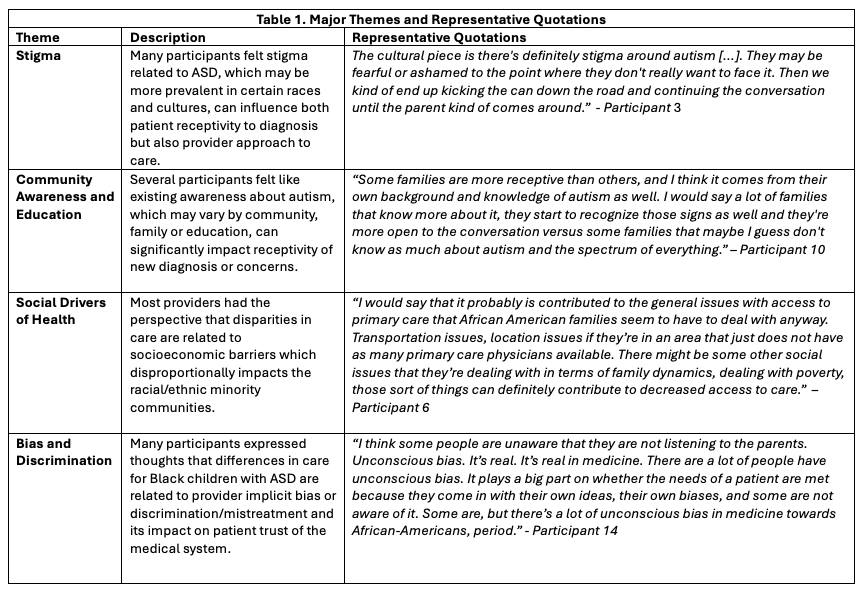
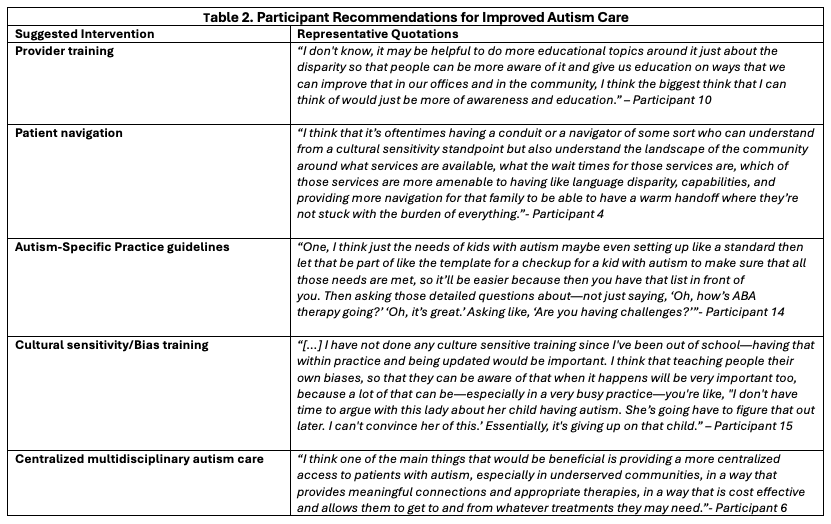
Background: Prior research documents disparities in care for racial and ethnic minority children with ASD, with higher unmet needs for children of color. Given its rising prevalence, many children with ASD are cared for within pediatric primary care (PC) settings, yet little is known about PC providers' perspectives on how race may impact their care. Objective: To explore PC providers' perspective on barriers to care for Black children with ASD and identify targets for intervention Design/Methods: Study participants were PC physicians (n=10) or advanced practice providers (n=5) recruited from 5 clinics within a pediatric PC network in the southeast US. Semi-structured interviews were conducted, audio-recorded, and transcribed. Interview topics included general PCP experience caring for autistic patients, perceived barriers to care for Black patients, and recommended targets for intervention. Interviews continued until thematic saturation was reached. Deductive and inductive coding strategies were used for codebook development. Two researchers independently coded the textual data and met to compare coding. Coding discrepancies were discussed and resolved iteratively. Coded text was summarized using reflexive thematic analysis. Representative quotations are provided in Tables 1 and 2. Results: Participants felt the discussion and parental receptivity around initial concerns for autism diagnosis is sometimes impacted by race due to perceived differences in cultural stigma, decreased community awareness about ASD and language barriers (Table 1). Participants hypothesized that existing disparities in care for Black autistic children are in part secondary to systemic barriers to healthcare access related to socioeconomic disadvantage and social drivers like insurance or transportation barriers and navigating parental competing demands. Finally, participants related disparities in care to implicit bias or discrimination, although most participants expressed that they do not typically alter how they approach care for patients based solely on race or ethnicity. Participant suggested targets for intervention included increased provider training on autism and cultural sensitivity, development of autism-specific practice guidelines, increased support from patient navigators and centralized, multidisciplinary autism care (Table 2).
Conclusion(s): In this study, decreased awareness about ASD, stigma, SDOH and provider bias were the primary barriers to care for Black children with ASD. Future research can examine if addressing these barriers through the various PCP-suggested interventions may reduce disparities for at-risk children.
Table 1. Major themes and representative quotations
Table 2. Participant Recommendations for Improved Autism Care