Session: Neonatal Pulmonology - Clinical Science 2: Bronchopulmonary Dysplasia II
389 - Validation of a New Japanese Classification for the Early Prediction of Severe Bronchopulmonary Dysplasia in Very Preterm Infants: A Secondary Analysis of a Randomized Controlled Trial
Friday, April 24, 2026
5:30pm - 8:00pm ET
Publication Number: 1373.389
Masato Ito, Akita Red Cross Hospital, Akita city, Akita, Japan; Shinya Hirano, Osaka Women's and Children's Hospital, Izumi, Osaka, Japan; Fumihiko Namba, Saitama Medical Center, Saitama Medical University, Kawagoe, Saitama, Japan
Assistant professor Akita Red Cross Hospital Akita city, Akita, Japan
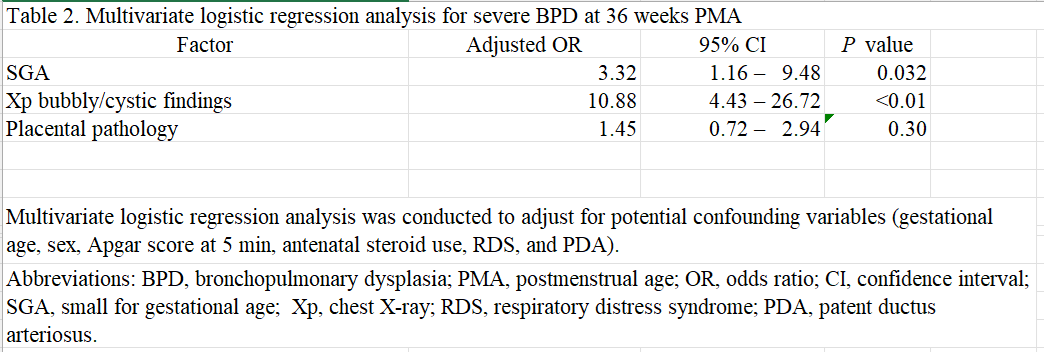
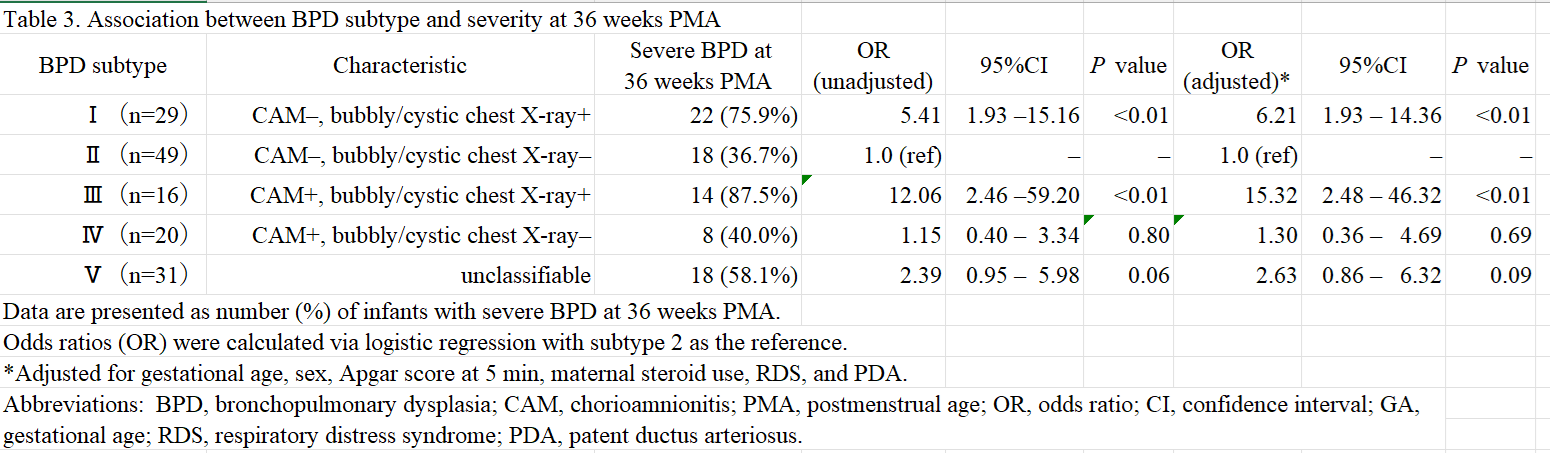
Background: Bronchopulmonary dysplasia (BPD) is the most prevalent chronic lung disease in very preterm infants; however, conventional classifications are currently limited in predicting severity before 36 weeks postmenstrual age (PMA). A new Japanese classification, based on small for gestational age (SGA), bubbly/cystic chest radiographic findings, and chorioamnionitis (CAM), was proposed to enable earlier risk stratification. Validation in homogeneous cohorts is still warranted. Objective: To examine the association between the new Japanese classification and severe BPD development at 36 weeks PMA in a secondary analysis of a randomized controlled trial (RCT). Design/Methods: A retrospective secondary analysis of a multicenter, double-blind RCT of inhaled corticosteroids in 12 tertiary NICUs in Japan (2006-2009) was conducted. Infants with birth weight < 1,000 g requiring mechanical ventilation were enrolled. Of 211 infants, 197 survivors were analyzed. According to the NICHD criteria, severe BPD was defined as the need for supplemental oxygen with an effective FiO₂ > 0.30 or positive pressure ventilation at 36 weeks PMA. Logistic regression analyses were adjusted for gestational age, birth weight, sex, Apgar score, maternal steroid use, respiratory distress syndrome, and presence of patent ductus arteriosus. Results: Of the 197 infants, 53 (26.9%) were SGA, 76 (38.6%) had bubbly/cystic findings, and 86 (43.7%) had CAM. A total of 90 infants (45.7%) developed severe BPD. Multivariable analysis revealed that SGA status (adjusted odds ratio [OR] 2.01, 95% confidence interval [CI] 1.01-4.01, P=0.047) and bubbly/cystic findings (adjusted OR 2.95, 95% CI 1.42-6.15, P=0.004) were independent risk factors. In disease type analysis, compared with type Ⅱ/Ⅱs, type Ⅰ/Ⅰs (bubbly/cystic only; adjusted OR 6.21, 95% CI 1.93-14.36) and type Ⅲ/Ⅲs (CAM plus bubbly/cystic; adjusted OR 15.3, 95% CI 2.48-46.32) exhibited significant associations, whereas type Ⅳ/Ⅳs (CAM only) and type Ⅴ did not. In the < 27-week subgroup, type Ⅲ/Ⅲs exhibited the highest risk (adjusted OR 20.8, 95% CI 1.80-165.3), whereas type Ⅰ/Ⅰs remained significant (adjusted OR 4.88, 95% CI 1.23-19.3).
Conclusion(s): The new Japanese classification showed that SGA status and bubbly/cystic chest radiographic findings at day 28 independently predicted severe BPD. Overall and subgroup analyses confirmed that disease types incorporating bubbly/cystic findings exhibited the strongest association. Early stratification using this classification may help identify high-risk infants for targeted interventions.
New BPD classification by the Japanese research group (2023)
Multivariate logistic regression analysis for severe BPD at 36 weeks postmenstrual age
Association between BPD subtype and severity at 36 weeks postmenstrual age









.png)