








Technology
Session: Technology 1: AI in Pediatrics

Assaf Landschaft, MSc (he/him/his)
System architect and principal data scientist - medical NLP (Contract)
Boston Children's Hospital
Bergisch Gladbach, Nordrhein-Westfalen, Germany
.png) Figure 1. Study design for zero-shot eligibility classification of pediatric ED asthma/RAD notes from Connecticut Children's Emergency Department (July-December 2024). Arm 1: single-pass joint prompt applying four inclusion (I1-I4) and three exclusion (E5-E7) rules. Arm 2: two-pass prompting: Step 1 inclusion-only, Step 2 exclusion-only, followed by deterministic fusion (Include if Inclusion = TRUE ∧ Exclusion = FALSE). Performance is reported at three points against clinician adjudication: Arm 1, Arm 2 Step 1, and Arm 2 fused.
Figure 1. Study design for zero-shot eligibility classification of pediatric ED asthma/RAD notes from Connecticut Children's Emergency Department (July-December 2024). Arm 1: single-pass joint prompt applying four inclusion (I1-I4) and three exclusion (E5-E7) rules. Arm 2: two-pass prompting: Step 1 inclusion-only, Step 2 exclusion-only, followed by deterministic fusion (Include if Inclusion = TRUE ∧ Exclusion = FALSE). Performance is reported at three points against clinician adjudication: Arm 1, Arm 2 Step 1, and Arm 2 fused..png) Table 1. Eligibility criteria for pediatric ED asthma/RAD cohort identification. Inclusion (I1-I4) and Exclusion (E5-E7) with representative positive and challenging negative EHR narrative snippets. Negative examples are selected to be similar to positives (e.g., historical diagnoses, rule-out language, non-ED contexts) to probe zero-shot specificity and instruction-load sensitivity.
Table 1. Eligibility criteria for pediatric ED asthma/RAD cohort identification. Inclusion (I1-I4) and Exclusion (E5-E7) with representative positive and challenging negative EHR narrative snippets. Negative examples are selected to be similar to positives (e.g., historical diagnoses, rule-out language, non-ED contexts) to probe zero-shot specificity and instruction-load sensitivity.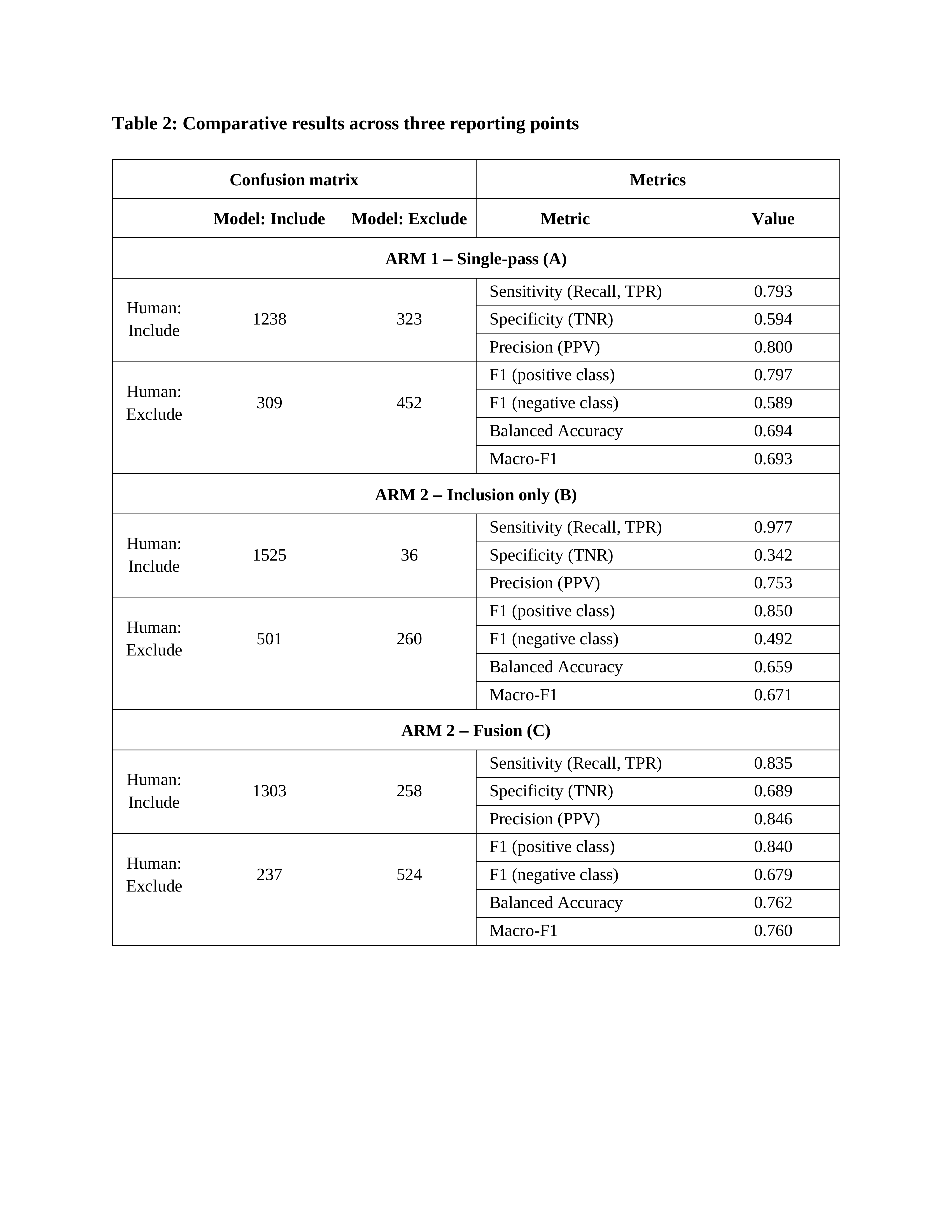 Table 2. Comparative performance of zero-shot eligibility classification across three reporting points: ARM 1 (single-pass), ARM 2 Step 1 (inclusion-only), and ARM 2 fused (inclusion∧¬exclusion), evaluated against clinician classification. Each block shows the 2×2 confusion matrix (rows = Human/Reference; columns = Model) and summary metrics: Sensitivity (TPR), Specificity (TNR), Precision (PPV), F1 (positive/negative), Balanced Accuracy, and Macro-F1.