








Health Equity/Social Determinants of Health
Session: Health Equity/Social Determinants of Health 1

Movicque King, MD (she/her/hers)
Neonatal - Perinatal Medicine Fellow
University of Virginia School of Medicine
Louisa, Virginia, United States
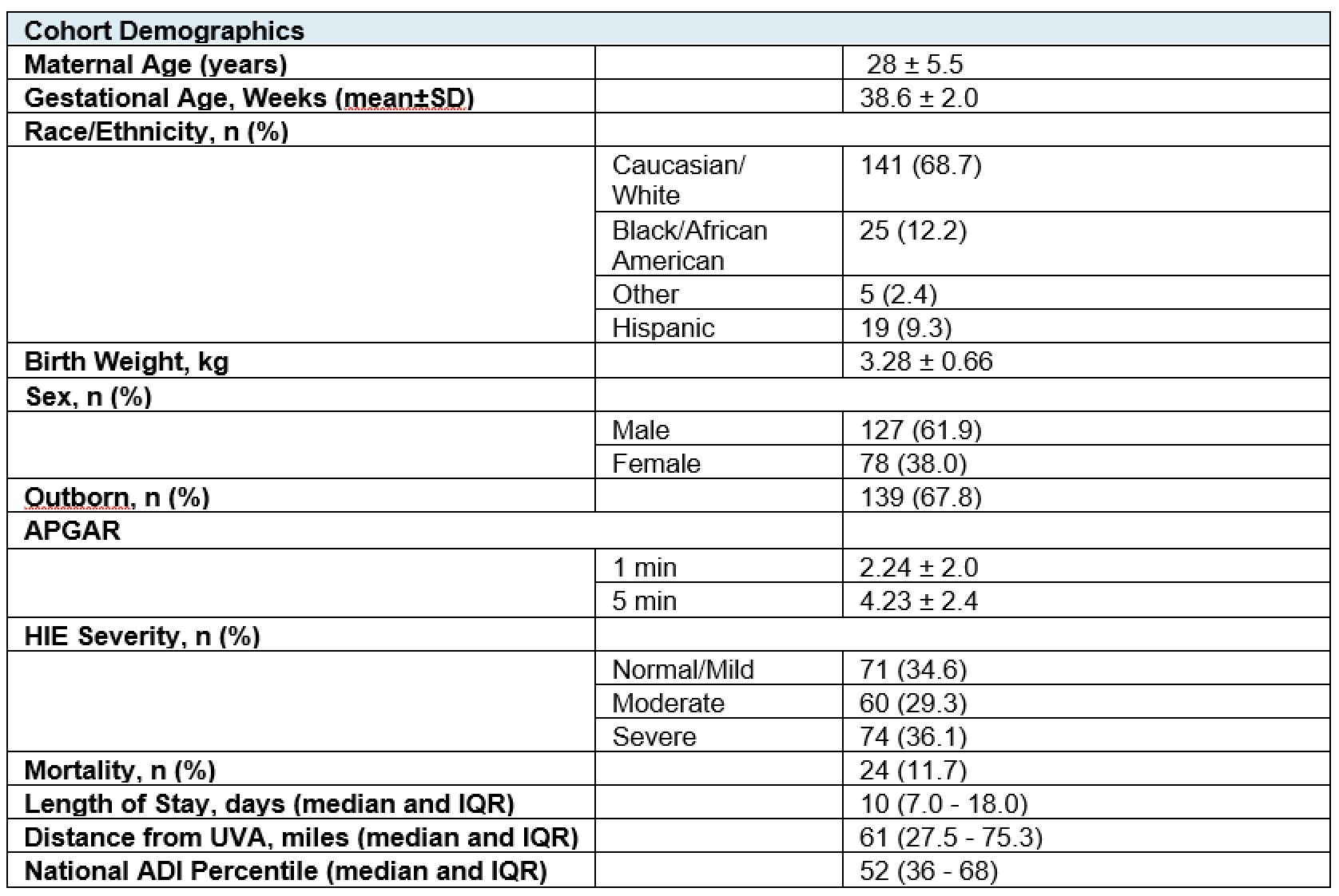 Data are reported as n (%), mean sd, or median (1st, 3rd quartiles). National ADI percentile ranges from 0-100, with higher scores indicating more neighborhood socioeconomic disadvantage.
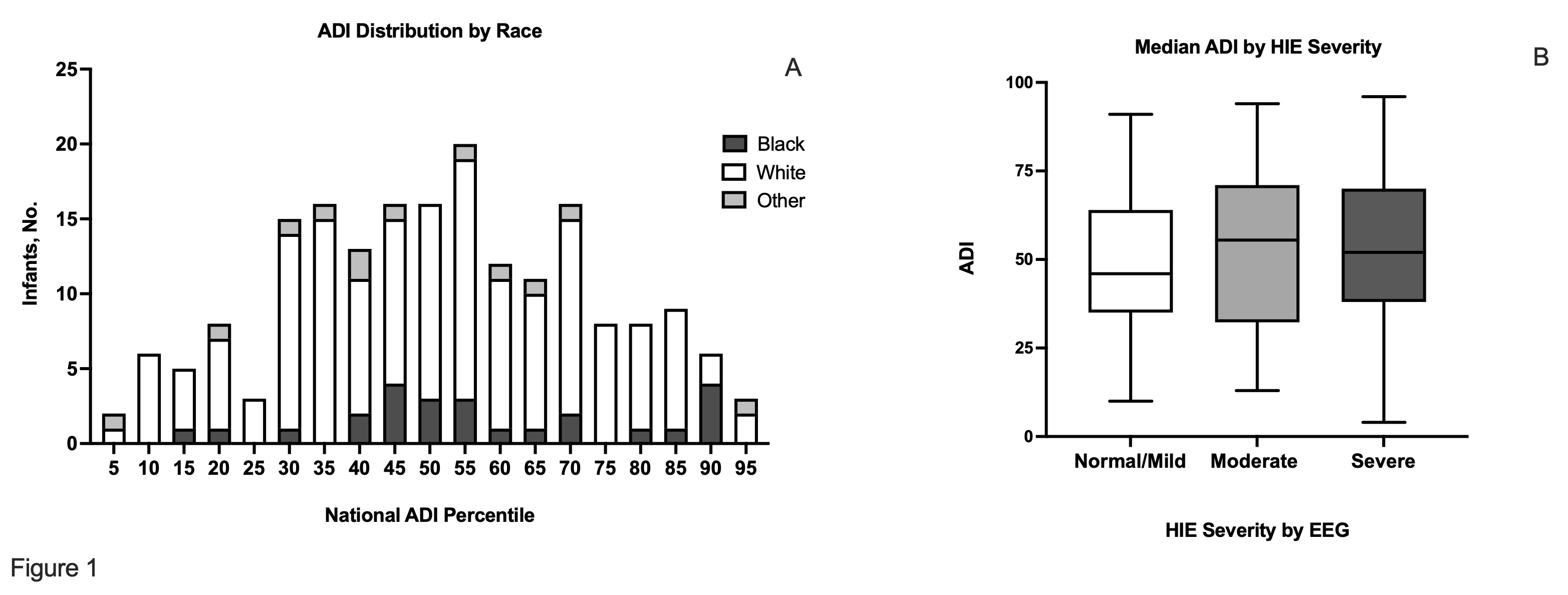 Panel A - ADI Distribution by Race. There was no significant difference in median ADI based on race. Panel B - Median ADI by HIE Severity. HIE severity was classified based on EEG interpretation by pediatric neurologist.
.png) Table A demonstrates significantly different ADI distribution only for inborn vs outborn status and no significant difference in ADI based on mortality, race, ethnicity, sex, or HIE severity. Table B. Panel 1 examines the relationship between ADI and LOS using a competing risks analysis to account for inpatient deaths, demonstrating that higher ADI is associated with longer length of stay. Higher HIE severity is also associated with a longer LOS while being outborn is not associated with longer LOS. Panel 2 demonstrates a confirmatory analysis using in-patient death as a covariate and similarly demonstrates higher ADI is associated with longer LOS. Panel 3 examines the relationship between ADI and follow up attendance where there was no association between ADI and but significant association with distance from hospital with follow up. Note: p <0.05*, p <0.01**, p<0.001***
Table A demonstrates significantly different ADI distribution only for inborn vs outborn status and no significant difference in ADI based on mortality, race, ethnicity, sex, or HIE severity. Table B. Panel 1 examines the relationship between ADI and LOS using a competing risks analysis to account for inpatient deaths, demonstrating that higher ADI is associated with longer length of stay. Higher HIE severity is also associated with a longer LOS while being outborn is not associated with longer LOS. Panel 2 demonstrates a confirmatory analysis using in-patient death as a covariate and similarly demonstrates higher ADI is associated with longer LOS. Panel 3 examines the relationship between ADI and follow up attendance where there was no association between ADI and but significant association with distance from hospital with follow up. Note: p <0.05*, p <0.01**, p<0.001***