Session: Medical Education 1: Diversity, Equity, and Inclusion
253 - Perceptions of Pediatric Subspecialist Division Leaders on Gender Equity
Friday, April 24, 2026
5:30pm - 8:00pm ET
Publication Number: 1239.253
Hannah J. Sharpe, Northwestern University The Feinberg School of Medicine, Chicago, IL, United States; Jiafeng Li, Ann & Robert H. Lurie Children's Hospital of Chicago, Chicago, IL, United States; Christiane E.L.. Dammann, Tufts Childrens Hospital, BOSTON, MA, United States; Abbie Bauer, Doernbecher Children's Hospital at Oregon Health & Science University, Portland, OR, United States; Juliann L. Kim, Stanford University School of Medicine, Los Altos, CA, United States; Lynn McDaniel, University of Virginia School of Medicine, Charlottesville, VA, United States; Kerri Machut, Ann & Robert H. Lurie Children's Hospital of Chicago, Chicago, IL, United States
Medical Student Northwestern University The Feinberg School of Medicine Chicago, Illinois, United States
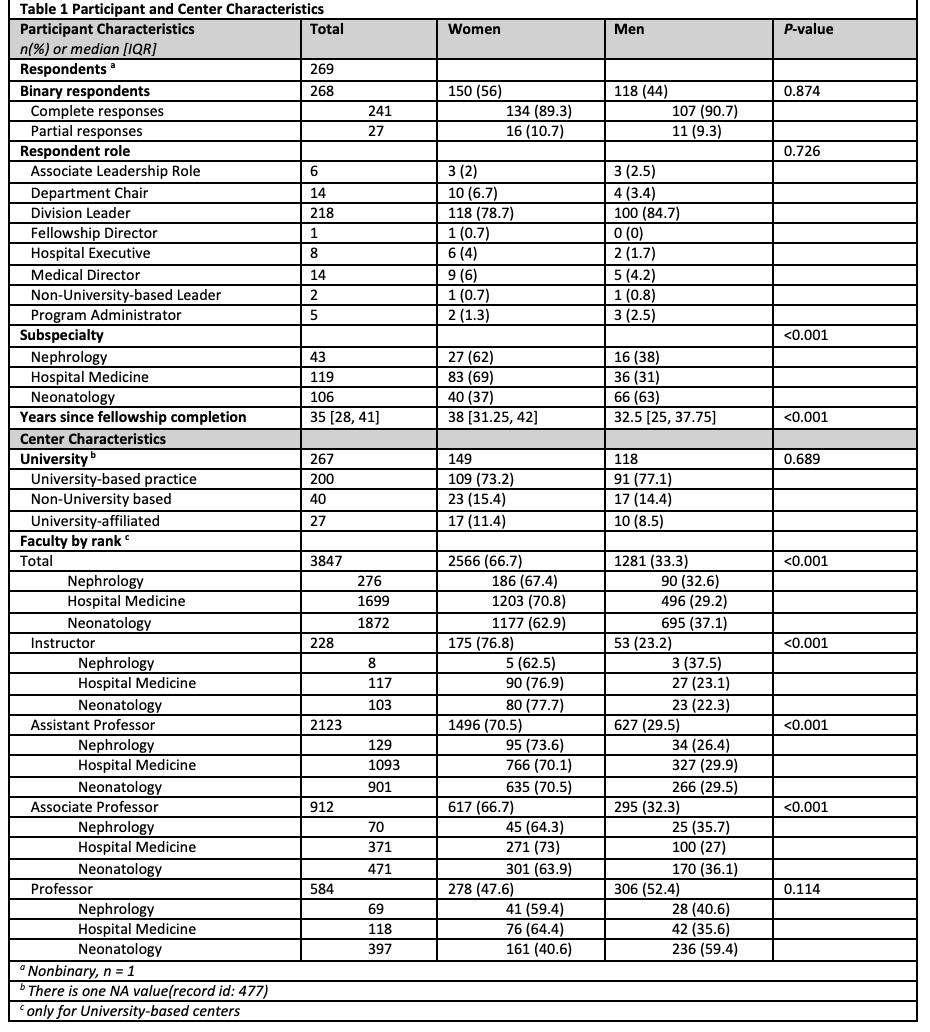
Background: Women predominate the pediatric workforce, yet gender inequities limit career advancement and wellbeing. Division leaders are important advocates for women in academic pediatrics. Objective: To compare the perspectives of pediatric division leaders regarding the state of gender equity in their subspecialties. Design/Methods: We developed an assessment with a survey methodologist. Questions addressed center and director characteristics, promotion timelines, leadership, compensation, benefits, and differences for these domains by gender. We emailed this REDCap assessment to the 460 US academic division directors in Neonatology, Nephrology, and Hospital Medicine. We analyzed de-identified data using R and Microsoft Excel. Results: Response rate was 58% (n=268). Center and respondent characteristics are shown in Table 1. Every rank has more women except Professor. Neonatology has a lower proportion of women in total and at the professor rank compared with other subspecialties (p < 0.001).
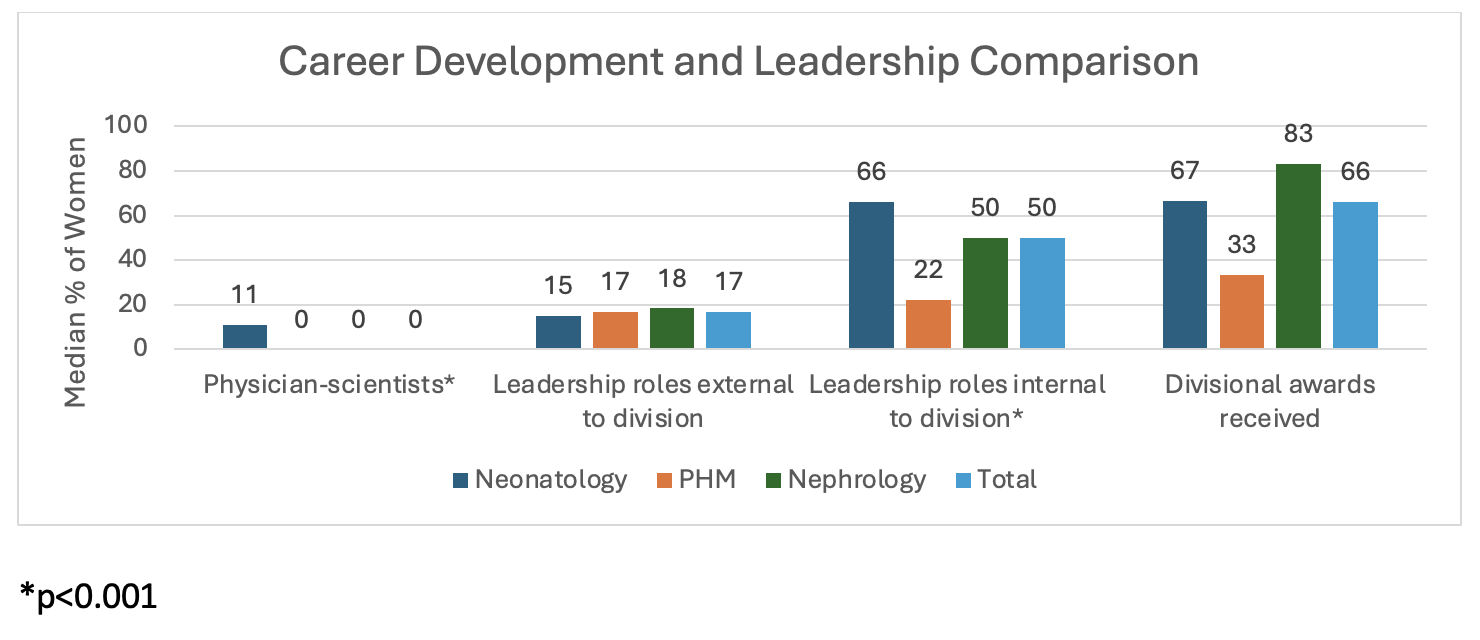
Across the full cohort, promotion timelines, physician scientists, and leadership positions did not differ by gender. Women received two-thirds of divisional awards, commensurate with the percent of women faculty. Women were more likely to be physician scientists and hold internal leadership roles in neonatology than others (p < 0.001) and held similar proportions of external leadership roles and awards across subspecialties (Figure).
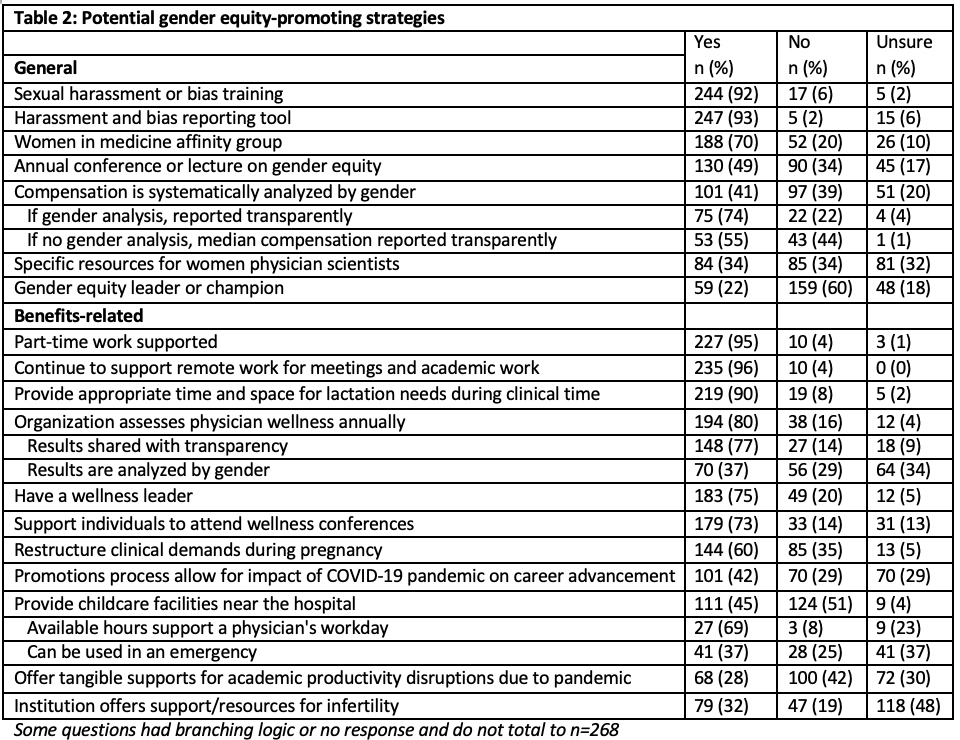
30% of respondents reported women in their division faced no inequities, though 75% reported gender inequity a middle-to-top priority to address. Over half reported lack of bandwidth, personnel, and resources as the most important barrier to addressing gender inequities. For those centers that analyzed compensation by gender (n=101), 91% reported no gender difference. Presence of potential gender-equity promoting practices was variable and leaders often unsure of their existence. Two-thirds have a Women in Medicine affinity group, but less than a quarter have gender equity champions at their institution (Table 2).
Conclusion(s): Despite perceptions of minimal gender inequity in these three pediatric subspecialties, these results do not conform to national objective data. A first step to address potential gaps in leader knowledge and supports for women faculty is tracking and reporting these measures accurately, systematically, and transparently. Understanding and addressing these issues across all of pediatrics could promote strategic change to retain and advance careers and scholarly contributions in this women-dominant academic workforce.