765 - Achieving Early Vascular Access for Preterm Infants in the Golden Hour
Friday, April 24, 2026
5:30pm - 8:00pm ET
Publication Number: 1741.765
Devanshi S. Shah, Cohen Children's Medical Center, New York, NY, United States; Benjamin Winchel, Northwell, Staten Island, NY, United States; Kristina Scarfo, Donald and Barbara Zucker School of Medicine at Hofstra/Northwell, Brooklyn, NY, United States; Marta Kurhan, Northwell, Wantagh, NY, United States; Emma Venturi, Cohen Children's Medical Center, Sayville, NY, United States; Barry Weinberger, Cohen Children's Medical Center, New Hyde Park, NY, United States; Olena Predtechenska, Northwell Health, Bellmore, NY, United States
Neonatal Perinatal Medicine Fellow Cohen Children's Medical Center New York, New York, United States
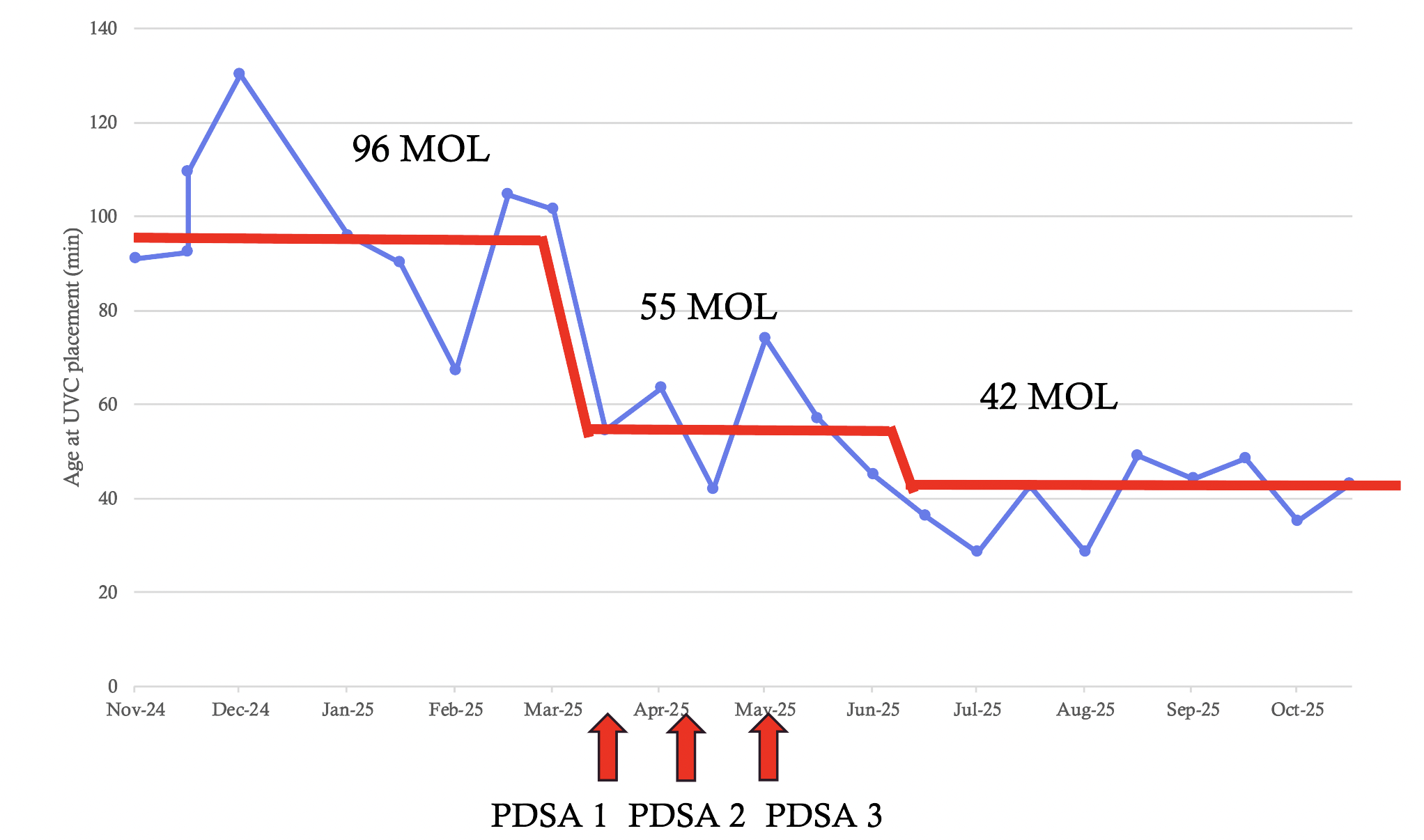
Background: Vascular access is essential for the care of newborn preterm infants, allowing for delivery of dextrose, fluids, nutrition, blood products, and medications as needed. Umbilical venous catheters (UVCs) are more secure than peripheral intravenous lines, and recent studies have suggested that their placement may be less traumatic. Therefore, early and effective placement of UVCs after delivery of preterm infants may help reduce the incidence of complications such as hypoglycemia, hypothermia, and intra-ventricular hemorrhage. Objective: Our SMART aim was to decrease the time to achieve UVC access to 45 mins after birth for infants born at < 30 weeks' gestation in our NICUs by October 31, 2025. The balancing measure was the proportion of UVCs placed successfully after the first attempt. Design/Methods: Infants born at < 30 weeks between Nov 2024 and Oct 2025 in our 57-bed level IV and 30-bed level III NICUs were included. A committee of neonatologists and nurses determined best practices during the Golden Hour, including UVC placement. Operational challenges involved establishing physician and nurse buy-in, relocating equipment for easy access, reinforcing skills, and introducing a comprehensive protocol prioritizing activities during the Golden Hour. Several distinct PDSA cycles were performed: PDSA 1: Targeted e-mails about the importance of Golden Hour and announcements at nursing brief every shift. PDSA 2: Educational program and simulations of Golden Hour for medical and nursing staff. PDSA 3: Implementation of Golden Hour, with posters in the delivery areas on the sequence and time course for stabilization and vascular access in the first hour. Results: Time to UVC placement decreased from median 96 to 55 mins after initiation of education (PDSA 1 and 2). Further improvement to 42 mins occurred within 1 month after implementation of the Golden Hour protocol (PDSA 3), likely related to improving skills and familiarity (Fig. 1). UVC placement success on the first attempt remained constant at approximately 82% (Fig. 2).
Conclusion(s): A systematic educational program and comprehensive Golden Hour protocol successfully decreased the time taken to achieve umbilical venous access to < 45 minutes for infants < 30 weeks gestation without impairing the success of line placement.










.png)
