233 - Hybrid, On-the-Job Neonatal Nurse Training in Uganda with NeoNatal Essential Training and Skills (NNETS) Program: Knowledge Gains and 6-Month Retention Compared with U.S. NICU Nurses
Friday, April 24, 2026
5:30pm - 8:00pm ET
Publication Number: 1221.233
Sheron Wagner, Baylor University, Telephone, TX, United States; Dickson Tumusiime, Nakasero Hospital, VANCOUVER, BC, Canada; Kathryn Miller, Connecticut Children's Medical Center, South Windsor, CT, United States; Naveed Hussain, Connecticut Children's Medical Center, Farmington, CT, United States
Clinical Assistant Professor DNP NNP Program Coordinator Baylor University Telephone, Texas, United States
Background: Least Developed Countries (LDCs - 46 listed by UN) are low-income countries with low human assets and professional skills. Many neonatal units in low-resource settings lack access to formal neonatal nurse (NN) training and cannot support travel for extended coursework. We piloted a hybrid, on-the-job program (NNETS-Uganda) and evaluated knowledge acquisition and 6-month retention, benchmarking 6-month recall against U.S. NICU nurses. Objective: To measure short-term knowledge gain, 6-month knowledge retention, and compare 6-month recall scores with U.S. NICU nurses. Design/Methods: A pilot NNETS program was designed in consultation with U.S. neonatal teaching experts, including the Council of International Neonatal Nursing (COINN). Published curricula were used to develop and deliver a 48-lecture, six-month didactic program (March-September 2022) via Zoom. A five-week on-site mentorship was provided by five U.S.-trained NNs at Nakasero Hospital in Kampala (September-October 2022). Eighteen volunteer NNs, NNPs, and neonatologists from U.S. universities conducted virtual sessions and recordings for asynchronous learning. NNs from Nakasero, St. Francis Nsambya, and Kampala Hospitals attended 45-minute live sessions twice weekly. Participants were evaluated with MCQs before, mid-course, at completion, and six months post-completion. Scores were analyzed using repeated-measures ANOVA, and six-month recall results were compared with U.S. NICU nurses using Student's t-test. Results: Forty-eight nurses from three hospitals in Kampala enrolled, and thirty-six achieved scores of ≥75% to complete the NNETS-Uganda course. Mean knowledge scores differed significantly across three time points (ANOVA F(2,33)=242.2, p< 0.001) (Figure 1). Post-hoc analysis showed gains between initial and final assessments (51.7 vs 94.4, p< 0.001). Six-month recall declined (67.2±17.7 vs 97.1±2.8, p=0.001) but remained higher than baseline (67.2±17.7 vs 53.0±10.6, p=0.002). Comparison with U.S. NICU nurses revealed no significant difference (67.2±17.7 vs 65.4±9.1, p=0.295).
Conclusion(s): A hybrid training model using live-remote-lectures and on-site skills training is a cost and resource-effective means training NN in LDC regions. Successful training can be done as an adjunct to their daily routine without disrupting workflow. Knowledge acquisition using this method of teaching was comparable with US based nurses working in the NICU. The acquisition of NICU skills and other competencies needs further research.










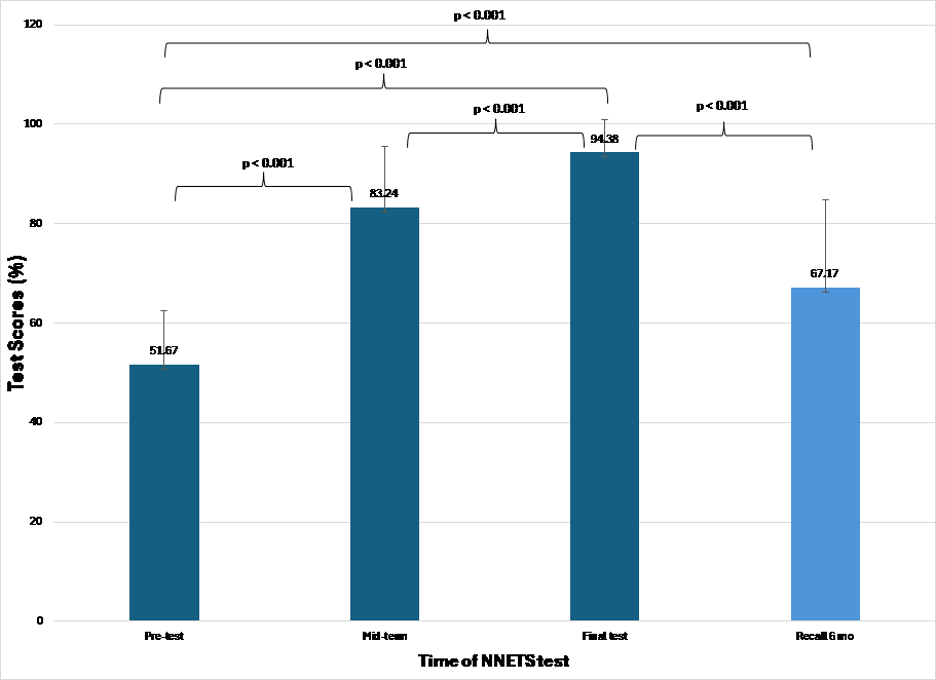 Figure 1