643 - Impact of a Neonatal Nutrition Program on Extrauterine Growth in Preterm Infants During Hospitalization.
Friday, April 24, 2026
5:30pm - 8:00pm ET
Publication Number: 1620.643
Valeria De Toro, Pontificia Universidad Catolica de Chile, Santiago de chile, Region Metropolitana, Chile; Valentina Maria. De la Carrera Ibarra, Pontificia Universidad Católica de Chile, Santiago, Region Metropolitana, Chile; Claudia Garrido, Pontificia Universidad Catolica de Chile, Santiago, Region Metropolitana, Chile
Assistant Professor Pontificia Universidad Catolica de Chile Santiago de chile, Region Metropolitana, Chile
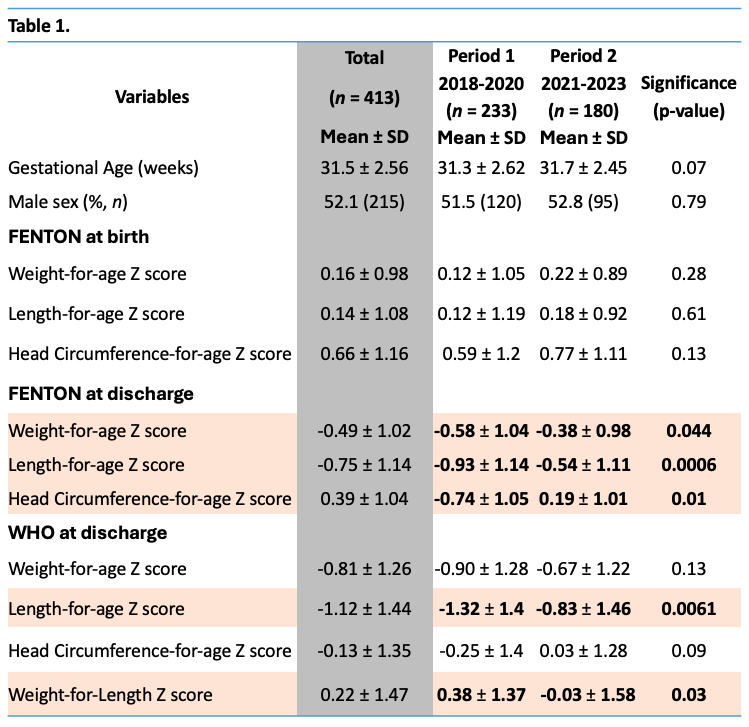
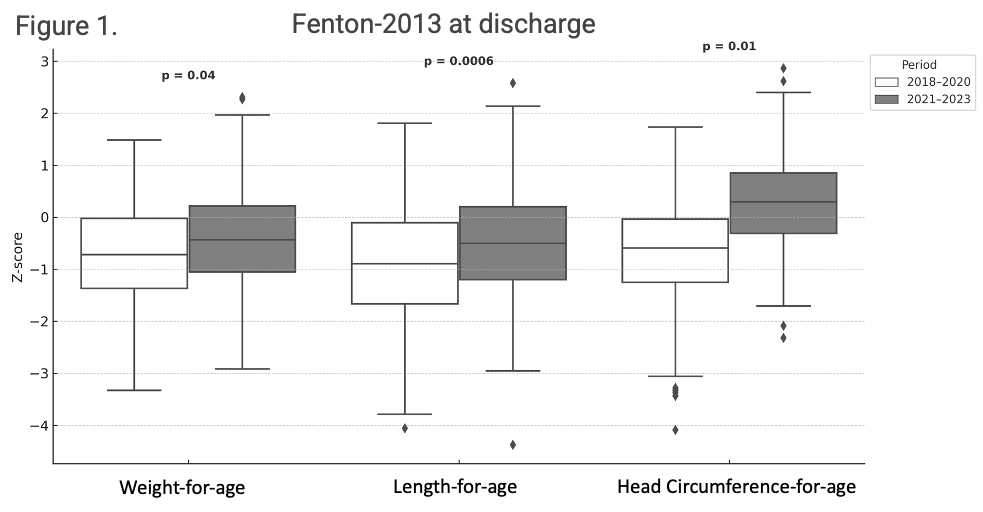
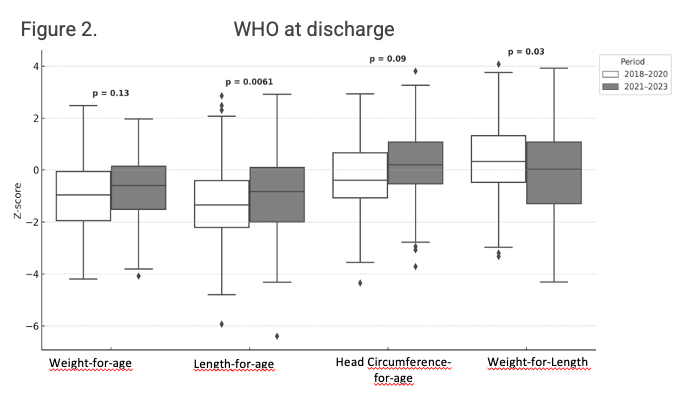
Background: Standardized and individualized nutritional monitoring is essential to optimize the nutrition of preterm infants, supporting healthy growth and reducing morbidity and mortality. Worldwide, specialized neonatal nutrition teams have proven effective in preventing malnutrition - whether due to deficiency or excess. Objective: To evaluate the impact of a nutritional intervention program on growth patterns from birth to neonatal discharge in preterm infants during two periods: P1-Pre-Intervention (2018-2020) and P2-Post-Intervention (2021-2023). Design/Methods: A retrospective cohort study including preterm infants (24-36 weeks of gestational age) hospitalized for ≥ 14 days in a single neonatal center. The nutritional intervention program, initiated in 2021, consisted of weekly monitoring of caloric and protein intake targets with individualized adjustments. Anthropometric variables (weight, length, and head circumference) were collected. Two groups, P1 and P2, were compared using Fenton 2013 and WHO growth curves to obtain birth and discharge Z-scores. Results: A total of 413 neonates were included (Table 1): P1 (n = 233) and P2 (n = 180). Females represented 47.9% of the sample; mean gestational age was 31.5 ± 2.5 weeks, and mean birth weight was 1,729 ± 556 g, with no significant baseline differences between groups. At discharge, the P2 group showed higher Fenton Z-scores (Fig. 1): weight-for-age (P1 −0.58 ± 1.04 vs. P2 −0.38 ± 0.98, p = 0.044), length-for-age (P1 −0.93 ± 1.14 vs. P2 −0.54 ± 1.11, p < 0.001), and head circumference-for-age (P1 −0.74 ± 1.05 vs. P2 0.19 ± 1.01; p < 0.01). According to WHO standards (Fig. 2), significant differences were also observed in discharge length-for-age (P1 −1.32 ± 1.40 vs. P2 −0.83 ± 1.46; p < 0.01) and weight-for-length (P1 0.38 ± 1.37 vs. P2 −0.03 ± 1.58; p = 0.03).
Conclusion(s): The implementation of a structured neonatal nutrition program positively impacted growth outcomes at discharge in the post-intervention period.
Table 1. Baseline characteristics
Figure 1. Anthropometric variables using Fenton 2013 at discharge
Figure 2. Anthropometric variables using WHO at discharge