Dr. Cleveland Clinic Children's CLEVELAND, Ohio, United States
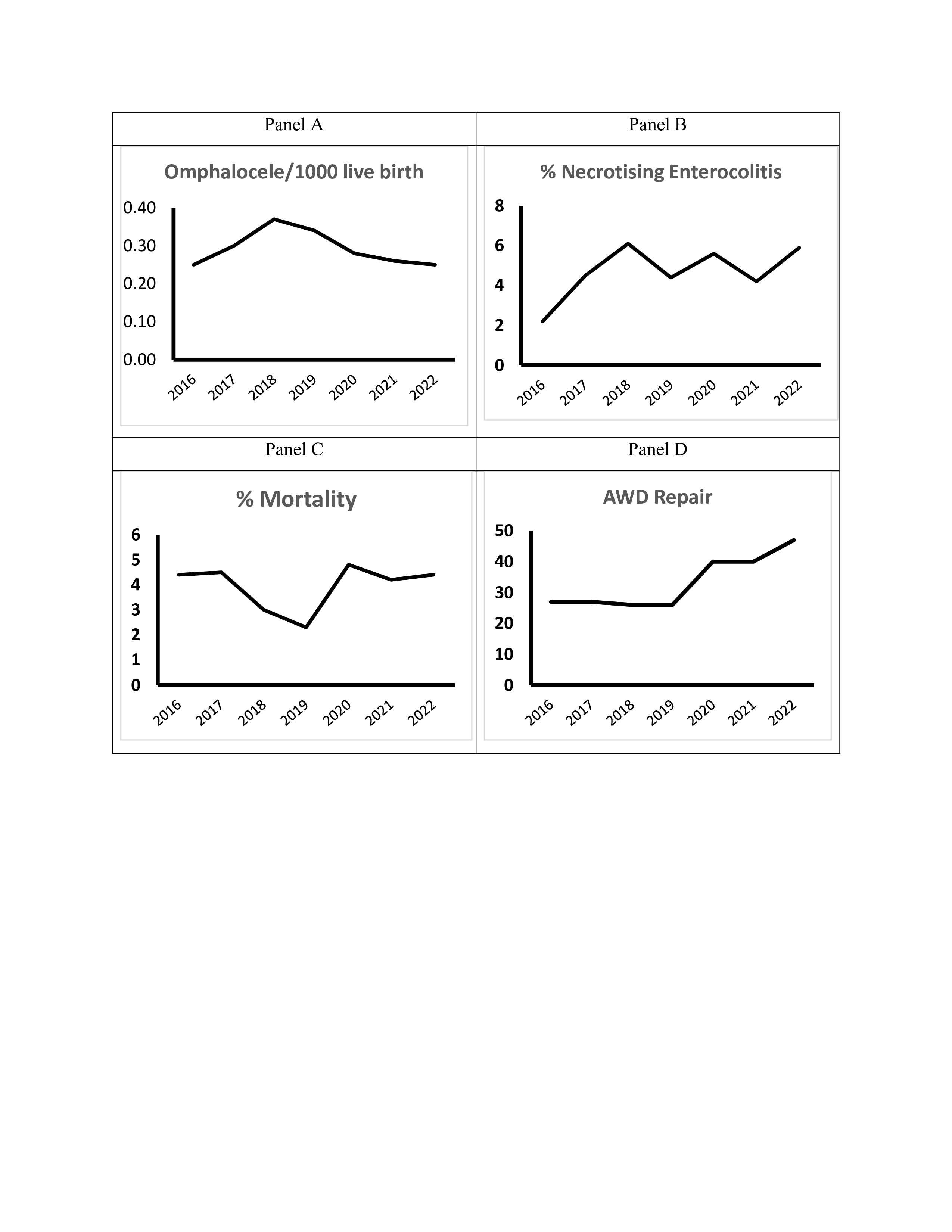
Background: Recent reports showed the prevalence of omphalocele may have been increasing in recent years, with increasing mortality and morbidities associated with it. Objective: To examine changes in the prevalence of omphalocele, necrotizing enterocolitis (NEC), surgical intervention, and associated mortality over recent years. Design/Methods: The study used the national dataset produced by the healthcare cost and utilization project (HCUP) for the years 2016-2022. We excluded infants < 34 weeks gestational age (GA), or birth weight (BW) < 1500g, infants with Trisomy 13 and 18, infants with complex congenital heart disease (CHD), congenital diaphragmatic hernia (CDH), severe brain or lung anomalies, or neural tube defects (NTD). Results: The study included 26,272,741 infants. There were 7716 infants with omphalocele (0.02%). The prevalence of omphalocele increased then decreased overtime with overall slight decrease in the years of the study, p = 0.004, Figure (1) Panel A. Among infants with omphalocele, the prevalence of NEC was 4.8% and it was significantly increased overtime. However, excluding the year 2016, where the prevalence of NEC was exceptionally low, the prevalence fluctuated between 4.2-6.1% and there was no significant trend for changes over the years, p = 0.76, Figure (1) Panel B. About 41% of the infants who were transferred out received abdominal wall repair and the prevalence of surgical repair has steadily increased over recent years, p < 0.001. Figure (1) Panel C. Overall mortality was 3.8% and it did not significantly change overtime, Figure (1), Panel D. Mortality among non-transferred infants who did not receive surgical intervention was 6.7 and it increased overtime, while the mortality among those who received abdominal wall repair is 2.4% and it did not change overtime. Compared to Caucasian infants (0.32/1000), omphalocele was more common in in African American (0.51/1000) p< 0.001), but less in Hispanic/Latino infants (0.24/1000) Asian/Pacific Islander infants (0.19/1000) p < 0.001), and Native American infants (0.14/1000), p < 0.001.
Conclusion(s): The prevalence of omphalocele slightly decreased over recent years. Occurrence of NEC in association with omphalocele did not significantly change overtime. The overall mortality and mortality among infants who received surgical repair did not change over recent years. More qualitative research is needed to explore reasons for increased mortality among those who did not have surgical repair. African American infants are the only racial group associated with higher prevalence of omphalocele.
Prevalence of omphalocele/1000 birth, and incidence of necrotizing enterocolitis, median length of stay and mortality associated with omphalocele in 2016-2020