523 - Establishing a Center of Excellence in Cerebral Palsy Care: Models of Care Delivery Within Cerebral Palsy Research Network Sites
Friday, April 24, 2026
5:30pm - 8:00pm ET
Publication Number: 1503.523
Laurie Glader, Nationwide Children's Hospital, Columbus, OH, United States; Nina Miller, Microsoft, Athens, NC, United States; Paul H. Gross, Cerebral Palsy Research Network, Greenville, SC, United States; Michael C. Kruer, Phoenix Children's Hospital, Phoenix, AZ, United States
Associate Chief, Division of Complex Care Nationwide Children's Hospital Columbus, Ohio, United States
Background: Cerebral palsy (CP) is the most common childhood onset physical disability. Because of the varying nature and extent of the underlying brain injury as well as the range of co-morbid conditions, CP is a heterogeneous condition. Providing medical, surgical and therapeutic care to individuals with CP requires the involvement of multiple disciplines, with differing constellations of specialty expertise for each individual. In order to offer individuals with CP optimal specialized treatment, to streamline resources, and to provide family-centered care, increasing numbers of medical centers offer CP programs. However, no data regarding key infrastructure and common elements of care at CP centers have previously been reported. Objective: To identify the frequency of elements of care for individuals with cerebral palsy (CP) among North American sites offering multi-disciplinary CP clinics, and to begin to create benchmarks for key features for centers providing CP care. Design/Methods: Recorded presentations by North American sites within the Cerebral Palsy Research Network were extracted for pre-determined data elements. Site principal investigators (PIs) confirmed accuracy of their center's extracted data. Common features were stratified into four domains: programmatic structure; clinical flow; data collection and program improvement; and service offerings. Free text responses provided further context. Analysis included frequency of service provision. Results: 11 sites participated. Twelve services emerged as universal; among them, tone and orthotic management, access to therapies and equipment, orthopedic surgery, and gait analysis. Ten additional services, including specialty programs within CP Clinics, were found at 72% of centers. An additional seven elements of service delivery, including mental health, transition, adult, and reproductive care, were present at less than 64% of sites
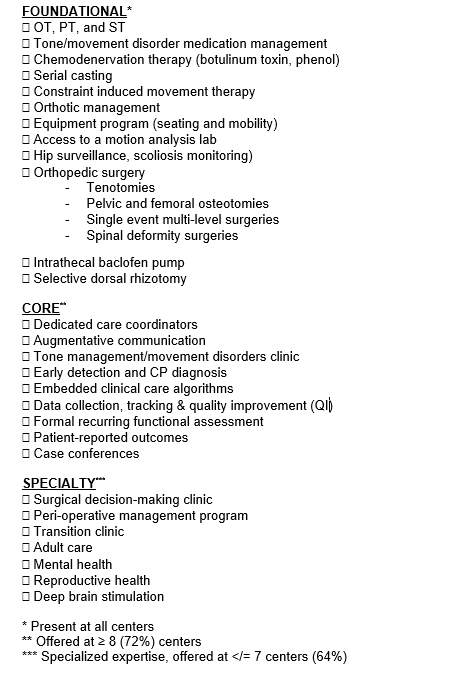
Conclusion(s): Based on representation in our cohort, we propose a checklist of Foundational, Core and Specialty features as benchmarks for individual CP Programs. Although additional work is needed to assess widespread applicability and utility, our findings provide a preliminary framework for establishing best practices for centers striving to provide comprehensive CP care.
Non-universal service offerings across participating programs (n=number of programs where service/activity is provided)
Checklists of Foundational, Core, and Specialty Services









.png)