








Developmental and Behavioral Pediatrics
Session: Developmental and Behavioral Pediatrics 3: ADHD/Behavior

Unaisa Bhayat, MD (she/her/hers)
Pediatric Resident PGY-1
Texas Tech University Health Sciences Center Paul L. Foster School of Medicine
El Paso, Texas, United States
.jpg) Of the 579 articles identified, 88 secondary literature articles were excluded. Of the remaining 491, 356 were excluded for focusing primarily on ADHD treatment and/or genetics. Ultimately, 51 primary research articles met inclusion criteria. These were categorized by thematic focus and synthesized accordingly.
Of the 579 articles identified, 88 secondary literature articles were excluded. Of the remaining 491, 356 were excluded for focusing primarily on ADHD treatment and/or genetics. Ultimately, 51 primary research articles met inclusion criteria. These were categorized by thematic focus and synthesized accordingly..jpg) In neurotypical children, there is a dynamic balance between the default mode network (DMN) and the task-positive network (TPN). In childhood, the substantia nigra dominates dopaminergic connectivity, which gradually shifts to increased ventral tegmental area (VTA) connectivity with maturation. The VTA-amygdala connection supports appropriate emotional learning, allowing the amygdala to distinguish safe from threatening stimuli, thereby modulating stress responses effectively. As development progresses, the putamen transitions from coupling with the DMN to integrating with the TPN, facilitating a shift from self-referential thought to goal-directed behavior. This is accompanied by strengthened interhemispheric communication and increased global network efficiency, supporting lateralization that optimizes cognitive capacity and fine motor skills, as well as delayed gratification, accurate error prediction and complex task switching.
In neurotypical children, there is a dynamic balance between the default mode network (DMN) and the task-positive network (TPN). In childhood, the substantia nigra dominates dopaminergic connectivity, which gradually shifts to increased ventral tegmental area (VTA) connectivity with maturation. The VTA-amygdala connection supports appropriate emotional learning, allowing the amygdala to distinguish safe from threatening stimuli, thereby modulating stress responses effectively. As development progresses, the putamen transitions from coupling with the DMN to integrating with the TPN, facilitating a shift from self-referential thought to goal-directed behavior. This is accompanied by strengthened interhemispheric communication and increased global network efficiency, supporting lateralization that optimizes cognitive capacity and fine motor skills, as well as delayed gratification, accurate error prediction and complex task switching. 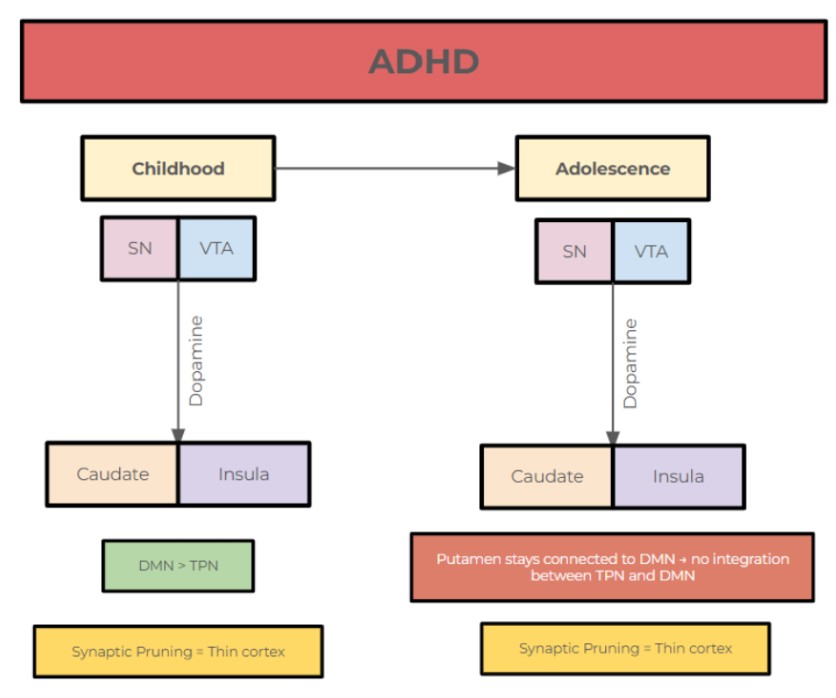 This diagram suggests that children with ADHD show increased connectivity within dopaminergic pathways-the substantia nigra (SN) and ventral tegmental area (VTA)-with heightened VTA-amygdala coupling. This is coupled with fronto-parietal cortical thinning, decreased global network efficiency, and compensatory local hyperconnectivity, especially in ventral brain regions, which favors accuracy in goal-directed tasks despite impaired hemispheric cross-talk. Developmentally, the putamen's failure to shift from DMN to TPN coupling may underlie persistent internal focus and reduced task engagement.