75 - Sleep Health Among Children Born Preterm: Insights from the National Survey of Children’s Health
Friday, April 24, 2026
5:30pm - 8:00pm ET
Publication Number: 1067.75
Claudia Kantner, Vanderbilt University, Chicago, IL, United States; Erin E. Von Klein, Vanderbilt University School of Medicine, Chicago, IL, United States
Vanderbilt University Chicago, Illinois, United States
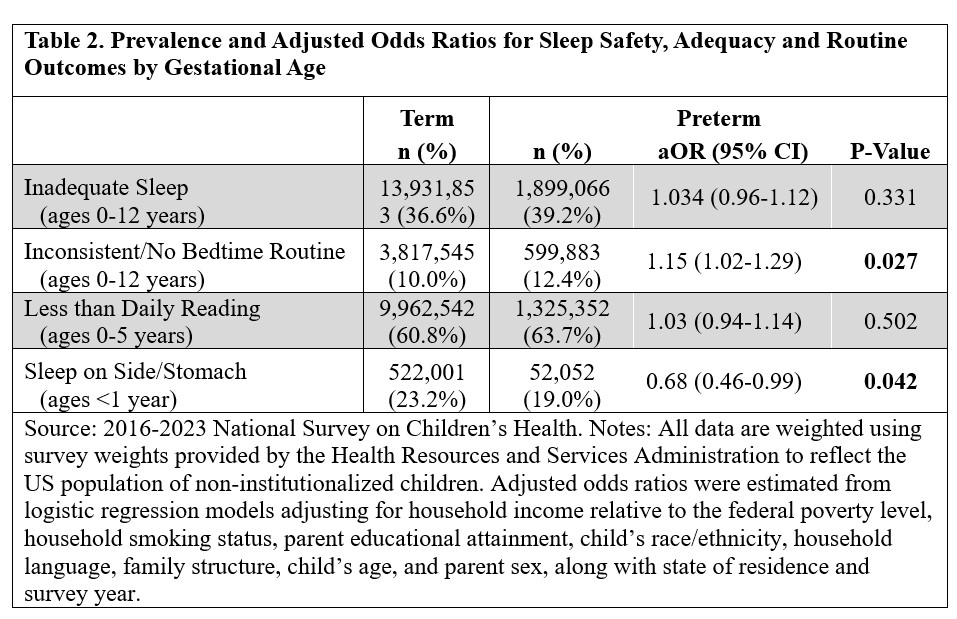
Background: Children born preterm are at risk for developmental and physical health challenges extending into childhood. Good sleep is an essential component of healthy neurodevelopment. Poor or irregular sleep in childhood is associated with challenges with emotional regulation, academic performance, and caregiver stress. Prematurity presents both biological and environmental pathways for disrupted sleep; however, research on the association of sleep with preterm birth at a population-level is limited. Better understanding the association of preterm birth and sleep health could improve early intervention and prepare children born preterm and their families for better long-term outcomes. Objective: This study investigates differences in sleep quality and routine for children born preterm with their term-born peers, including measures of adequate sleep duration, consistent bedtime routines, daily reading and safe sleep practices during infancy. To identify and address predictors of adverse outcomes, we used a large, nationally representative dataset of parent-reported outcomes and predictors. Design/Methods: Using data from the National Survey of Children's Health (2016-2023), we analyzed four sleep-related outcomes. Responses we dichotomized as outlined in Table 2. We applied multivariable models to adjust for demographic and socioeconomic factors selected a priori based on literature and causal reasoning. Specifically, covariates included the child's age, sex, and race/ethnicity; parental educational attainment; percent of the federal poverty level; family structure; primary household language; household smoking exposure; and state and survey year. Results: Children born preterm had higher odds of inconsistent bedtime routines (adjusted odds ratio (aOR) 1.146, 95% CI 1.02-1.29), but not did not differ adequacy of sleep duration (aOR 1.038, 95% CI 0.96-1.12) or lower frequency of daily reading (aOR 1.03, 95% CI 0.94-1.14). Among infants under one-year, preterm birth was associated with lower odds of being placed on their side or stomach for sleep (aOR 0.68, 95% CI 0.46-0.99).
Conclusion(s): Surprisingly, we found children born preterm were more likely to be positioned in a safe sleep position (on their back) during the first year of life. However, when including older children, children born preterm were less likely to have a consistent bedtime routine-a sleep behavior strongly associated with emotional regulation and school readiness. Together, these findings suggest opportunities for early family-based interventions and anticipatory guidance to promote healthy sleep patterns among children born preterm.
Table 1. Descriptive Characteristics of Children Aged 0-12 Years and their Caregivers by Gestational Age
Table 2. Prevalence and Adjusted Odds Ratios for Sleep Safety, Adequacy and Routine Outcomes by Gestational Age









.png)