658 - Quantitative estimation of bilirubin load and bilirubin neurotoxicity.
Friday, April 24, 2026
5:30pm - 8:00pm ET
Publication Number: 1635.658
Christian V. Hulzebos, Beatrix Children's Hospital, University Medical Center Groningen, Groningen, Groningen, Netherlands; Peter H. Dijk, Childrens, Groningen, Groningen, Netherlands; Jon F. Watchko, University of Pittsburgh School of Medicine, Sewickley, PA, United States
Assistant Professor Beatrix Children's Hospital, University Medical Center Groningen Groningen, Groningen, Netherlands
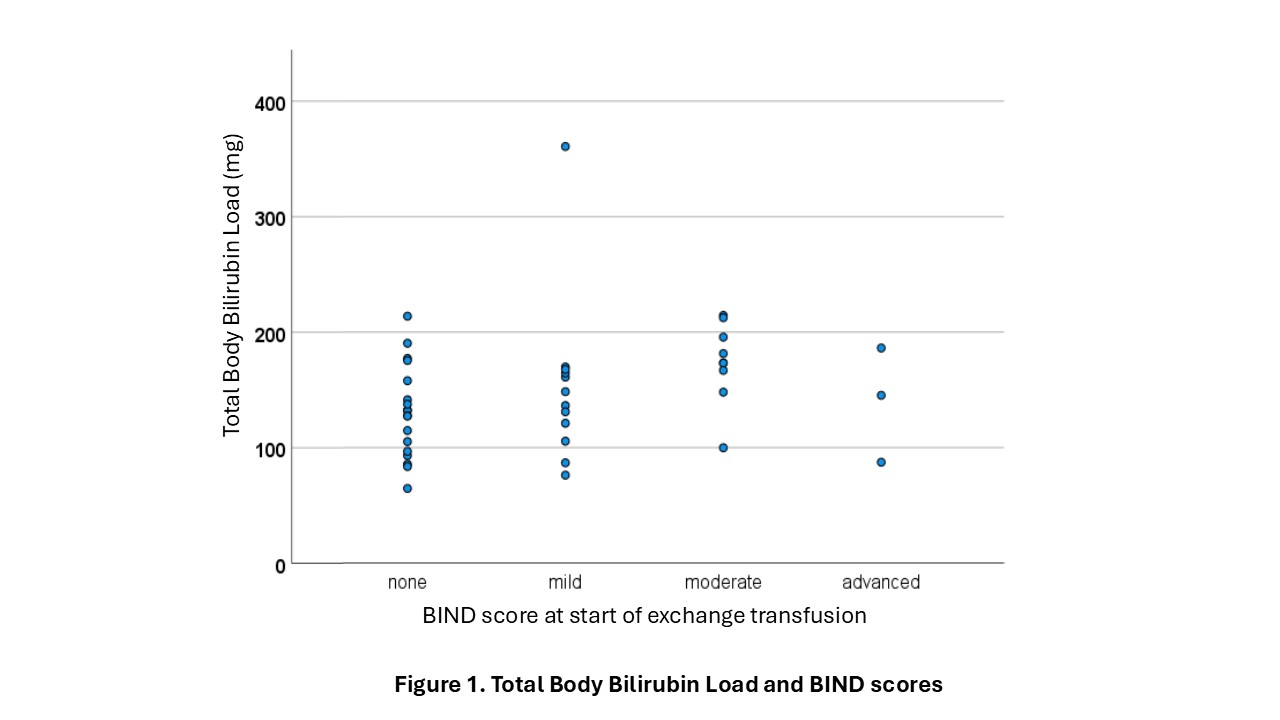
Background: The risk of bilirubin encephalopathy is driven by the magnitude of the total body bilirubin load (TBBL), its extravascular component (EVBL), and the level of diffusible unbound free bilirubin (Bf) available to enter the central nervous system. Objective: Using a new methodology for estimating TBBL and EVBL we determined how the pre-exchange total serum bilirubin (TSB), Bf, and the Bf/TSB ratio relate to pre-exchange TBBL and EVBL in a contemporary cohort of neonates who underwent an exchange transfusion (ET) for hyperbilirubinemia. Design/Methods: This is a retrospective analysis of jaundiced newborns who underwent an ET after 24 hours of postnatal age between January 2005 and December 2008 in the Clinical Unit of the National Reference Center for Perinatal Hematobiology (CNRHP), Paris (France). Rebound bilirubin levels were presented at a prior PAS meeting. Here, we quantitatively estimate EVBL and TBBL using the method described in J Perinatol 2024:44;902-904. To our knowledge, this is the first application of this novel approach in this context. The BIND score was calculated according to the neurological evaluation of Johnson and colleagues. Pearson's correlation (r) was used to quantify linear associations between variables. Results: In total, we included 53 infants with a mean (SD) BW of 2845 (603) g and GA of 37 (2.5) week. Pre-ET TSB was 421 (90) µmol/L, pre-ET Bf was 20 (8.5) nmol/L, with a pre-ET Bf/TSB ratio of 23.6 (10.8). TBBL was 139 (53) mg and EVBL 99 (47) mg. BIND scores at the start of ET (n=42) identified no BIND in 18 infants, mild BIND in 12, moderate BIND in 9, and advanced BIND in 3 infants. We found significant correlations between pre-ET TSB and TBBL (r=0.50, p< 0.001), and EVBL (r=0.381, p=0.005). Significant correlations also existed between pre-ET Bf and TBBL (r=0.36, p= 0.008), and EVBL (r=0.31, p=0.027). The Bf/ TSB ratio was not significantly related to any of the quantitatively estimated parameters. Figure 1 shows a wide range of TBBL values (mg) across infants with different BIND grades.
Conclusion(s): Pre-exchange TSB and Bf, but not the Bf/TSB ratio, correlated significantly with TBBL and EVBL. Variation in all bilirubin indices across infants with BIND suggests neurotoxicity is not solely driven by bilirubin exposure.
Figure 1. Total Body Bilirubin Load and BIND scores