Wound Care Practice Director Pediatrix Medical Group Friendswood, Texas, United States
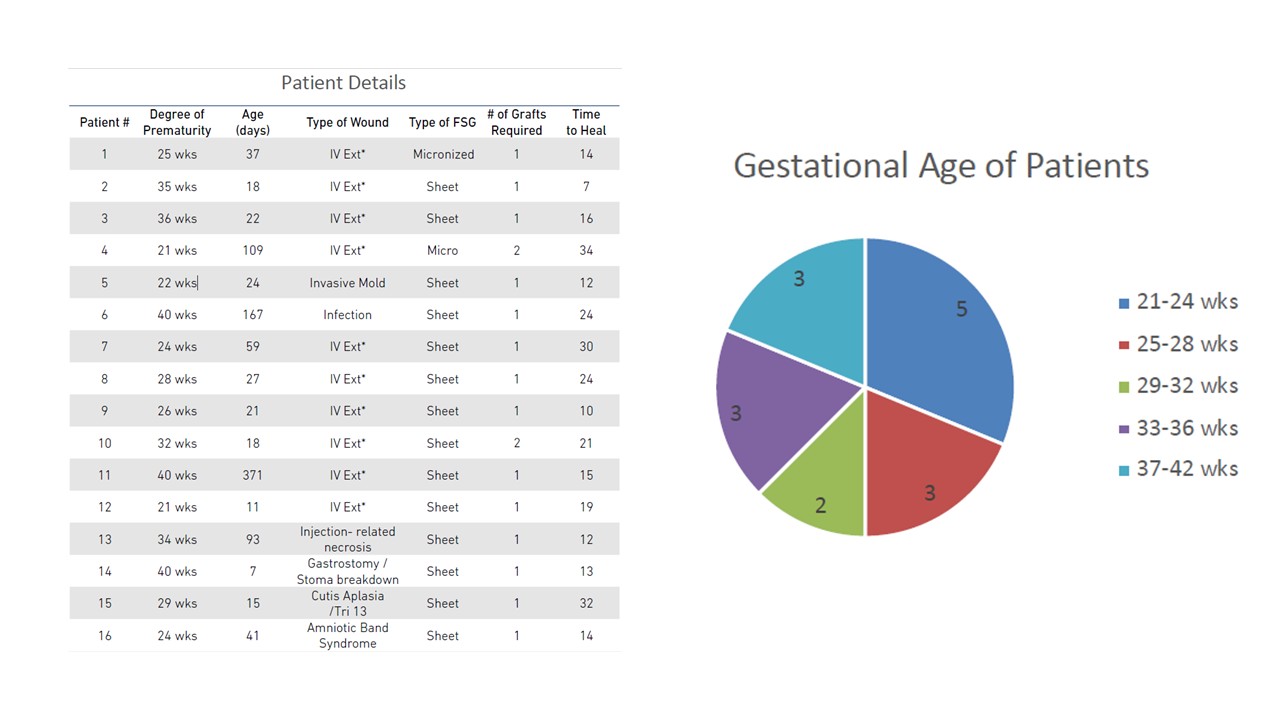
Background: Intact fish skin grafts (IFSGs), derived from Icelandic cod, have shown favorable outcomes in adult acute and chronic wound care. Their dermal-like structure and bioactive properties support healing while minimizing complications. In infants, however, complex wound management poses unique challenges due to fragile skin barriers, higher infection risk, and the importance of long-term functional and cosmetic outcomes. Although IFSGs are well-studied in adults and reported in limited pediatric cases, evidence in neonates remains scarce. Objective: The primary objective was to assess the safety and outcomes of IFSG application in infants with complex wounds. Design/Methods: All neonatal intensive care unit (NICU) infants treated with intact fish skin grafts (FSGs) at our facility from January 2022 through June 2025 were included. Patients ranged from 21 weeks' gestation to term and 7-371 days of life. Wounds included IV extravasations, soft tissue infections, congenital conditions, and device-related injuries. After wound bed preparation, FSGs were applied at the bedside without surgery and left in place for 7-14 days. Sites were assessed every 3-4 days for infection or graft-related complications. The primary endpoint was complete wound closure. Results: Sixteen infants met inclusion criteria, with gestational ages from 21 weeks prematurity to term. Fourteen required a single IFSG, while two received two applications. Complete wound closure occurred in all patients, with an average closure time of 18 days. No graft-related adverse effects or complications were observed.
Conclusion(s): This case series represents the largest documented evaluation of IFSGs in preterm infants and neonates with complex wounds. Across 16 patients, IFSGs were well tolerated with no graft-related complications, even in the most fragile skin barrier conditions. These findings provide early evidence that IFSGs can be safely integrated into neonatal wound care and may expand biologic options for this highly vulnerable population.










.jpg)
.jpg)