358 - Evaluation and Management of Infants Born to Mothers with Active Genital Herpes Simplex Virus Lesions
Saturday, April 25, 2026
3:30pm - 5:45pm ET
Publication Number: 2347.358
Jaibir S. Khera, Kaiser Permanente - Oakland Medical Center, Oakland, CA, United States; Tara L. Greenhow, Kaiser Permanente Northern California, San Francisco, San Francisco, CA, United States; Zahra Samiezade-Yazd, Kaiser Permanente Division of Research, Pleasanton, CA, United States; Tran Nguyen, Kaiser Permanente - Oakland Medical Center, Roseville, CA, United States; Beverly Young, Kaiser Foundation Hospital - Roseville Women's and Children's Services, Roseville, CA, United States; Lea Bornstein, Kaiser Permanente - Oakland Medical Center, Oakland, CA, United States; Daniel D.. DiLena, Kaiser Permanente Division of Research, Pleasanton, CA, United States
Pediatrics Resident Kaiser Permanente - Oakland Medical Center Oakland, California, United States
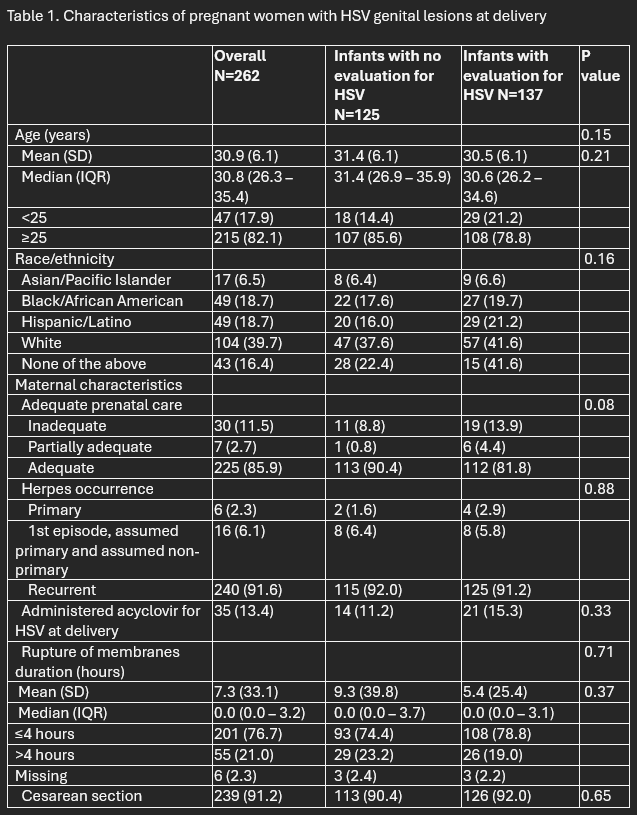
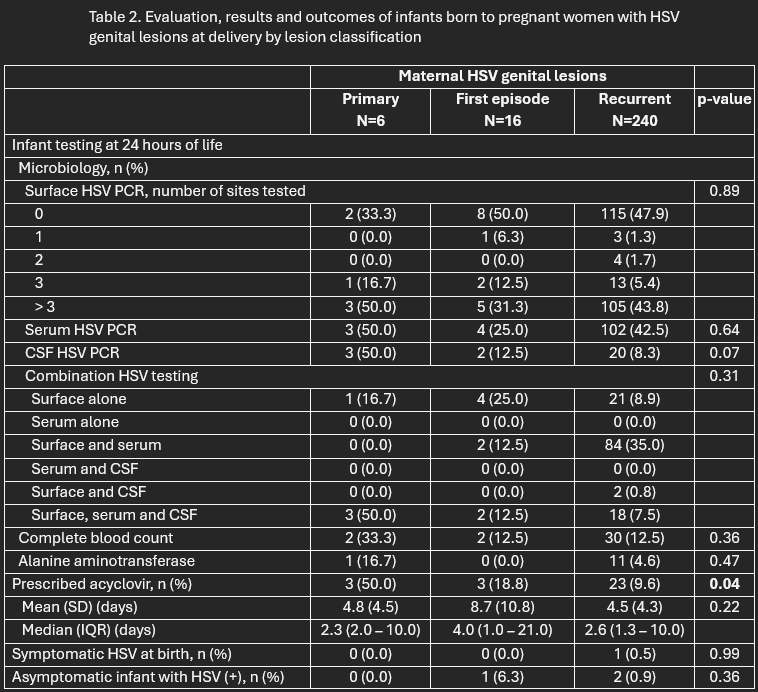
Background: Genital herpes simplex virus (HSV) infections at delivery are classified as primary, non-primary, or recurrent, distinctions that carry markedly different infant risk. Vertical transmission occurs in approximately 50% of maternal primary infections, compared to only 2% in recurrent cases. Given these differences, Kimberlin et al. (2013) established standardized guidelines for the evaluation and management of infants born to women with active genital HSV lesions at delivery. Objective: Within a large integrated healthcare system, we evaluated the assessment and management of infants born to mothers with active genital HSV at delivery, focusing on adherence to published guidelines and associated neonatal outcomes. Design/Methods: This was a retrospective data-only study of all infants born in our integrated healthcare system from October 1, 2011, and September 30, 2023, to women with HSV genital lesions at delivery. Maternal demographics, prenatal history, HSV episode type, laboratory studies and mode of delivery were extracted from the electronic health record (EHR). Infant EHR data included laboratory studies and manual data abstraction confirmed number, location and type of viral studies obtained and acyclovir administration and duration. All infants' records were reviewed for evidence of HSV disease within 42 days after birth. Results: HSV genital lesions were identified in 262 women at delivery [Table 1], including 6 (2.3%) with primary, 16 (6.1%) with first episode presumed primary or non-primary, and 240 (91.6%) with recurrent infection. Evaluation practices for the 262 exposed neonates did not differ significantly by maternal HSV episode type; however, infants born to mothers with primary lesions were more often treated with acyclovir [Table 2]. Four infants tested positive for HSV at birth: three were asymptomatic with normal laboratory findings, and one with presumed congenital HSV and vesicular lesions. No infants returned within 42 days with HSV. Adequate prenatal care was documented in 90.4% of women without infant evaluation versus 81.8% whose infants were evaluated (p = 0.04) [Table 1]. Other maternal clinical factors did not differ significantly between groups.
Conclusion(s): Neonatal HSV evaluation varied widely, with most practices diverging from Red Book-recommended guidelines. The number and type of studies performed did not differ significantly by maternal HSV episode type. These findings highlight gaps between guideline-based recommendations and clinical practice, emphasizing the need for system-wide education to optimize neonatal HSV management.
Characteristics of Pregnant Women with HSV Genital Lesions at Delivery
Evaluation, Results, and Outcomes of Infants Born to Pregnant Women with HSV Genital Lesions at Delivery by Lesion Classification