428 - Malaria in Hospitalized Pediatric Patients in Canada: A Retrospective Review from 2014 to 2023
Saturday, April 25, 2026
3:30pm - 5:45pm ET
Publication Number: 2416.428
Geraldine Huynh, University of Alberta Faculty of Medicine and Dentistry, Edmonton, AB, Canada; Rohini R. Datta, The Hospital for Sick Children, Toronto, ON, Canada; Jason Brophy, Children's Hospital of Eastern Ontario/University of Ottawa, Ottawa, ON, Canada; Jeannette Comeau, Dalhousie University Faculty of Medicine, Halifax, NS, Canada; Andrea Conroy, Indiana University School of Medicine, Indianapolis, IN, United States; Devika Dixit, University of Calgary, Calgary, AB, Canada; Michael T. Hawkes, University of British Columbia, Vancouver, BC, Canada; Sandra Isabel, Faculty of Medicine Université Laval, Quebec City, PQ, Canada; Joan L. Robinson, University of Alberta, Edmonton, AB, Canada; Anael Tessier-Gagnon, Faculty of Medicine Université Laval, Québec, PQ, Canada; Joseph V. Vayalumkal, University of Calgary, Calgary, AB, Canada; Thomas S. Armstrong, University of Alberta Faculty of Medicine and Dentistry, CALGARY, AB, Canada; Jennifer Bowes, Children's Hospital of Eastern Ontario Research Institute, Ottawa, ON, Canada; Shenna Dunn, McMaster University Michael G. DeGroote School of Medicine, Jasper, ON, Canada; Laura Erdman, McMaster University, Hamilton, ON, Canada; Élodie Gemme, Max Rady College of Medicine, Rady Faculty of Health Sciences, University of Manitoba, Winnipeg, MB, Canada; Charlotte Gubany, Universite de Montreal Faculty of Medicine, Montreal, PQ, Canada; Sameer Kassim, Max Rady College of Medicine, Rady Faculty of Health Sciences, University of Manitoba, Winnipeg, MB, Canada; Carsten Krueger, Children's Hospital, Calgary, AB, Canada; Alison Lopez, The University of Western Ontario - Schulich School of Medicine & Dentistry, London, ON, Canada; Victoria Mailhot, Faculty of Medicine Université Laval, Sainte-Foy, PQ, Canada; Gunjan Mhapankar, MICHAEL GARRON HOSPITAL, Toronto, ON, Canada; Fatema Mohamed, The Hospital for Sick Children, Toronto, ON, Canada; Myriam Perkins, Faculty of Medicine Université Laval, Québec, PQ, Canada; Marina Salvadori, McGill University Faculty of Medicine and Health Sciences, London, ON, Canada; Rhea S.. Thomas, McMaster University Michael G. DeGroote School of Medicine, Mississauga, ON, Canada; Hanna Van Dierdonck, McMaster University Michael G. DeGroote School of Medicine, Dunrobin, ON, Canada; Elizabeth Zhang, University of Alberta Faculty of Medicine and Dentistry, Edmonton, AB, Canada; Kescha Kazmi, The Hospital for Sick Children, Toronto, ON, Canada; Shaun K.. Morris, Hospital for Sick Children, Toronto, ON, Canada
Clinical Assistant Professor University of Alberta Faculty of Medicine and Dentistry Edmonton, Alberta, Canada
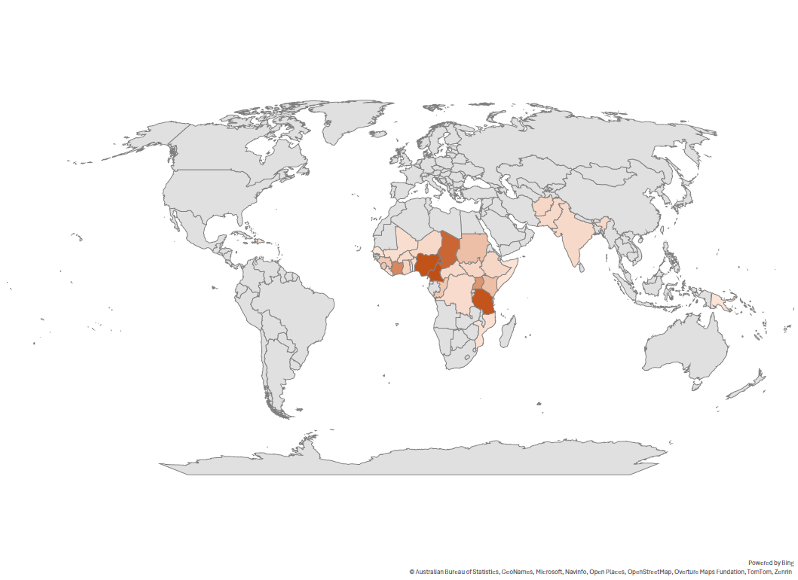
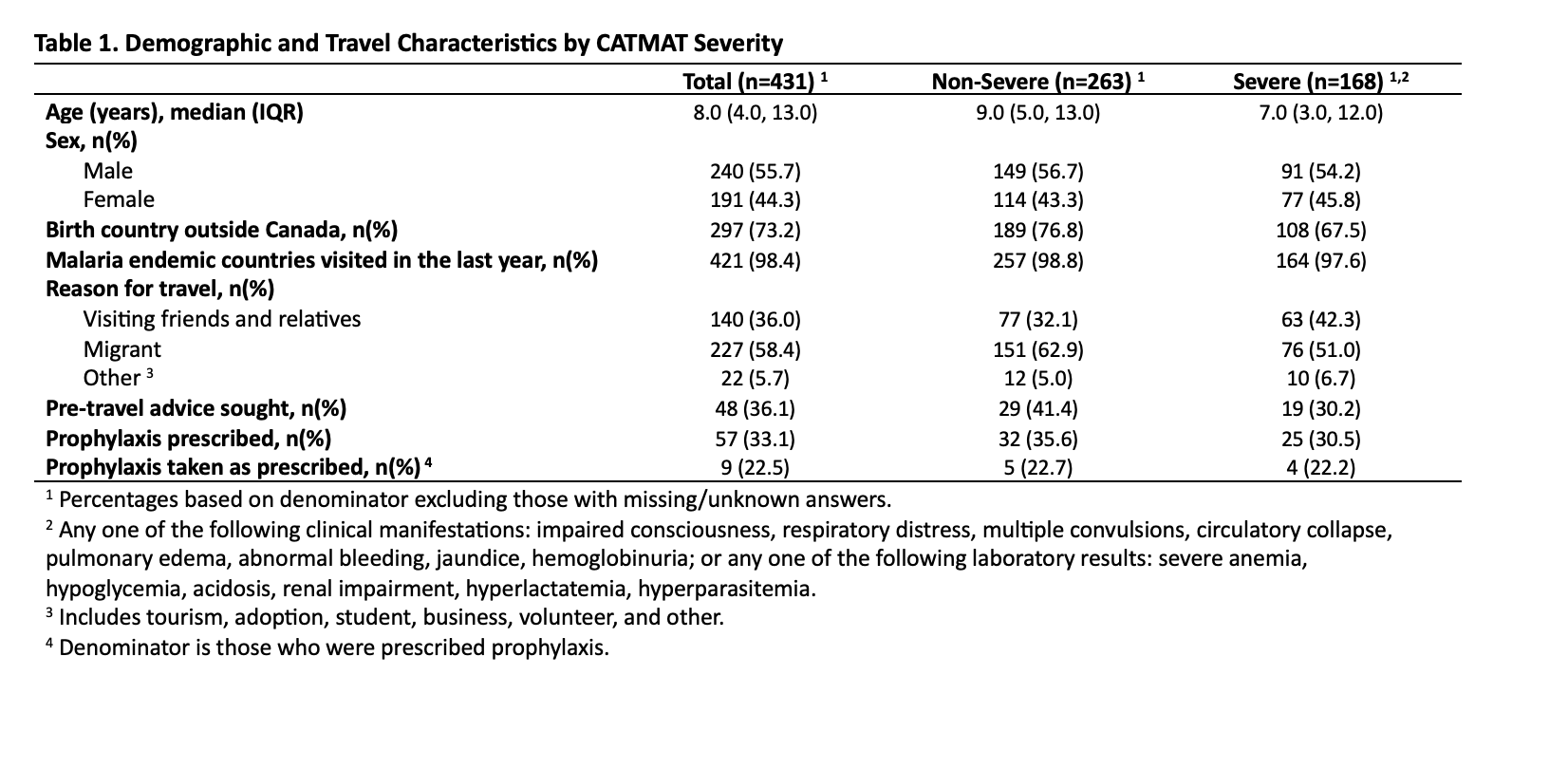
Background: Malaria remains a major global cause of childhood illness and death, yet Canadian pediatric data on its burden and outcomes are limited. Travel to and from endemic regions, particularly among visiting friends and relatives (VFR) and newcomer families, poses ongoing risk. COVID-19-related travel restrictions may have altered trends. Objective: To describe the burden, epidemiology, clinical features and outcomes of malaria in Canadian children (2014-2023) and assess the impact of pandemic-related travel restrictions. Design/Methods: Retrospective multicenter review of children < 18 years admitted with laboratory-confirmed malaria to 11 tertiary pediatric hospitals in the Pediatric Investigators Collaborative Network on Infections in Canada (PICNIC), 2014-2023. Data included demographics, travel history, Plasmodium species, diagnostics, management, complications, and outcomes. Trends were compared across pre-pandemic (2014-2019), pandemic (2020-2021), and post-pandemic (2022-2023) periods. Results: Among 431 hospitalized children (55.7% male; median age 8 years), 297 (73.2%) were born outside Canada and 421 (98.4%) had recent travel to endemic countries, primarily sub-Saharan Africa. One transfusion-acquired case occurred without travel. Travel reasons were refugees/newcomers (n=227, 58.4%), VFR (n=140, 38.1%), and other (n=22, 5.7%). Pre-travel health advice was documented in 48 (36.1%), chemoprophylaxis in 57 (33.1%), with 9 (22.5%) adherent. Forty-seven patients (11%) had a prior emergency visit before diagnosis, underscoring missed presentations. P. falciparum predominated (n=365, 84.7%), followed by P. vivax (n=20, 4.6%) and mixed infections (n=16, 3.7%). Severe malaria occurred in 168 (39.0%); 61 (14.2%) required intensive care. Artesunate was used in 160 patients (38.5%), with delayed hemolysis in 8 (5.4%). One unrelated death occurred. Cases fell during pandemic-related travel restrictions and rebounded post-2022. Acute kidney injury occurred in 2 patients of 38 patients (5.3%) with elevated creatinine by Committee to Advise on Tropical Medicine and Travel (CATMAT) and 22 (57.9%) by Kidney Disease: Improving Global Outcomes (KDIGO) criteria. P. falciparum infection was the only significant predictor of severe malaria.
Conclusion(s): Pediatric malaria in Canada mainly affects children with travel from sub-Saharan Africa, particularly VFR and newcomers and carries substantial morbidity. Pandemic travel restrictions temporarily reduced incidence. Findings support pediatric-focused guidance using KDIGO-based AKI criteria, enhanced pre-travel prevention and education for front line workers.
Table 1. Demographic and Travel Characteristics by CATMAT Severity
Table 2. Diagnostic Modality, Treatment, and Outcomes by The Committee to Advise on Tropical Medicine and Travel (CATMAT) Severity
Figure 1. Malaria-endemic countries recently visited










.png)