711 - TEEEN® Program: A platform for medical student training in pediatric obesity
Saturday, April 25, 2026
3:30pm - 5:45pm ET
Publication Number: 2694.711
Astia Innis, University of Connecticut, Hartford, CT, United States; Eva J.. Farkas, Tufts University School of Medicine, Portland, ME, United States; Kailynn M. Barton, Tufts University School of Medicine, Cambridge, MA, United States; Kyle M. Monahan, Tufts University, Medford, MA, United States; Ryan Veiga, Tufts University, Cambridge, MA, United States; Shirley Gonzalez, Tufts University School of Medicine, Natick, MA, United States
Assistant Clinical Professor Tufts University School of Medicine Natick, Massachusetts, United States
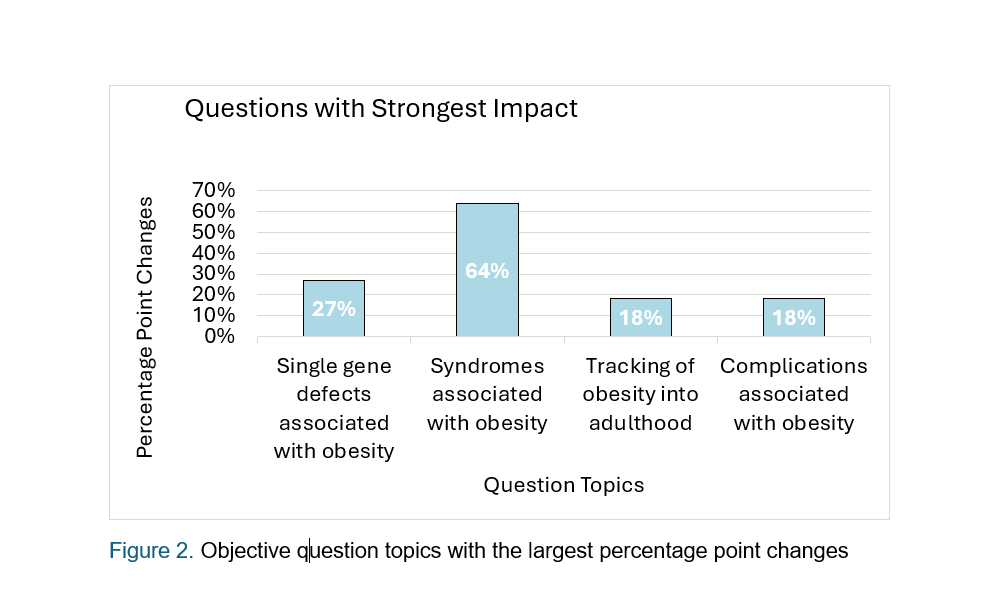
Background: Pediatric obesity and related comorbidities such as Type 2 diabetes continue to rise worldwide. Limited training in pediatric obesity within medical curricula hinders clinicians' ability to manage this condition effectively. The TEEEN® (Teen Empowerment, Education, Exercise, and Nutrition) program is a monthly, family-based initiative in which medical student volunteers promote healthy lifestyles in at-risk youth through social cognitive theory, play-based learning, physical activity, motivational interviewing, and cooking lessons. The program supplements medical education with experiential learning in pediatric obesity. Objective: This study assessed knowledge acquisition and changes in confidence in counseling and motivational interviewing among medical student participants. Design/Methods: Medical students were invited to participate as program leaders. The project included a lecture on pediatric obesity by an Obesity Medicine Specialist and at least 18 months (≥4 sessions) of TEEEN® program participation. Pre/post surveys evaluated (1) knowledge of pediatric obesity and (2) self-reported comfort in counseling families. Analyses used McNemar's test for objective knowledge and Wilcoxon signed-rank test for self-reported comfort (p < 0.05). The study was approved as exempt by the St. Elizabeth's Medical Center IRB. Results: Eleven medical students participated between 2018-2024, averaging 13 sessions over 1.8 years. All but one question showed improvement or no change. In some cases, the lack of observed impact was likely due to high pre-intervention knowledge scores. Significant improvement was found for question 6 (p=0.023) Figure 1. The largest percent-point gains occurred for single gene defects (27%), syndromic obesity (64%), tracking into adulthood (18%), and obesity complications (18%) Figure 2. For subjective items, significant improvement was noted for questions 1-5 Figure 3. All participants reported that the program enhanced their understanding of pediatric obesity beyond clinic and classroom learning.
Conclusion(s): Comprehensive pediatric obesity education is essential to prepare future physicians for this public health challenge. Participation in the TEEEN® program was associated with improved knowledge, counseling confidence, and motivational interviewing skills, and increased comfort working with diverse families. Despite the small sample size, the TEEEN® program appears to be a promising model for strengthening undergraduate medical education in obesity. Future directions include refining content areas with limited improvement and assessing interest in working with underserved population.










.png)
.png)
