563 - Advanced Practice Provider Sedation Practice And Outcomes: A Report From The Pediatric Sedation Research Consortium
Saturday, April 25, 2026
3:30pm - 5:45pm ET
Publication Number: 2548.563
Juan Boriosi, University of Wisconsin-Madison, Madison, WI, United States; Christina H. Bryndzia, University of Wisconsin School of Medicine and Public Health, Madison, WI, United States; Megan Peters, University of Wisconsin School of Medicine and Public Health, Madison, WI, United States; Peggy Dorr, University of Maryland Medical Center, Mount Airy, MD, United States
Associate Professor of Pediatrics University of Wisconsin-Madison Madison, Wisconsin, United States
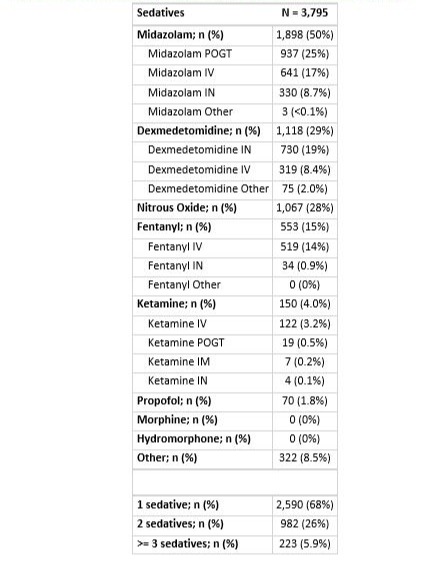
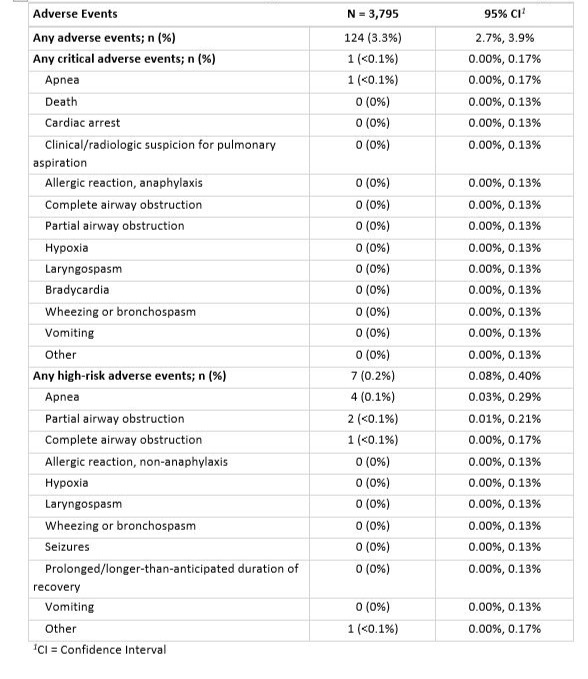
Background: There is a demand for sedation providers proficient in pediatric procedural sedation (PPS). Objective: to describe the current practice of PPS for procedures outside the operating room (OR) by advanced practice providers (APP) using data from the Pediatric Sedation Research Consortium (PSRC). Design/Methods: This is a study of a prospective data collection of natural airway cases with patient age less than 18 years, where the responsible provider is an APP, from April 27, 2020, to July 31, 2024. We excluded cases performed in the OR and/or using inhaled anesthetics other than nitrous oxide. Descriptive statistics, adverse events, and interventions were reported. We surveyed site investigators of all institutions that contributed APP cases to the PSRC database to further define APP practice. This study was determined exempt human subject by the IRB. Results: Of the 103,547 cases reviewed, 3,795 (3.6%) met inclusion criteria (table 1). Median age was 6 years (IQR 2,11) and 49% were male. Ninety-five percent of cases were ASA status 1-2. The most common primary reason for the procedure was renal (21%) and the most common procedure was radiologic (24%). Most procedures took place in a sedation unit (76%). The most common sedatives administered were midazolam (50%), dexmedetomidine (29%), and nitrous oxide (28%) (table 2). Propofol was used in infrequently (1.8%). Cases with any adverse events, any high-risk adverse events, and any critical adverse events were infrequent, 3.3%, 0.2%, and 0.1%, respectively (table 3). Only 0.4% of cases were unable to be completed. The APP practice survey was sent to twelve sites. Eight sites answered the survey (response rate 67%). Seven sites employ only nurse practitioners, and one site employs both nurse practitioners and physician assistants. All APPs independently (.i.e. without physician supervision) develop a sedation plan and provide minimal and moderate sedation. In five sites, APPs do not provide deep sedation, in two sites deep sedation is provided with physician supervision and in one site deep sedation is provided by APP without physician supervision.
Conclusion(s): Although APPs were the sedation providers in a minority of cases, the data demonstrate safe and effective sedation practice by this provider group with a very low rate of adverse events. APP most commonly provide minimal or moderate sedation independent from physician supervision.










.jpg)