








Neonatal Less Than 25 weeks
Session: Neonatal Less Than 25 Weeks 1: Physiology and Management

Madison Pelton, MD (she/her/hers)
Resident
University of Washington School of Medicine
Seattle, Washington, United States
.png) Table 1. IVH (Intraventricular Hemorrhage); CRIB - II (Clinical Risk Index for Babies); PDA (Patent Ductus Arteriosus); pRBC (Packed Red Blood Cell), PVL (Periventricular Leukomalacia).
Table 1. IVH (Intraventricular Hemorrhage); CRIB - II (Clinical Risk Index for Babies); PDA (Patent Ductus Arteriosus); pRBC (Packed Red Blood Cell), PVL (Periventricular Leukomalacia).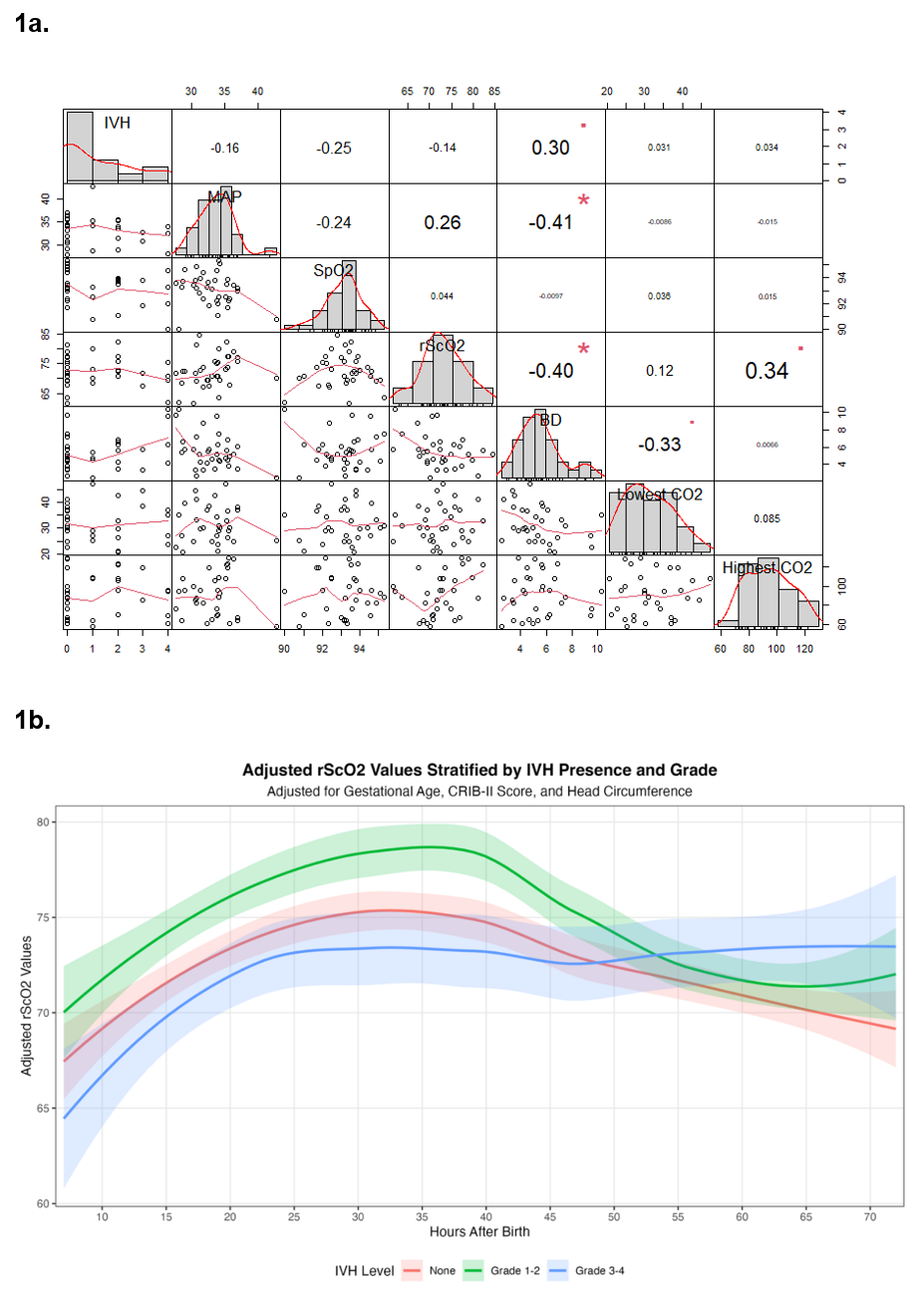 1a: Correlation matrix plot illustrates the relationship between hourly hemodynamic metrics and grade of IVH (Intraventricular Hemorrhage) (0-4) in the first 72 hours after birth. IVH (Intraventricular Hemorrhage); MAP, mean arterial pressure; SpO2, peripheral oxygenation; rScO2, regional cerebral oxygen saturation as measured by near-infrared spectroscopy; BD, base deficit; Lowest CO2 within first 72 hours, Highest CO2 within first 72 hours. *denotes significance p <0.05 , R values denoted positive or negative correlation 1b. rScO2 trends in all infants from 6-72 hours after birth stratified by presence and grade of IVH.
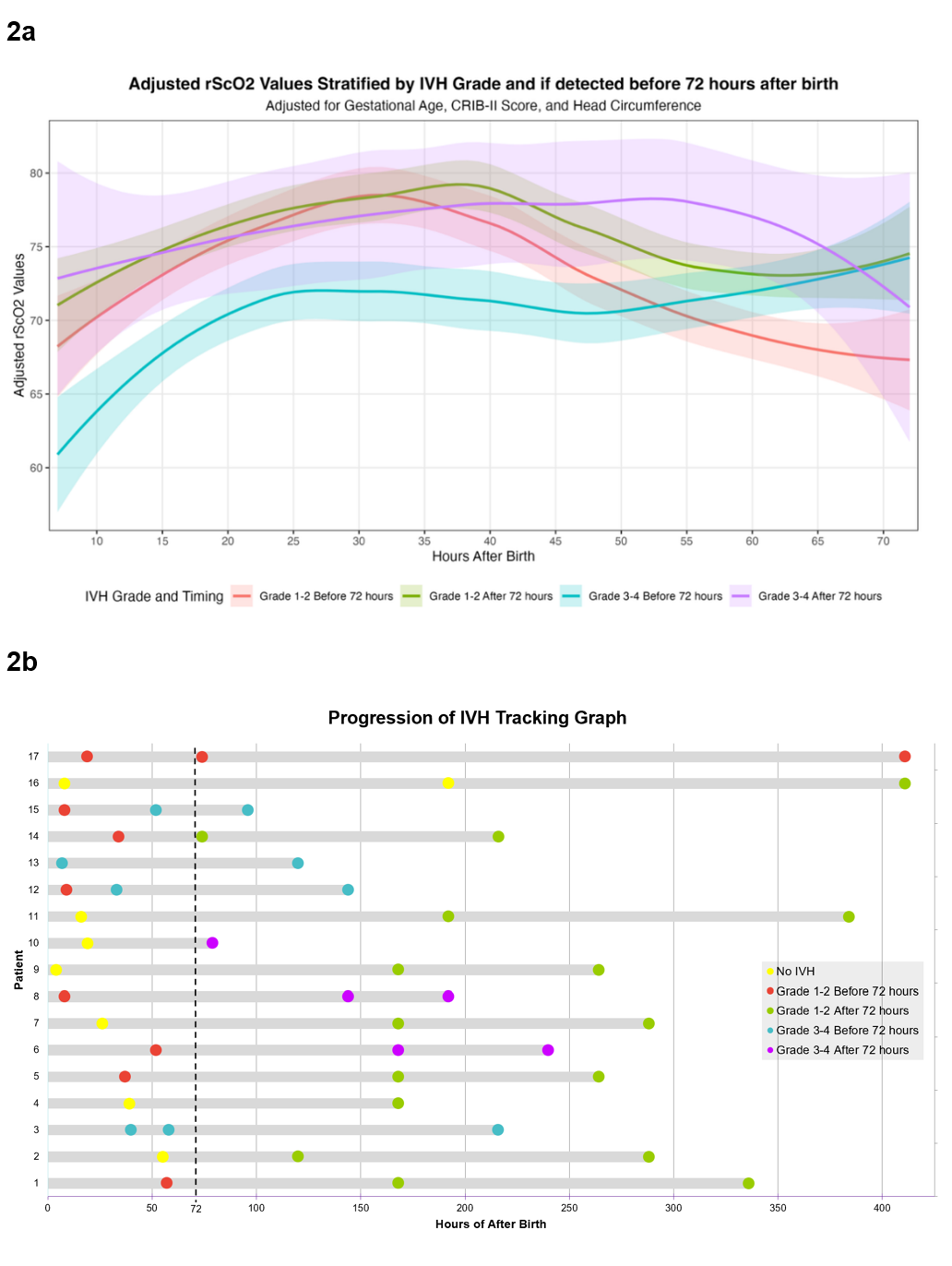 2a. rScO2 trajectories from 6-72 hours after birth in patients with IVH stratified by if the IVH occurred before or after 72 hours. 2b Tracking graph of evolution of IVH over time, legend indicating bleed before or after 72 hours of life. Hourly tracking for each patient included in the study that developed IVH during hospitalization. Each patient is represented by a horizontal row indicating the hours after birth when the cranial US was obtained. Each circular marker indicates when the cranial ultrasound was performed and the grade of IVH. Note, for patients 3, 12, 13, 15, and 17 there was no new or progressed bleed after 72 hours so the color indicating when the bleed occurred does not change. These points are included in the graph to indicate that further ultrasounds were obtained and showed the same grade of IVH that was detected < 72 hours after birth. Hourly data was winsorized to the 88th percentile to account for outliers.