375 - Using Best-Worst Scaling to identify barriers to inpatient vaccine delivery at 10 US Children’s Hospitals
Saturday, April 25, 2026
3:30pm - 5:45pm ET
Publication Number: 2364.375
Mersine A. Bryan, University of Washington School of Medicine, Seattle, WA, United States; Alexandra J.. Mihalek, Children’s Hospital of Orange County, Long Beach, CA, United States; Chuan Zhou, Seattle Children's Research Institute, Seattle, WA, United States; Sanyukta Desai, University of Texas at Austin Dell Medical School, Austin, TX, United States; Susan Wu, Children's Hospital Los Angeles/USC Keck School of Medicine, Los Angeles, CA, United States; Erin Avondet, University of Utah School of Medicine, Salt Lake City, UT, United States; Nathan M. Money, University of Utah School of Medicine, Salt Lake City, UT, United States; Elizabeth O. Mertens, Medical College of Wisconsin, Milwaukee, WI, United States; Rena Kasick, Nationwide Children's Hospital, Columbus, OH, United States; Sumeet Banker, Columbia University Vagelos College of Physicians and Surgeons, New York, NY, United States; Rachel Solstad, University of Utah School of Medicine, Salt Lake City, UT, United States; Daniel Williams, Medical University of South Carolina College of Medicine, Charleston, SC, United States; Sunita A. Hemani, Emory University School of Medicine/Children’s Healthcare of Atlanta, Atlanta, GA, United States; Catherine S.. Forster, University of Pittsburgh School of Medicine, Pittsburgh, PA, United States; Chris Bonafide, Childrens Hospital of Philadelphia, Philadelphia, PA, United States; Douglas J.. Opel, Seattle Children's Research Institute, Seattle, WA, United States
Associate Professor University of Washington School of Medicine Seattle, Washington, United States
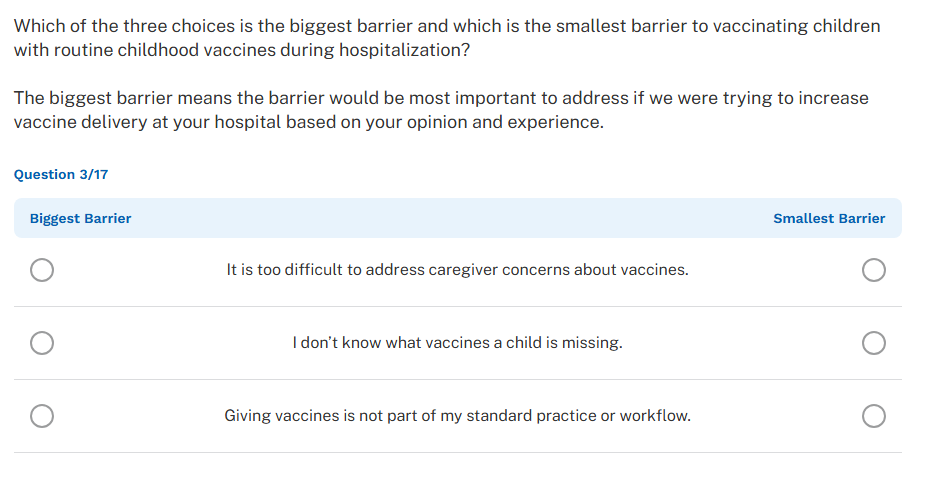
Background: Hospitalized children are often not up-to-date on vaccines. Despite this, vaccines are administered in only 2% of hospitalizations. Objective: To identify important and modifiable clinician-identified implementation barriers to vaccine delivery during hospitalization. Design/Methods: We conducted a survey of nurses, pharmacists and hospitalists at 10 US children's hospitals. We used the Consolidated Framework for Implementation Research to identify implementation determinants that were modifiable barriers for vaccine delivery. A list of 28 potential determinants was generated. Potential determinants were reviewed by an advisory panel and pre-tested using cognitive interviews with 6 individuals from 4 sites to remove overlapping or less modifiable determinants. The final survey included 17 potential determinants. We used a survey method, Best-Worst Scaling (BWS), to identify which barriers participants rated as most and least important. A factorial experimental design was used to systematically generate the combinations of attributes and levels presented to participants. To minimize cognitive burden and enhance response quality, each BWS task (or "choice set") included three attributes.(Figure 1) Sawtooth software randomized BWS tasks for each participant. We collected participants' demographic characteristics. The survey was pilot tested in 16 eligible individuals from 6 sites. We administered the survey to randomly selected participants from rosters of eligible nurses, pharmacists and hospitalists. We quantified the relative importance of each barrier using preference scores (PS) and 95% confidence intervals (CIs) based on Hierarchical Bayesian regression analysis. A higher preference score represents that the attribute was selected as the most important barrier more frequently in the choice sets. Results: 91 people completed the survey, 52 physicians, 17 nurses and 21 pharmacists. Most participants were female (76%) and White (71%). The three top ranked barriers were: "Caregivers do not want vaccines during hospitalization" (PS 12.1 [95% CI 11.2, 12,8]), "I have more urgent tasks to do for my patients than giving vaccines" (PS 9.4 [95% CI 8.6,10.2]), and "It is too difficult to address caregiver concerns about vaccines." (PS 9.0 [95% CI 8.1,9.8]).(Table 1, Figure 2)
Conclusion(s): In a survey of multidisciplinary clinicians, the most important barriers to vaccine delivery were related to caregiver vaccine concerns and workflow processes (e.g. priority and urgency). Addressing these key implementation barriers for inpatient clinicians is necessary to develop effective vaccine delivery programs in hospitals.
Figure 1: Example of Best-Worst Scaling Item from Survey
Table 1: Ranking of Implementation Barriers using Best-Worst scaling from most important to least important barrier.
Figure 2: Ranking of Implementation Barriers using Best-Worst scaling from most important to least important barrier.










.png)
.png)
