367 - Patient and Clinician Factors Associated with Antibiotic Treatment for Acute Otitis Media in Children Presenting with a Respiratory Illness
Saturday, April 25, 2026
3:30pm - 5:45pm ET
Publication Number: 2356.367
Louis Vernacchio, Pediatric Physicians' Organization at Boston Children's, Wellesley, MA, United States; Jonathan Hatoun, Pediatric Physicians' Organization at Children's, Boston, MA, United States; Laura B. Patane, Boston Childrens' Hospital, Cambridge, MA, United States
Director of Research Pediatric Physicians' Organization at Boston Children's Hospital Wellesley, Massachusetts, United States
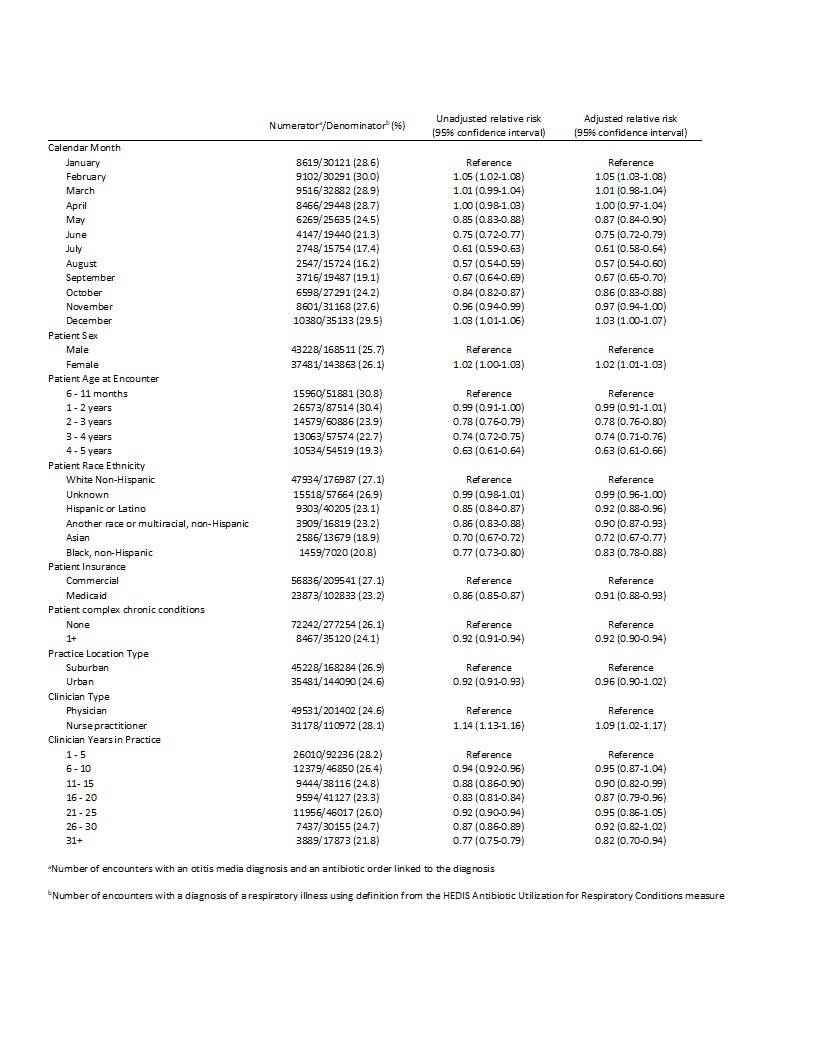
Background: Otitis media (OM) is the most common reason for antibiotic prescriptions for U.S. children. We previously defined a measure of the propensity of clinicians to diagnose OM and treat it with antibiotics, called the Otitis Media Treatment Index (OMTI), which calculates the proportion of encounters for a respiratory illness among children 6-59 months of age in which the clinician diagnoses OM and prescribes an antibiotic for it. We previously determined that there is wide variability-greater than 10-fold-in this measure among individual pediatric primary care clinicians. Objective: To define patient and clinician predictors of the OMTI using two years of data from a large statewide primary care pediatric population. Design/Methods: We analyzed factors associated with the OMTI among 485 pediatric primary care clinicians from the Pediatric Physicians' Organization at Children's, a pediatric primary care network of 80 practices in Massachusetts. Each included clinician had at least 100 qualifying encounters in both 2023 and in 2024. We performed bivariable and multivariable logistic regressions to identify patient and clinician characteristics that corelate with the OMTI. For the regression analysis, the 2 years of data were combined with adjustment for month of the year, all other variables in the model, and repeated observations by individual clinician. Results: The were 161,593 qualifying encounters in 2023, 42,613 of which involved an OM diagnosis with an antibiotic prescribed for it, yielding an OMTI of 26.4%; in 2024, the OMTI was 38,096/150,781 (25.3%). Among patient characteristics, age under 2 years, commercial insurance, female sex, White or unknown race/ethnicity, and the absence of any complex chronic conditions were each associated with higher risk of being diagnosed and treated with antibiotics for OM (Table). Among clinician characteristics, nurse practitioners were more likely to diagnose OM and treat with antibiotics compared to physicians in our sample.
Conclusion(s): Using the OMTI, a measure of the proportion of children 6-59 months of age presenting to primary care with a respiratory illness who are diagnosed with OM and treated with an antibiotic for it, this study defines patient and clinician characteristics associated with the propensity to diagnose and treat OM. This information can be used to guide quality improvement efforts for OM-related antibiotic stewardship.
Association of patient and clinician factors with Otitis Media Treatment Index