255 - Beyond the Wound: Secondary Victims of Pediatric Firearm Injury
Saturday, April 25, 2026
3:30pm - 5:45pm ET
Publication Number: 2245.255
Sheila Pahlavan, Children's Hospital Colorado, Denver, CO, United States; Mairead Dillon, University of Colorado School of Medicine, Denver, CO, United States; Alexandria Dulchavsky, Children's Hospital Colorado, Denver, CO, United States; Ryan Phillips, Memorial Health, Savannah, GA, United States; Jenny Stevens, Children's Hospital Colorado, Aurora, CO, United States; Maya Haasz, Children's Hospital Colorado, Aurora, CO, United States
Resident Physician Children's Hospital Colorado Denver, Colorado, United States
Background: Firearms are the leading cause of death among youth, yet studies of pediatric morbidity and mortality fail to fully capture their negative impact. Little is known about the impact of firearm injuries on families and communities (secondary victims), which may arise from knowing a victim, witnessing violence, or proximity to firearm violence. Objective: 1. To assess the impact of firearm violence on secondary victims as reported by patients and parents. 2. To compare patient and parent perceptions of secondary victims. Design/Methods: This secondary analysis drew from a prospective cohort study of pediatric patients treated at one of four Colorado trauma centers (2008-2020). Eligible participants presented with a firearm injury, were English-speaking, aged < 18 years at the time of injury, ≥8 years at survey start, and ≥5 months post-injury. The parent study assessed mental and physical health outcomes of pediatric firearm injured patients using validated tools. For this secondary analysis, participants were asked the open-ended question, "I am sure there were many people affected by your injury. Other than you/ your child, can you tell me who was affected (relationship to the child)." Qualitative responses were converted into categorical variables (sibling, friend, grandparent, etc.) and grouped by response type. Responses were compared by respondent type (patient vs. parent) and patient age ( < 18 vs. ≥18). Pearson's Chi-squared and Fisher's exact tests were used to assess associations, with p< 0.05 considered significant. Results: We included 17 patients with firearm injuries (7 < 18 years, 10 ≥18 years), and 20 parents (15 < 18 group, 5 ≥ 18 group). In both age groups, most participants identified family as secondary victims (95% of respondents). Parents more often reported siblings (75% vs 41%, p = 0.037), grandparents (45% vs. 5.9%, p = 0.010), and extended family (30% vs 0%, p = 0.022) as secondary victims. Within community, participants described coworkers, witnesses, and even perpetrators as secondary victims. There was no difference in parent vs. patient perceptions of community members as secondary victims (22%), and no difference between age groups for any analyses.
Conclusion(s): This pilot data demonstrates that the impact of firearm injury extends beyond the victim to families and communities. These findings highlight the need for family and community-centered approaches in prevention and recovery efforts. Prospective research in larger populations is needed to better identify secondary victims, the means to support them, and the way to leverage these relationships in prevention efforts.
Comparison of Parent and Patient Reports of Secondary Victims of Pediatric Firearm Injury * Indicates a significant difference (p <0.05) between groups.









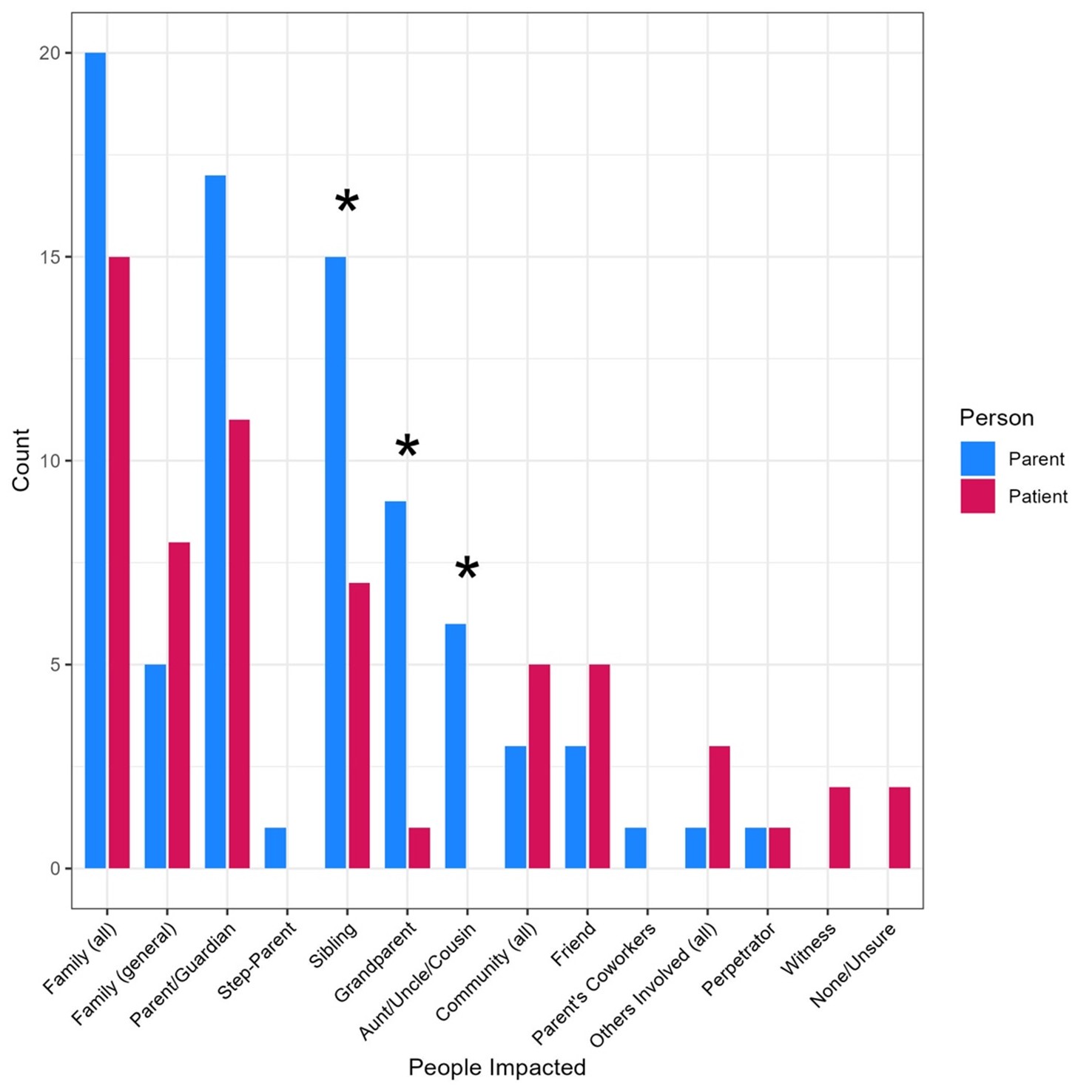 * Indicates a significant difference (p <0.05) between groups.