17 - Sudden Unexpected Infant Death: A Review of Previous Research and the Needed Path to Renewed Decline in the Post–COVID-19 Pandemic Era
Saturday, April 25, 2026
3:30pm - 5:45pm ET
Publication Number: 2014.17
Ayesha Khalid, Marshall University Joan C. Edwards School of Medicine, Huntington, WV, United States; Andrea Lauffer, Thomas Memorial Hospital-West Virginia University, South Charleston, WV, United States
Resident Physician Marshall University Joan C. Edwards School of Medicine Huntington, West Virginia, United States
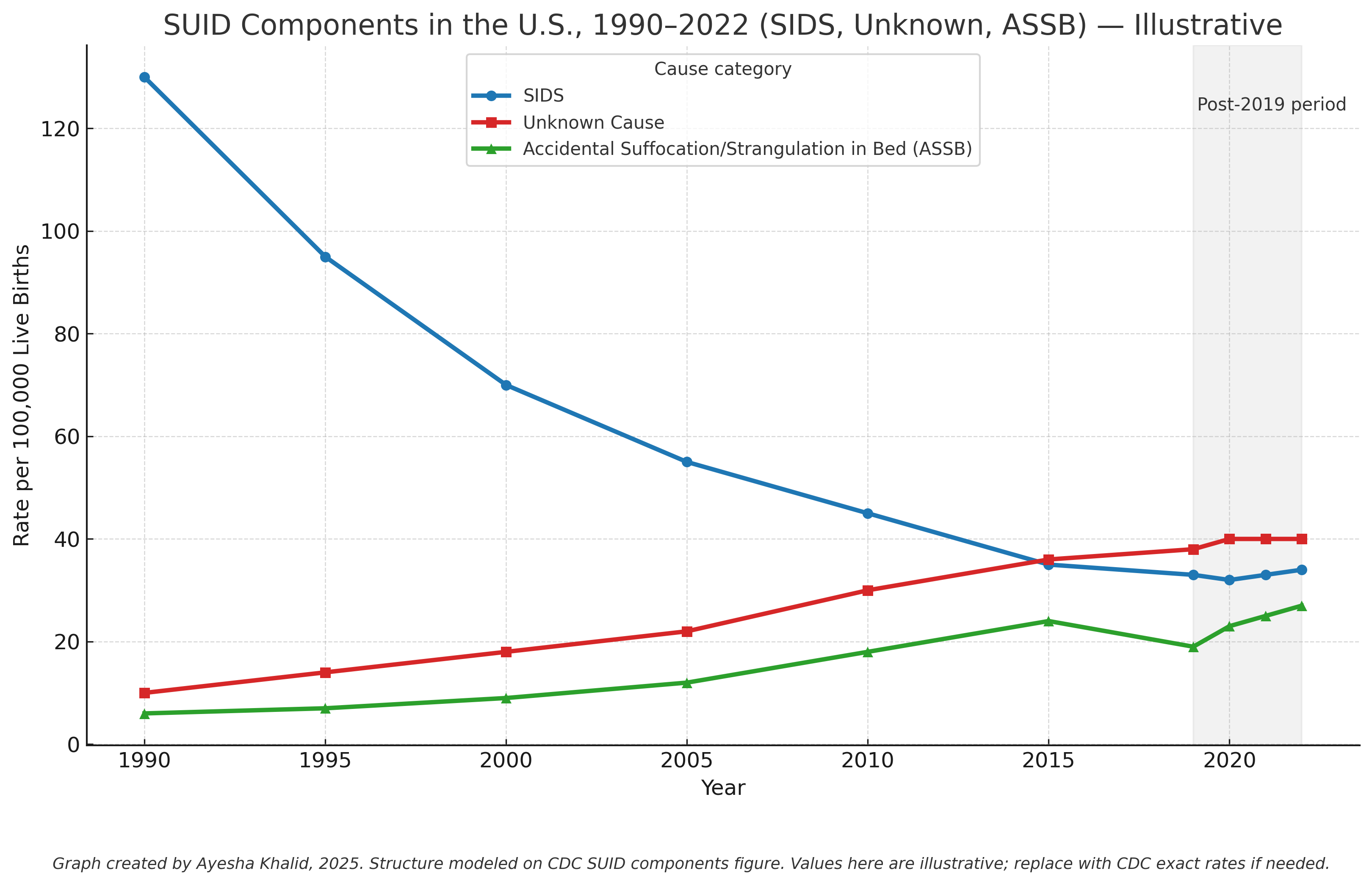
Background: According to data published in 2022, there are 3,700 sudden unexpected infant deaths (SUIDs) in the United States per year. After the 1990s decline, SUID rates plateaued, followed by an increase after 2019. SUIDs continue to be a health disparity among racial minority groups and those living in rural areas, with non-Hispanic Black and American Indian/Alaska Native infants experiencing the highest rates.The 2022 AAP policy reiterated core safe-sleep guidance, and the 2022 federal ban on inclined sleepers and crib bumpers may influence future trends. Objective: To summarize previously published research on SUIDs; the post-2019 increase; highlight racial, geographic, and socioeconomic disparities; outline variability in state rates and data systems; and identify research needs in biologic, genetic, environmental, and policy domains to support a renewed decline. Design/Methods: Synthesis of prior epidemiologic, meta-analysis and case-study research: vital records analyses (e.g., CDC ; NCHS linked birth/infant death data), ICD-10 W75 for ASSB (Accidental Suffocation and strangulation in bed), logistic and Join point analyses; meta-analytic work on serotonergic pathways; and a genetic case study/control analysis (SCN5A, SCN1Bb). Comparisons span pre- and post-COVID-19 eras, with attention to racial/ethnic groups, urban-rural status, and state-level variation. Policy and product changes (2022 bans) are noted as targets for evaluation. Results: National data were relatively stable from 2015-2019, then rose in 2020; monthly risk analyses of 2021 showed a 9-14% increase from pre-pandemic baseline and a 15% increase from 2019 to 2020 disproportionately affected NHB infants. In 2022, of 3,700 SUID cases, 1,529 were SIDS, 1,131 unknown causes, and 1,040 ASSB. Racial and geographic disparities persisted. Neonatal SUID rates did not decrease in parallel with post-neonatal rates. Meta-analytic evidence supports a role for serotonergic pathway deficiencies; genetic studies suggest variants may predispose but are not determinative, consistent with a multifactorial model.
Conclusion(s): SUID rates have shifted from plateau to post-2019 increase with widening racial and geographic gaps. Parallel advances in neurobiology and genomics support a multifactorial risk model. Priorities include uniform data tracking and standardized investigations to reduce misclassification, evaluation of 2022 product bans, equity-focused prevention in high-risk groups, and targeted research on biologic, genetic, environmental and social determinants. Ethical, family-centered approaches are essential to enable participation while protecting privacy.