716 - Medical Student Self-Assessment Using the Accreditation Council of Graduate Medical Education (ACGME) Clinician-Educator (CE) Milestones During an Educator Curriculum
Saturday, April 25, 2026
3:30pm - 5:45pm ET
Publication Number: 2699.716
Nicolle Fernández. Dyess, University of Colorado School of Medicine, Denver, CO, United States; Danielle Miller, University of Colorado School of Medicine, Denver, CO, United States; Chad Stickrath, University of Colorado School of Medicine, Aurora, CO, United States
Assistant Professor University of Colorado School of Medicine Denver, Colorado, United States
Background: The ACGME published the clinician-educator (CE) milestones in 2022 as a framework for CE faculty self-assessment. It is unknown whether these milestones seem relevant to medical students or how they self-assess on them.
At the University of Colorado, post-clerkship third-year medical students match into a non-clinical, leadership trail, one of which is in medical education. Each trail is a 12-month curriculum comprised of two, 2-week, in-person immersions within an asynchronous, longitudinal curriculum. Objective: We performed a pragmatic, exploratory study addressing the following questions: 1) Do students enrolled in the medical education trail believe the milestones are relevant to students?, 2) How do students self-assess on the milestones?, and 3) What rationale do students submit for their self-assessments?
We hypothesized that 1) the milestones would be relevant to students, 2) there would be a statistically significant pre/post difference in each milestone, and 3) students would submit the activities they completed during the trail as rationale. Design/Methods: The ACGME CE Supplemental Guide Template was modified into a pre/post self-assessment worksheet completed at the end of the trail. Whenever the students self-assessed at a level greater than "Not Yet Completed Level 1," they were asked to describe their evidence for choosing that level. They were also asked to describe each milestone's relevance to students. Subsequently, the students completed 1:1 meetings with a trail director to discuss the activity.
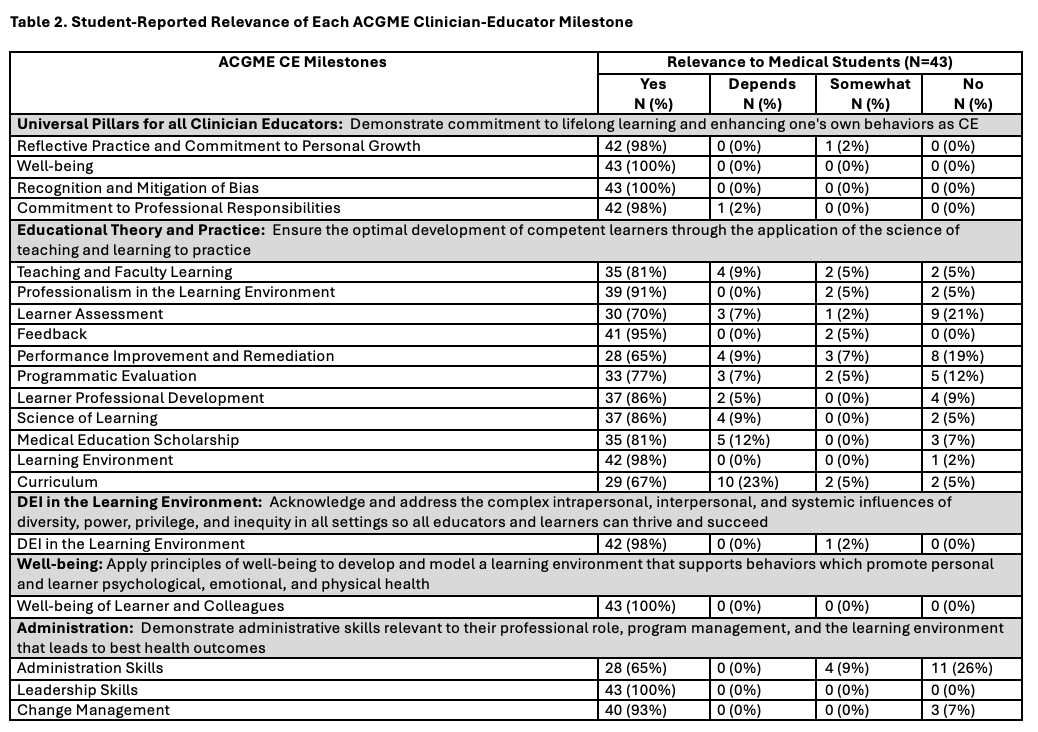
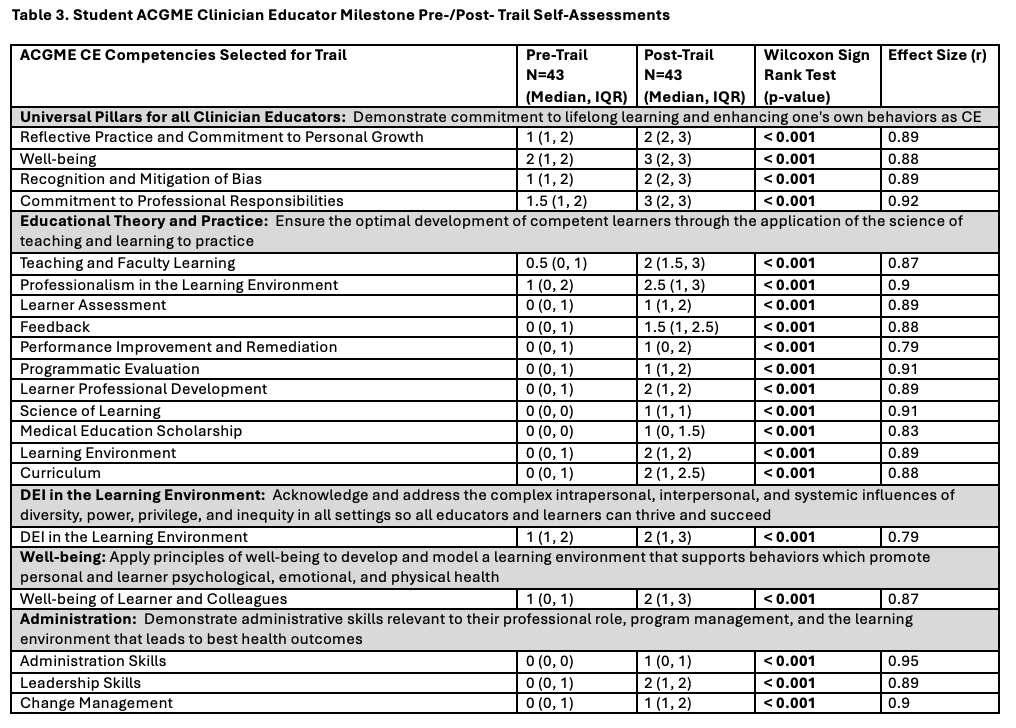
The student cohort and relevance designations were characterized using descriptive statistics. Wilcoxon sign rank tests were used to compare pre/post self-assessments. Results: Forty-five students completed the medical education trail in 2025 (Table 1). Most students felt the ACGME CE milestones were relevant (Table 2). The least relevant milestones were administration skills, learner assessment, performance improvement and remediation, and programmatic evaluation. Pre/post milestone self-assessments for each sub-competency increased significantly (all p-values < 0.001) with large effect sizes (Table 3). Most of the rationale for self-assessments was comprised of activities performed for the trail. However, some students submitted evidence of activities performed prior to the trail.
Conclusion(s): Medical students believe the ACGME CE milestones are relevant to medical students interested in pursuing CE careers. This framework should be considered both as a tool for self-assessment and reflection in this population and a tool for program evaluation.
Table 1: Future Leaders in Medical Education Trail Student Demographics
Table 2. Student-Reported Relevance of Each ACGME Clinician-Educator Milestone










.png)