256 - Caregiver Motivations and Firearm Safety: A Mixed Methods Analysis from Texas
Saturday, April 25, 2026
3:30pm - 5:45pm ET
Publication Number: 2246.256
Kelly A. Pretorius, Baylor College of Medicine, Austin, TX, United States; Mike Henson-Garcia, University of Michigan, Austin, TX, United States; Krista Haines, Duke, Durham, NC, United States; Corrie E. Chumpitazi, Duke University School of Medicine, Durham, NC, United States; Wesley U. Okafor, Baylor College of Medicine, Houston, TX, United States; Maha J.. Khalil, Baylor College of Medicine, Houston, TX, United States; Elizabeth A. Camp, Baylor College of Medicine, Houston, TX, United States; Sampayo M. Esther, Baylor College of Medicine, Houston, TX, United States
Assistant Professor Baylor College of Medicine Austin, Texas, United States
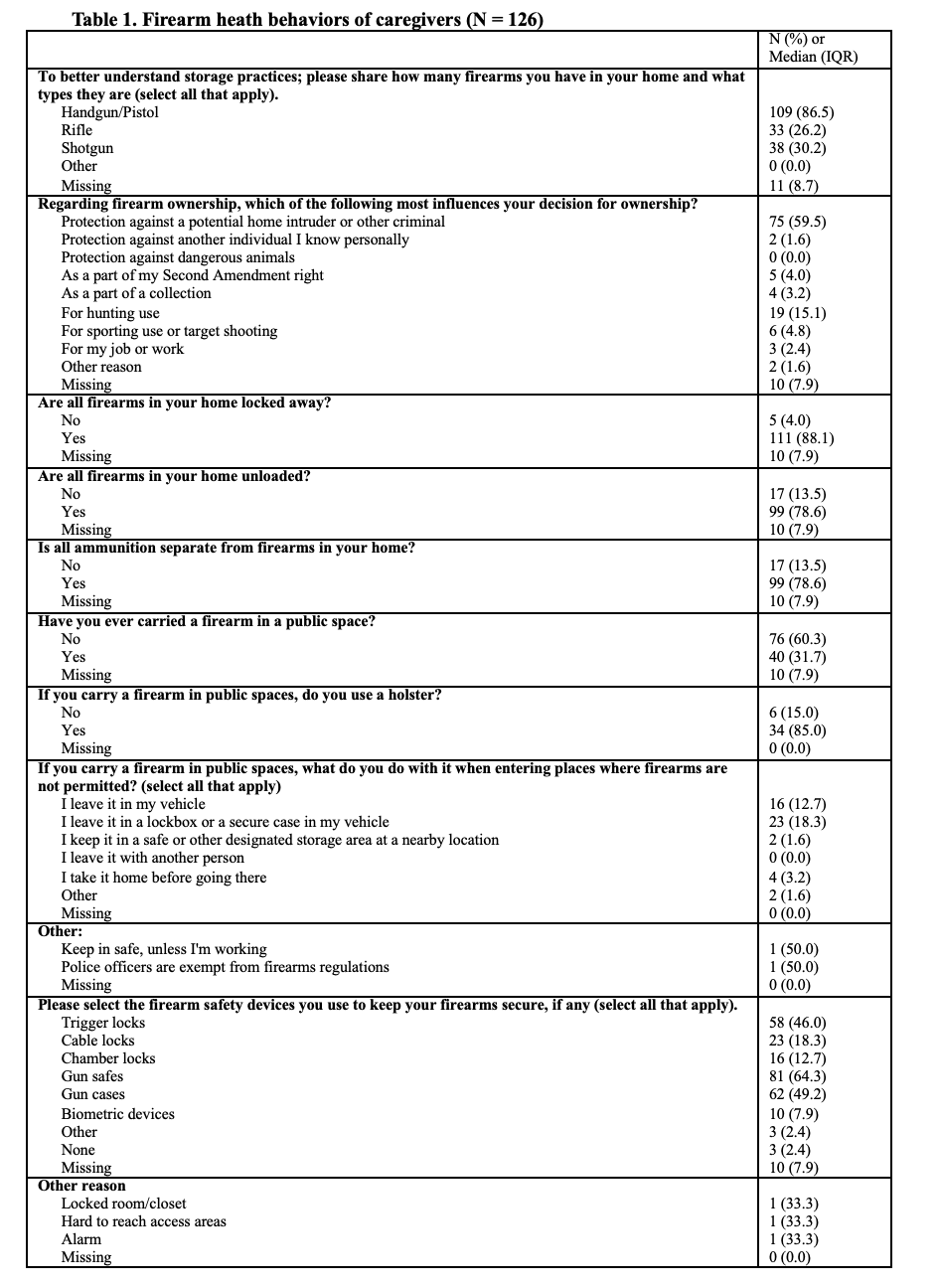
Background: Firearm-related fatalities are the leading cause of death among U.S. children and adolescents. Although secure storage markedly reduces pediatric injury and death, millions of children live in homes with loaded and unlocked firearms. Recently the pediatric firearm death rate rose 46%, with notable clusters in southern states. Given regional differences in firearm laws and culture, research in Texas is particularly warranted. Objective: To examine the motivations, influences, and storage practices of firearm-owning caregivers in Texas using a mixed methods design. Design/Methods: This study was approved by the Baylor College of Medicine IRB. The survey, grounded in the Transactional Model of Stress and Coping, was revised based on feedback from community firearm experts and stakeholders to ensure cultural relevance. Using convenience sampling, we recruited firearm-owning caregivers seeking care for their child in an urban, freestanding Children's Hospital Emergency Department. Eligible participants completed an electronic exploratory survey available in English and Spanish. Preliminary results from surveys were collected from May through October 2025 (Table 1). Enrollment and qualitative interviews are ongoing. Results: To date, 432 participants were approached and screened for eligibility. 274 reported not owning a firearm, and 126 completed the survey. Participant demographics are displayed in Table 2. Among participants, 114 (90.5%) reported using safety devices on their firearms. A total of 109 (86.5%) owned a handgun/pistol, 38 (30.2%) a shotgun, and 33 (26.2%) a rifle. The majority (59.5%) indicated that protection was the primary reason for firearm ownership. Regarding firearm storage practices, 111 (88.1%) reported their firearms were locked away, 99 (78.6%) unloaded, and 99 (78.6%) reported ammunition being stored separately. The most used safety device was gun safes (64.3%), followed by gun cases (49.2%). 40 (31.7%) persons reported carrying their firearm in a public space, and of those, 34 (85%) used a holster. 66.7% of participants said they had discussed firearm safety with children in their home.
Conclusion(s): Survey participants represented a diverse group of caregivers who primarily owned firearms for protection and generally practiced safe storage. However, a notable proportion carried firearms in public, highlighting the need for education on safe carrying practices. Two-thirds reported discussing firearm safety with their children, suggesting openness to safety dialogue and opportunities for clinicians and public health professionals to reinforce firearm safety practices.









.png)
