237 - Medical Neglect in Canada: A Cross-Sectional Study Exploring Drivers of Substantiation Using a National Dataset
Saturday, April 25, 2026
3:30pm - 5:45pm ET
Publication Number: 2228.237
Nicolette Joh-Carnella, University of Toronto Temerty Faculty of Medicine, Toronto, ON, Canada; Kate Allan, University of Toronto, Toronto, ON, Canada; Ashley vandermorris, Division of Adolescent Medicine, SickKids, Toronto, ON, Canada; Kristin Denault, McGill University, Montreal, PQ, Canada; Barbara Fallon, Factor-Inwentash Faculty of Social Work, University of Toronto, Toronto, ON, Canada
Pediatric Resident University of Toronto Temerty Faculty of Medicine Toronto, Ontario, Canada
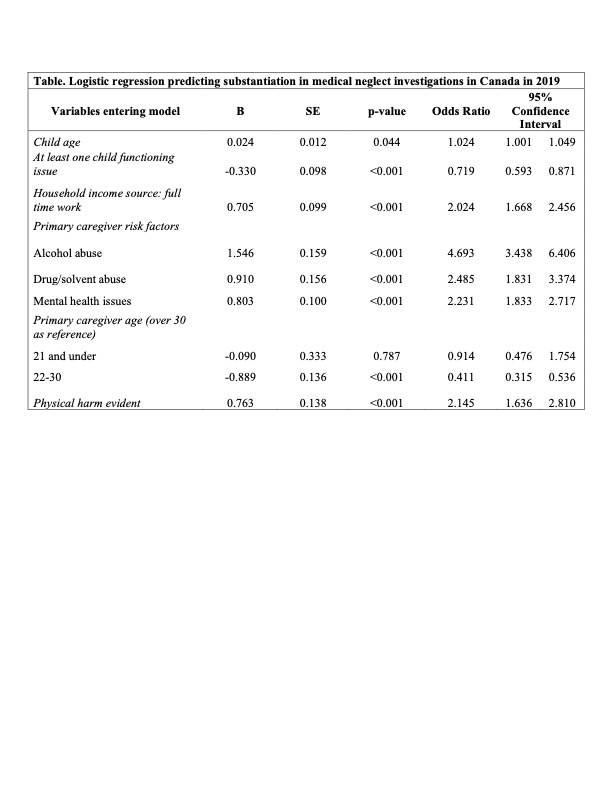
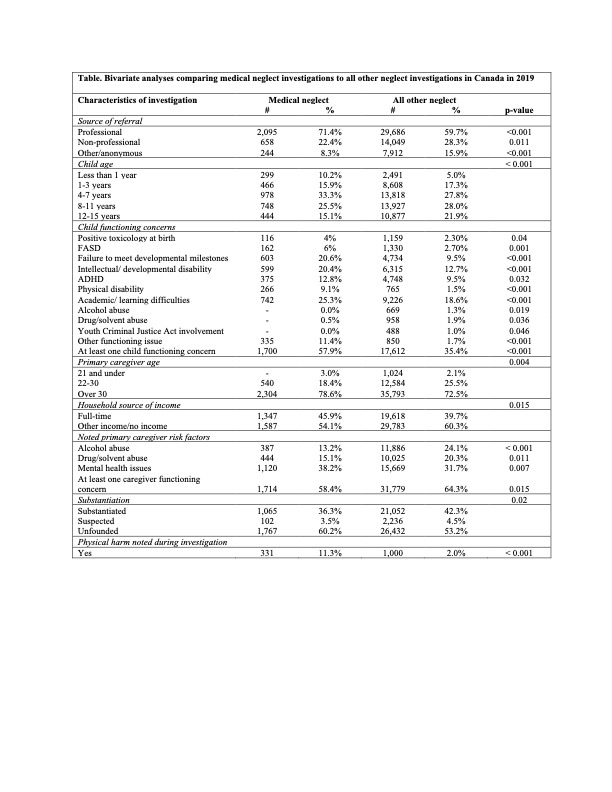
Background: Medical neglect is multifactorial and exists within the context of barriers to healthcare, caregiver health literacy challenges, other caregiver risk factors, and healthcare provider-caregiver relationship dynamics. This study explores child welfare investigations for medical neglect in Canada. Objective: The most recent national-level dataset with information on child welfare investigations in Canada (the Canadian Incidence Study of Reported Child Abuse and Neglect 2019 [CIS-2019]) was used to answer the following research questions: (1) What are the household, family, child, and case characteristics in child welfare investigations for medical neglect compared with all other neglect investigations in Canada? and (2) Which characteristics are associated with substantiation of medical neglect in Canadian child welfare investigations? Design/Methods: A multi-staged sampling design was used to select a representative sample of child welfare agencies, and data were collected over a 3-month sampling period. Complex survey design weights were used to derive an annual estimate of maltreatment-related investigations conducted in the country (299,171 investigations involving children aged 0-15 years). The current study specifically examined the estimated 2,934 investigations for medical neglect in the CIS-2019. Bivariate analyses compared medical neglect investigations with investigations involving other forms of neglect, and a binary logistic regression identified characteristics associated with substantiation of medical neglect. Results: Compared to other neglect investigations, medical neglect investigations were more likely to involve children less than one year old, caregivers under 21 years old and over 30 years old, households whose primary source of income was full-time work, primary caregivers with mental health concerns, and children with at least one functioning concern. Medical neglect investigations in which the primary caregiver had noted alcohol abuse (OR=4.693, p< 0.001), drug/solvent abuse (OR=2.484, p< 0.001), or mental health concerns (OR=2.231, p< 0.001) were more likely to be substantiated.
Conclusion(s): Medical neglect is a child welfare concern with potentially dire consequences. We demonstrate that substantiated cases of medical neglect in Canada arise within the context of complex caregiver and child factors. Early collaboration, preventative efforts, and supportive relationships between families and their healthcare teams could enhance adherence to medical recommendations and mitigate child harm.
Bivariate analyses comparing medical neglect investigations to all other neglect investigations in Canada in 2019 - Estimate < 100 investigations
Logistic regression predicting substantiation in medical neglect investigations in Canada in 2019










 - Estimate < 100 investigations