633 - Comparison of Two Methods for Measuring Left Cardiac Output in Very Preterm Infants
Saturday, April 25, 2026
3:30pm - 5:45pm ET
Publication Number: 2618.633
Aseel Sa'deh, Iwk Health Center, Dalhousie University, halifax, NS, Canada; Souvik Mitra, University of British Columbia Faculty of Medicine, Vancouver, BC, Canada; Jayani Abeysekera, Dalhousie University Faculty of Medicine, Halifax, NS, Canada; Tim Disher, IWK Health Centre, West Porters Lake, NS, Canada; Tara R. Hatfield, IWK Health, Halifax, NS, Canada; Ahmed Galal, Dalhousie University, Halifax, NS, Canada; Christy G. Woolcott, Dalhousie University Faculty of Medicine, Halifax, NS, Canada; Walid El-Naggar, Dalhousie University, Halifax, NS, Canada
Professor of Pediatrics Dalhousie University Halifax, Nova Scotia, Canada
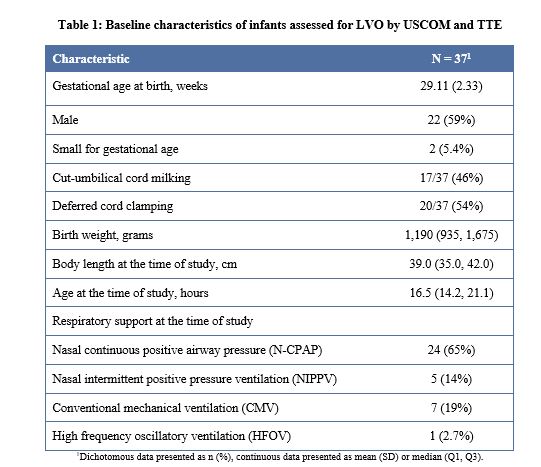
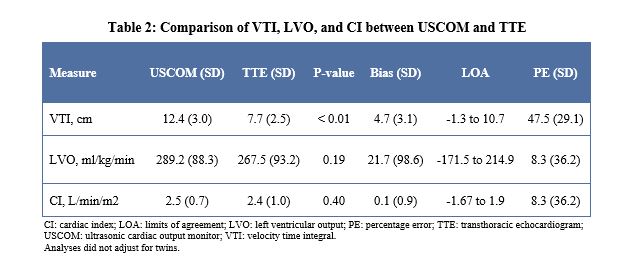
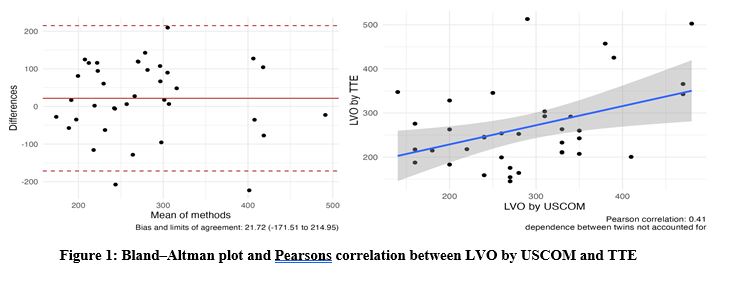
Background: There is controversy in the literature whether assessment of left ventricular output (LVO) by ultrasonic cardiac output monitor (USCOM) correlates with transthoracic echocardiogram (TTE) in very preterm infants. Objective: To assess the degree of agreement between these 2 methods for measuring LVO. Design/Methods: We assessed LVO in preterm infants < 32 weeks' gestation at 12-24 hours of age. USCOM (USCOM Ltd, Coffs Harbour, NSW, Australia) was used first by placing the transducer on a suprasternal position of the chest to measure trans-aortic blood flow. At least five adequate profiles were required to obtain a mean value for LVO. This was followed by assessing TTE LVO by measuring aortic diameter and velocity time integral (VTI). Measurements of LVO were done off-line by a single interpreter who was blinded to the other method's value. VTI, LVO and cardiac index were compared between the two methods. Results: Thirty-seven infants received both assessments at mean (SD) gestational age 29.0 (2.3) weeks and mean (SD) age of 16.5 (14.2,21.1) hours (Table 1). Mean (SD) LVO by USCOM was 289.2 (88.3) mL/kg/min compared to 267.5 (93.2) by TTE, p=0.19 (Table 2). Bland-Altman plot bias was 21.7 mL/kg/min and the limits of agreement were -171.5 to 215.0 mL/kg/min (Figure 1). The Pearson correlation coefficient between the two methods was 0.41.
Conclusion(s): Measurement of LVO by USCOM moderately correlated with that by TTE in very preterm infants at < 24 hours of age. However, clinicians should be aware of the limits of agreement between these values which may impact clinical decisions
Table 1: Baseline characteristics of infants assessed for LVO by USCOM and TTE
Table 2: Comparison of VTI, LVO, and CI between USCOM and TTE
Figure 1: Bland-Altman plot and Pearsons correlation between LVO by USCOM and TTE