698 - Integration of Faculty-Written Neonatal Patient Oral Cases Predicts and Supports Neonatal Trainee Board Outcomes
Saturday, April 25, 2026
3:30pm - 5:45pm ET
Publication Number: 2681.698
Shaina K. Lodhi, Loma Linda University Children's Hospital, Loma Linda, CA, United States; Anamika I. Banerji, Loma Linda University Children's Hospital, Loma Linda, CA, United States; Andrew Hopper, Loma Linda University Children's Hospital, Loma Linda, CA, United States
Assistant Professor Loma Linda University Children's Hospital Loma Linda, California, United States
Background: The COVID-19 pandemic disrupted medical training, with declines in in-training exam (SITE) performance and board pass rates. Reduced clinical exposure further compromised faculty's ability to assess trainee competency. Objective: Our program developed an innovative learning tool using structured oral case assessments to enhance education and predict neonatology board outcomes. Design/Methods: Core faculty created oral case scenarios covering common neonatology presentations, each following a standardized format: -Patient presentation, key clinical concepts, and diagnostic reasoning -Follow-up questions based on labs and imaging -Detailed answer key and faculty evaluation form
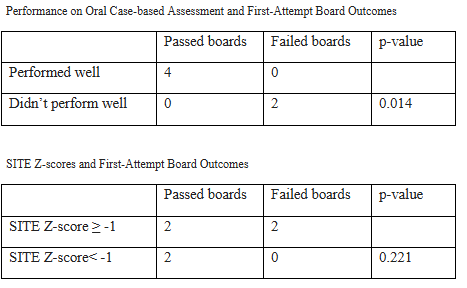
Graduating fellows completed 9-12 oral cases via in-person verbal assessments. Each session included two cases evaluated by two faculty members. Trainees needing improvement were given targeted review materials and reattempted cases. (QR: Sample Case) Chi-square test assessed associations between oral case performance, 3rd-year SITE scores, and first-attempt board exam outcomes. Results: Twelve fellows completed oral cases; six have attempted boards, with four passing. All trainees who performed well in oral cases passed on the first attempt, while those who performed poorly did not (p=0.014). One trainee with a SITE score >2 SD below the mean performed well on oral cases and passed boards.
Discussion
Prior studies link in-training exams with board outcomes. Despite a low sample size, our findings show a significant association between oral case performance and board success, even in trainees with low SITE scores.
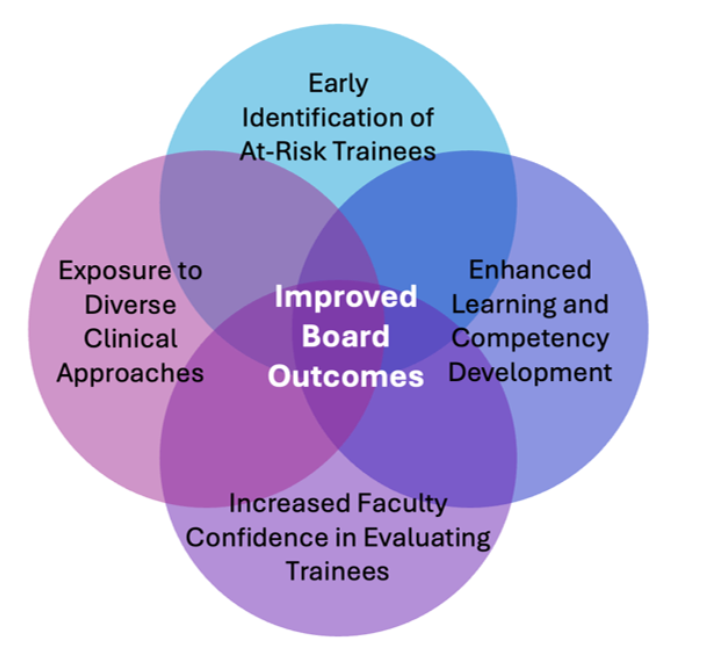
Benefits of integrating structured oral cases into fellowship training include: -Early Identification of At-Risk Trainees: Enables targeted intervention -Enhanced Learning: Simulates real-world decision-making and reinforces critical knowledge -Improved Faculty Confidence in Assessments: Structured format strengthens evaluations -Exposure to Diverse Clinical Approaches: Trainees gain insights into varying faculty strategies
Trainees who passed despite low SITE scores may have used this process to bridge knowledge gaps.
Conclusion(s): Incorporating structured oral cases into neonatology fellowship provides a valuable learning and evaluation tool, predicting board success and addressing educational gaps. Further research could support an AI-assisted model combining oral case performance and SITE scores to personalize learning and improve board pass rates.
Benefits of Structured Oral Cases
Performance on Oral Cases, SITE Z-score, and First-Attempt Board Outcome
QR Code for Sample Case with Answer Key and Scoring