675 - Neonatal Brain Volumes Differ Across Neurobehavioral Profiles and Vary by Antenatal Opioid Exposure
Saturday, April 25, 2026
3:30pm - 5:45pm ET
Publication Number: 2658.675
Yao Wu, Children's National Hospital, Washington, DC, United States; Stephanie L. Merhar, Cincinnati Children's Hospital Medical Center, Cincinnati, OH, United States; Carla M. Bann, RTI International, Apex, NC, United States; Jamie E. Newman, RTI International, Research Triangle Park, NC, United States; Kushal Kapse, Developing Brain Institute, Washington, DC, United States; Josepheen De Asis-Cruz, Children's National Health System, Bethesda, MD, United States; Jonathan M. Davis, Tufts University School of Medicine, Boston, MA, United States; Namasivayam Ambalavanan, University of Alabama School of Medicine, Birmingham, AL, United States; Sara DeMauro, Children's Hospital of Philadelphia, Philadelphia, PA, United States; Scott A. Lorch, The Children's Hospital of Philadelphia, University of Pennsylvania, Philadelphia, PA, United States; Deanne Wilson-Costello, Case Western Reserve University School of Medicine, Cleveland, OH, United States; Brenda Poindexter, Children's Healthcare of Atlanta, Atlanta, GA, United States; Nicole Mack, RTI International, Chicago, IL, United States; Myriam Peralta-Carcelen, University of Alabama at Birmingham, Birmingham, AL, United States; Catherine Limperopoulos, Children's National Health System, Washington DC, DC, United States
Developing Brain Institute Children's National Hospital Washington, District of Columbia, United States
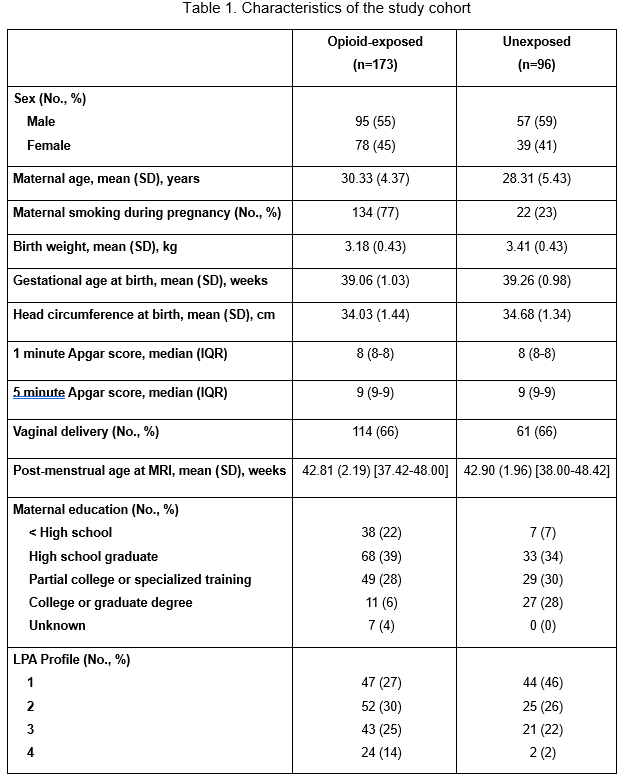
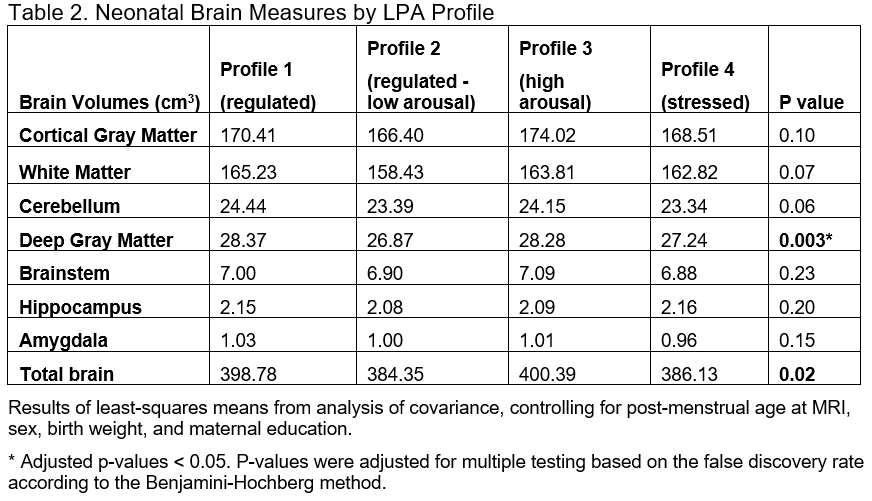
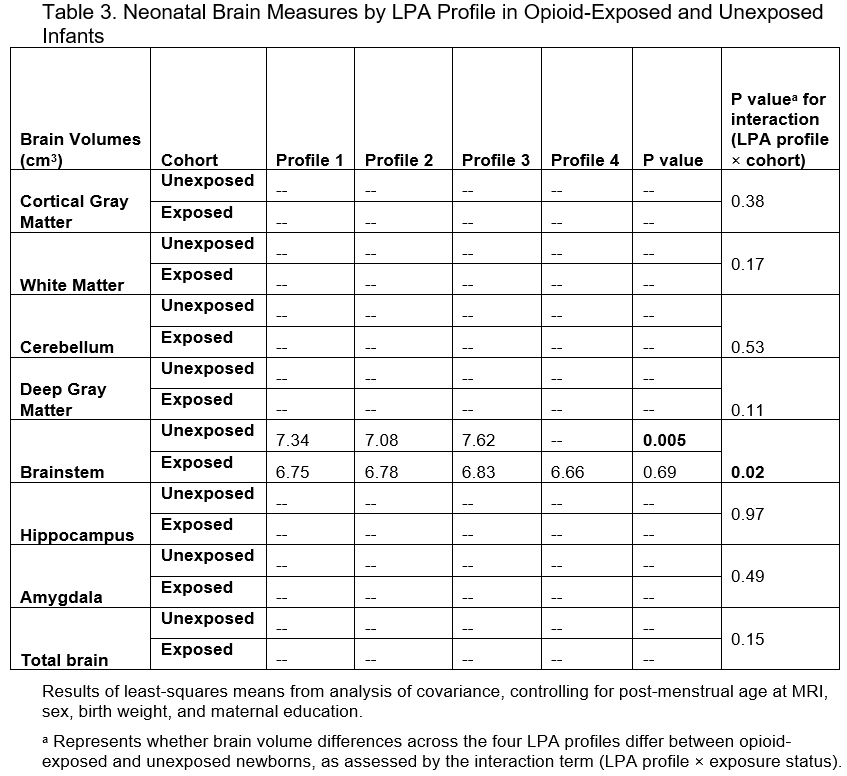
Background: Antenatal opioid exposure is associated with adverse neurodevelopmental outcomes. While impaired global and regional brain growth in exposed neonates has been reported, the structure-function relationship between altered brain volumes and neonatal neurobehavior has not been explored. Objective: To examine the relationship between NeoNatal Neurobehavioral Scale (NNNS-II) profiles and brain volumes in opioid-exposed and unexposed neonates. Design/Methods: As part of the multi-site Outcomes of Babies with Opioid Exposure Study, unsedated 3D T2-weighted MRIs were performed in opioid-exposed and unexposed neonates using Philips and Siemens 3T scanners with harmonization across four US sites. Brain segmentation of cortical and deep gray matter, white matter, cerebellum, brainstem, amygdala, and hippocampus was performed using DrawEM and a 3D U-Net pipeline with manual corrections. Neonatal neurobehavior was assessed using the NNNS-II. Latent profile analysis (LPA) of 8 NNNS-II summary scores identified 4 profiles: Profile 1 (Regulated) showed near-optimal scores across all scales; Profile 2 (Regulated-Low Arousal) had above-average attention and self-regulation but low arousal-reactivity; Profile 3 (High Arousal) had poor attention/self-regulation and high arousal-reactivity; Profile 4 (Stressed) had high arousal-reactivity, low self-regulation, and increased handling needs. Brain volumes across LPA profiles were compared using ANCOVA, adjusting for postmenstrual age at MRI, sex, birth weight, and maternal education. An interaction term (LPA profile × exposure) was further included to assess whether differences in brain volumes across the four LPA profiles varied between opioid-exposed and unexposed newborns. Results: Among 269 neonates with MRI (173 exposed, 96 unexposed), 258 (166 exposed, 92 unexposed) completed NNNS-II assessments at a mean age of 19.8 days and had valid LPA profiles. Deep gray matter volumes differed across four LPA profiles in the combined sample (Table 2). In addition, brainstem volumes differed by LPA profile between opioid-exposed and unexposed cohorts, with significant differences observed only in unexposed controls (Table 3).
Conclusion(s): Neonatal deep gray matter volumes vary across neurobehavioral profiles, underscoring the relationship between brain development and early neurobehavior. Cohort-dependent brainstem differences suggest opioid exposure may alter typical brain-behavior relationships. Longitudinal follow-up is ongoing to assess how early brain structure-function relationships influence later neurodevelopmental outcomes.
Table 1. Characteristics of the study cohort
Table 2. Neonatal Brain Measures by LPA Profile
Table 3. Neonatal Brain Measures by LPA Profile in Opioid-Exposed and Unexposed Infants