558 - Performance of simultaneous peripheral and central blood cultures in febrile oncology patients
Saturday, April 25, 2026
3:30pm - 5:45pm ET
Publication Number: 2543.558
Borja Gómez, Hospital Universitario Cruces, Barakaldo, Pais Vasco, Spain; Jose Antonio Alonso Cadenas, Hospital Infantil Universitario Niño jesús, Madrid, Madrid, Spain; Monica Sancosmed, HOSPITAL VALL D'HEBRON, BARCELONA, Catalonia, Spain; Ana Jové-Blanco, Hospital General Universitario Gregorio Marañón, Madrid, Madrid, Spain; Mirian Moreno, Hospital Cruces, Bilbao, Pais Vasco, Spain; Oriol Quintana, Hospital Universitario Cruces, Bilbao, Pais Vasco, Spain; Fernando Almarza, Hospital Universitario Cruces, BILBAO, Pais Vasco, Spain; Ana María Martínez Álvarez, Sección de Urgencias Pediátricas, Servicio de Pediatría, Hospital Clínico Universitario Virgen de la Arrixaca (Murcia), Murcia, Murcia, Spain; Paula García-Sánchez, La Paz University Hospital, Madrid, Madrid, Spain; Izaskun Olaciregui, Donostia University Hospital, San Sebastian, Pais Vasco, Spain; Luisa Barón, Hospital Universitario 12 de Octubre, Madrid, Madrid, Spain; Andrea Riego, Hospital Universitario 12 de Octubre, Madrid, Madrid, Spain; Manuel Gijón, Hospital Universitario 12 de Octubre, MADRID, Madrid, Spain; Nerea González, Hospital Universitario de navarra, Bilbao, Pais Vasco, Spain; Nuria Gilabert Iriondo, Hospital Universitario Son Espases, Calvia, Islas Baleares, Spain; Irene Cinta Barceló Carceller, Hospital de la Santa Creu i Sant Pau, Barcelona, Catalonia, Spain; María Fernandez, H, Oviedo, Asturias, Spain; Elena Aquino Oliva, Hospital Universitario de Toledo (Spain), Toledo, Castilla-La Mancha, Spain; Maria Esteban, Hospital Universitario de Toledo, Las Rozas, Madrid, Spain; Emilia Urrutia, Hospital universitario Virgen de las Nieves, Granada, Andalucia, Spain; Santiago Mintegi Raso, Hospital Universitario Cruces, Bilbao, Pais Vasco, Spain
Pediatric Emergency Physician Hospital Universitario Cruces Barakaldo, Pais Vasco, Spain
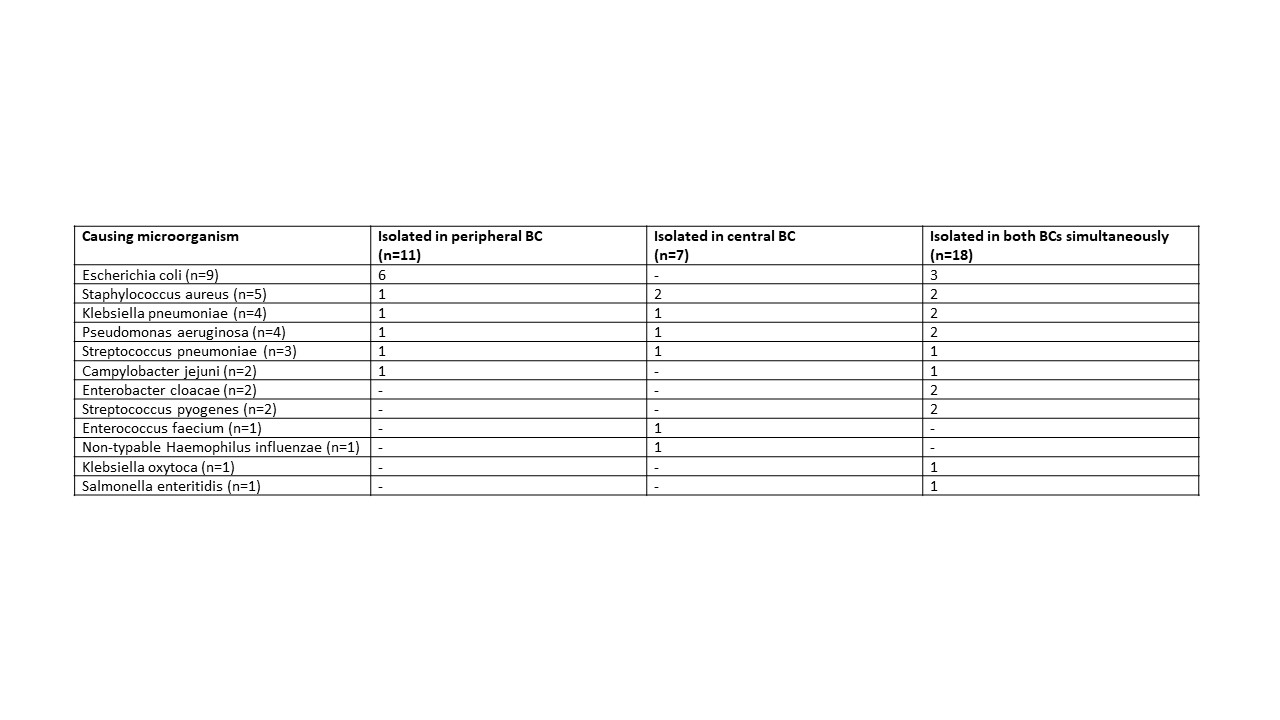
Background: oncology patients have a substantial risk of bacteremia when presenting with a febrile episode. Current guidelines strongly recommend obtaining blood cultures (BCs) from all lumens of central venous catheters (CVC). However, the practice of simultaneously obtaining a peripheral BC remains controversial. Arguments against this practice include the unclear impact of increased bacteremia detection and concerns regarding the potential isolation of skin contaminants. Objective: to evaluate the diagnostic performance of peripheral BCs in identifying bacteremia among febrile oncology patients. Design/Methods: secondary analysis of a multicenter prospective study conducted across 15 hospitals members of the Spanish Pediatric Emergency Research Group (RISEUP). We included oncology patients receiving chemotherapy who presented with fever to the Emergency Department between November 2022 and October 2024. Bacteremia was defined as the growth of a) a bacterial pathogen in any BC; b) the same opportunistic bacterium in both a peripheral and a central BC obtained simultaneously in the Emergency Department; or c) the same opportunistic bacterium in two different central BCs obtained separately during the febrile episode. Growth of an opportunistic bacterium in a single BC was considered potential contamination. Results: we included 1,197 episodes (median age: 6 years [IQR 3-10]; severe neutropenia rate [ < 500 neutrophils/mcL]: 46.6%). Table 1 shows the proportion of peripheral and central BCs obtained. Peripheral BC collection rates ranged from 2.3% to 100% across participating centers (p < 0.001). Patients in whom both BCs or only one of them were obtained were similar in sex, age, general appearance, fever degree and severe neutropenia rate. Among the 808 episodes in which both BCs were obtained, 77 (9.5%) bacteremias were identified. Of these, 36 (46.8%) were caused by common bacterial pathogens: 11 (30.5%) were diagnosed by a single positive peripheral BC, and 7 (19.4%) by a single positive central BC. Table 2 summarizes the causing bacteria by the BC type in which they were isolated. Potential contamination was observed in 14 (1.7%) central BCs and 9 (1.1%) peripheral BCs (p=0.3). The rate of bacteremia among the 331 episodes with only one BC obtained was 6.2% (p=0.08, compared to those with both BC obtained).
Conclusion(s): relying solely on BCs obtained from CVCs in febrile oncology patients may lead to missed diagnoses of clinically significant bacteremias. Peripheral BCs are not associated with higher contamination rates compared to those drawn from central lines.
Table 1: Distribution of blood cultures collected in the Emergency Department
Table 2: causing microorganism in the 36 bacteremias by common bacterial pathogens according to the blood culture sample in which they were isolated.










.jpg)