220 - A participatory multiphased co-development of a toolkit of engagement practices to enhance patients, families, and communities' engagement in pediatric patient-centered outcomes research
Saturday, April 25, 2026
3:30pm - 5:45pm ET
Publication Number: 2212.220
Perla Chebli, New York University Grossman School of Medicine, New York, NY, United States; Yi-Ling Tan, New York University Grossman School of Medicine, New York, NY, United States; Jennifer A.. Wong, NYU Langone Health, New York, NY, United States; Steph Lomangino, New York University Grossman School of Medicine, Bloomfield, CT, United States; Andrea Li, Family Voices, Encinitas, CA, United States; Terry Forlenzo, n/a, Newtown, CT, United States; Jessica Velazquez, New York University Grossman School of Medicine, New York, NY, United States; Allysa Ware, Family Voices, Cleveland, OH, United States; Alan L. Mendelsohn, New York University Grossman School of Medicine, New York, NY, United States; Hollyce Tyrrell, Academic Pediatric Association, McLean, VA, United States; H. Shonna Yin, NYU Grossman School of Medicine, New York, NY, United States; Simona Kwon, NYU Grossman School of Medicine, New York, NY, United States
Associate Professor of Pediatrics and Population Health NYU Grossman School of Medicine New York, New York, United States
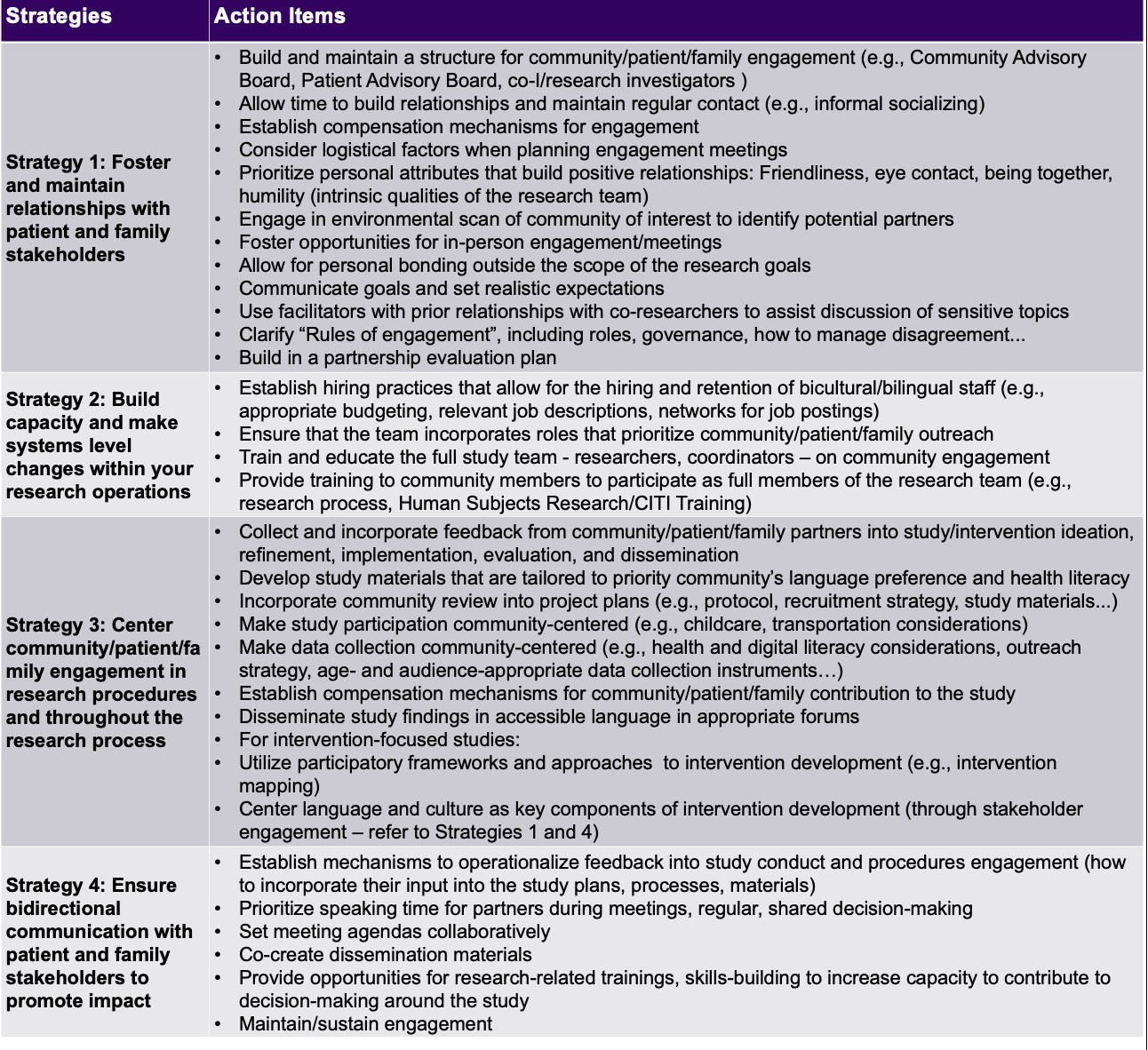
Background: Patient and family engagement is key to conducting meaningful, impactful, and equitable research, leading to improved child health outcomes and greater patient/family satisfaction. Structural barriers include language and literacy, research team knowledge/motivations, and institutional policies. Few studies have explored current practices to engage patients and families, particularly those who are underrepresented in pediatric patient-centered outcomes research (PCOR). Objective: A community-academic team composed of representatives from Family Voices (family-led nonprofit working to improve systems of care for children) and NYU Grossman School of Medicine, in collaboration with 3 pediatric research networks (APA CORNET, PRIS, DBPNet), aimed to co-develop a toolkit of practices that can enhance the engagement of patients, families, and communities in pediatric PCOR. Design/Methods: We followed a participatory multiphased process consisting of (1) ongoing discussions with community and scientific advisory boards (CAB, SAB); (2) a scoping review of stakeholder-engaged pediatric and family health research to summarize documented engagement practices from the literature (n=30 articles full text review); (3) key informant (KI) interviews with community stakeholders and pediatric research subject matter experts (n=23) analyzed through a hybrid inductive-deductive content analysis; (4) three rounds of a modified Delphi process with CAB and SAB to gain consensus from lived experience and subject matter experts on evidence-based best practice strategies and actions synthesized from KI interviews and narrative review findings. Results: Four overarching engagement strategies were derived: (1) Foster and maintain relationships with patient and family stakeholders; (2) Build capacity and make systems level changes within research operations; (3) Center patient, family, and community engagement in research procedures and throughout the research process; and (4) Ensure bidirectional communication with patient, family, and community stakeholders (see Table 1). A plain language toolkit was developed that includes the four key strategies, prioritized action items, and practical tools.
Conclusion(s): Engagement strategies focused on fostering relationships with relevant partners and building research team and institutional capacity to conduct partnered research. The toolkit will be implemented and evaluated in an upcoming cluster randomized trial with pediatric and family health study sites. Note: Last 2 authors are co-senior authors.
Table 1. Strategies and action items derived from the qualitative interviews and scoping review









.jpg "Shonna Yin, MD, MS (she/her/hers) photo")