655 - Active Sleep During Extrauterine Third Trimester is Associated with Neurophysiologic Maturation in Preterm Infants
Saturday, April 25, 2026
3:30pm - 5:45pm ET
Publication Number: 2638.655
Sudeepta Basu, Children's National Hospital, Washington, DC, Washington, DC, United States; Venkata Chaitanya Chirumamilla, Childrens National Hospital, Washingotn DC, DC, United States; Julius Ngwa, Children's National Health System, Washington, DC, United States; Katherine Ottolini, George Washington University School of Medicine and Health Sciences, Washington, DC, United States; Adre J. du Plessis, Children's National Health System, Bethesda, MD, United States; Rathinaswamy Govindan, Children's National Hospital, Washington, DC, United States
Associate Professor Children's National Hospital, Washington, DC Washington, District of Columbia, United States
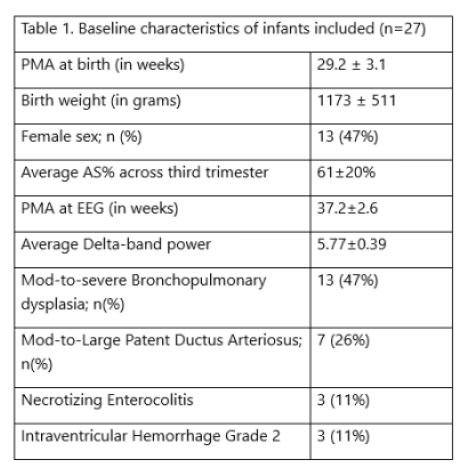
Background: The majority of infants born prematurely experience sleep-cycle dysmaturation during their extrauterine third trimester. Dysmature sleep-cycle maturation during infancy, measured as lower active sleep (AS) duration, is associated with worse cognitive outcomes. Although sleep (in particular, AS) is considered vital for neural network maturation, its relationship with objective metrics of neurophysiologic maturation [quantitative measures by electroencephalography (EEG)] remains unclear. Objective: To test our hypothesis that AS duration% (of total sleep time) during the third trimester will be associated with EEG spectral power in preterm infants. Design/Methods: In this prospective observational cohort study of preterm infants born at < 36 weeks PMA, we retrieved beat-to-beat heart rate (btb-HR) data from the bedside monitor from admission through NICU discharge. We delineated sleep states throughout the NICU stay using a baseline heart rate shift of >18 beats per minute (bpm) within a 30-second epoch to delineate AS, and epochs with a shift of ≤18 bpm to delineate quiet sleep (QS) (Fig. 1a, previously validated). We acquired a 2-hour video-EEG during the third trimester (34-40 weeks PMA) and quantitatively analyzed spectral power in each frequency band as a marker of electrocortical maturation. We performed a linear-mixed-effects analysis to investigate the relationship between AS duration% in the third trimester and Delta-band EEG power, an inverse marker of neurophysiologic maturation with age (i.e., decreased Delta-power with greater maturation), adjusted for PMA at the time of EEG recording. Results: Baseline characteristics of 27 preterm infants (born at PMA 30.2 ± 3.2) included for analysis are summarized in Table 1. AS% increased with advancing PMA (r=0.5, p= 0.04). Using a linear mixed-effects model for the analysis of 37 EEG recordings from the 27 infants, we observed a negative association between EEG Delta-band power (on F3 EEG channel) and AS% (in weeks building up to the EEG) with an estimate of -0.57; P = 0.058 (Fig. 2).
Conclusion(s): We report preliminary trends of association between AS duration% during the extrauterine third trimester and quantitative EEG markers of neurophysiologic maturation (lower Delta-band power). Our findings generate a hypothesis that early postnatal sleep maturation could serve as a biomarker of underlying neurophysiologic maturation and are being investigated in a larger cohort of preterm infants, who are being followed for cognitive outcomes.
Table1. Baseline characteristics of study cohort
Fig. 1 Sleep-state analysis (a) AS-QS delineation using Δbtb-HR and (b) Longitudinal trajectory of Active Sleep% with Advancing age during Third Trimester
Fig. 2 Negative trend of Delta-band EEG power with AS duration%









.jpg "Sudeepta Basu, MD, MSHS (he/him/his) photo")
.png)
.png)
