343 - Trends in Successful Early Extubation Among Extremely Preterm Infants (22–26 Weeks)
Saturday, April 25, 2026
3:30pm - 5:45pm ET
Publication Number: 2332.343
Abdul Kader S. Surti, Cleveland Clinic Children's, Lorain, OH, United States; Victoria Smith, Cleveland Clinic - Fairview Hospital, Cleveland, OH, United States; Anthony Bernick, Cleveland Clinic Children's, Willowick, OH, United States; Ann L.. Farah, Cleveland Clinic Children's, Rocky River, OH, United States; Firas Saker, Cleveland Clinic Children's, Cleveland, OH, United States; SABINE IBEN, Cleveland Clinic Children's, Cleveland, OH, United States
Fellow Cleveland Clinic Children's Lorain, Ohio, United States
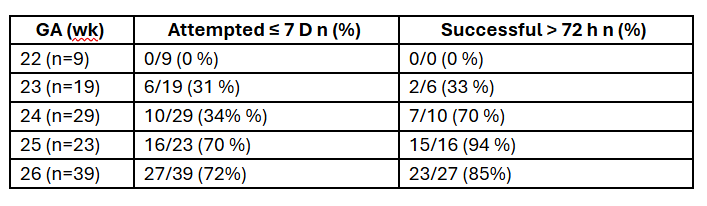
Background: Ventilator induced lung injury due to prolonged exposure to invasive mechanical ventilation is a major contributor for chronic pulmonary morbidity. Early extubation within the first week of life reduces lung injury and bronchopulmonary dysplasia (BPD) in extremely preterm infants. Extremely low birth weight (ELBW) infants are at highest risk, but there is hesitance to transition to noninvasive support in this population. Previous studies demonstrate that extubation success increases with gestational maturity, but evidence at the lowest gestations (22-24 weeks) remains limited. Our center has reported low BPD rates through a proactive strategy aimed at facilitating early extubation. The gestational threshold for successful extubation within the first week of life remains unclear. Objective: To define the gestational age threshold for successful extubation (> 72 h) within the first week of life among infants 22-26 weeks' gestational age. Design/Methods: Retrospective cohort study of infants 22-26 weeks admitted to two Level III NICUs participating in the NEAR4NEOS registry (10/2022-10/2025).The study included total intubated infants surviving to day 10 (study period). Early extubation was defined as removal of invasive ventilation within 7 days of life; success was defined as remaining extubated for >72 hours. Results: Among 165 intubated infants with a GA 22-26 weeks, early-extubation success increased with advancing GA. No infant at 22 weeks achieved successful extubation within the first week of life. At 23 weeks, 25 % remained extubated > 72 h, increasing to 70 % at 24 weeks and > 85 % at ≥ 25 weeks (Table 1).
Conclusion(s): Successful extubation within the first week of life was infrequent below 24 weeks GA but nearly universal at ≥ 25 weeks, defining a physiologic threshold for sustainable ventilator independence. These findings support national trends toward earlier liberation from mechanical ventilation and quantify feasibility of sustaining noninvasive ventilatory support at the limits of viability. Future work will evaluate associations between early extubation and long-term pulmonary and neurodevelopmental outcomes.
Table 1. Early Extubation Attempts and Success Rates Within the First Week of Life by Gestational Age (22-26 Weeks)