26 - Green pigmentation of deciduous teeth in infancy
Saturday, April 25, 2026
3:30pm - 5:45pm ET
Publication Number: 2023.26
Yi-Li Hung, Cathay General Hospital, Taipei, Taipei, Taiwan (Republic of China); Wu-Shiun Hsieh, Department of Pediatrics, Cathay General Hospital, Taipei, Taiwan, Taipei City, Taipei, Taiwan (Republic of China); Chung-Min M. Shen, Cathay General Hospital, Taipei, Taipei, Taiwan (Republic of China)
director of neonatology Cathay General Hospital Taipei, Taipei, Taiwan (Republic of China)
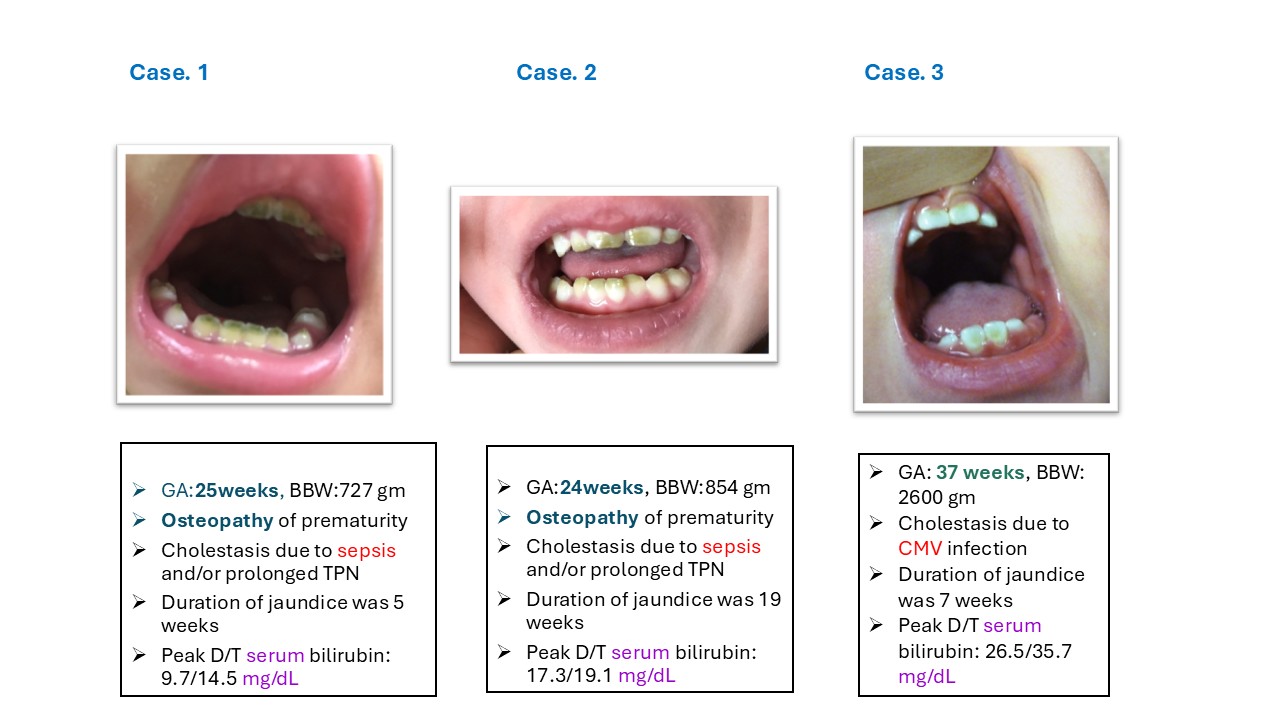
Background: Green pigmentation in deciduous teeth is a rare phenomenon in infancy and is associated with bilirubin deposition in the hard dental tissues. Here, we report three infants with green staining of their primary teeth. Two of them were extreme-low-birth weight premature infants who suffered from cholestasis due to sepsis and prolonged total parenteral nutrition usage. The other infant with green teeth developed neonatal jaundice due to congenital cytomegalovirus (CMV) infection. Objective: This report aims to review the literature and address the clinical profiles of infants at risk of developing green teeth. Design/Methods: A PubMed search was performed for all English-language case reports from 1950 to 2022 with keywords of ''intrinsic green deciduous teeth'' and ''green teeth in infant." The reference lists of the retrieved articles were reviewed for additional cases. Detailed information regarding sex, perinatal characteristics, cause of jaundice, and the duration and severity of hyperbilirubinemia were recorded. Results: In total, 66 cases of green deciduous teeth were reported, with no sex differences (male:female; 1:0.92). Thirty-three (50%) of them were cases of biliary atresia (BA). In the remaining 33 cases, 15 infants (22.7%) suffered from cholestasis due to sepsis during the neonatal period, all of which were born prematurely at a gestational age of 24-34 weeks. Fourteen infants (21.2%) had hemolytic jaundice, 13 of which were also preterm infants. Two infants (3%) had cholestasis secondary to congenital CMV infection. Patients without BA had lower serum total bilirubin levels and a shorter duration of hyperbilirubinemia than those with BA. The pigmentation areas of the teeth were more restricted to the upper part of the crown, and the permanent teeth were seldom affected in non-BA cases.
Conclusion(s): Half of the infants with green teeth were due to biliary atresia. Extremely premature infants were vulnerable to intrinsic green staining of deciduous teeth due to sepsis or hemolysis-related neonatal jaundice, which may be related to the poor density of the tooth matrix and disturbances in the resorption of calcium, phosphate, and vitamin D. In addition, congenital CMV infection could also cause green teeth in infancy.