635 - Impact of Time-Sensitive Recruitment on Representativeness in The Budesonide in Babies Randomized Controlled Trial
Saturday, April 25, 2026
3:30pm - 5:45pm ET
Publication Number: 2620.635
Mar Romero-Lopez, UT Health. Houston, Houston, TX, United States; shampa Saha, RTI International, Durham, NC, United States; Namasivayam Ambalavanan, University of Alabama School of Medicine, Birmingham, AL, United States; Anup Katheria, University of California, San Diego School of Medicine, San Diego, CA, United States; Jon E. Tyson, McGovern Medical School at the University of Texas Health Science Center at Houston, Houston, TX, United States; Ravi M. Patel, Children's Healthcare of Atlanta and Emory University, Atlanta, GA, United States; Elliott Weiss, University of Washington School of Medicine, Seattle, WA, United States; Susan Wootton, McGovern Medical School at the University of Texas Health Science Center at Houston, Bellaire, TX, United States; Kanekal Gautham, McGovern Medical School at the University of Texas Health Science Center at Houston, Houston, TX, United States; Gabriela Dominguez, McGovern Medical School at the University of Texas Health Science Center at Houston, Houston, TX, United States; Rebecca A.. Dorner, Sharp Mary Birch Hospital for Women & Newborns, San Diego, CA, United States; Matthew Rysavy, McGovern Medical School at the University of Texas Health Science Center at Houston, Houston, TX, United States; on behalf of NICHD Neonatal Research Network, NICHD Neonatal Research Network, Bethesda, MD, United States
Assistant Professor of Pediatrics. Division of Neonatology UT Health. Houston Houston, Texas, United States
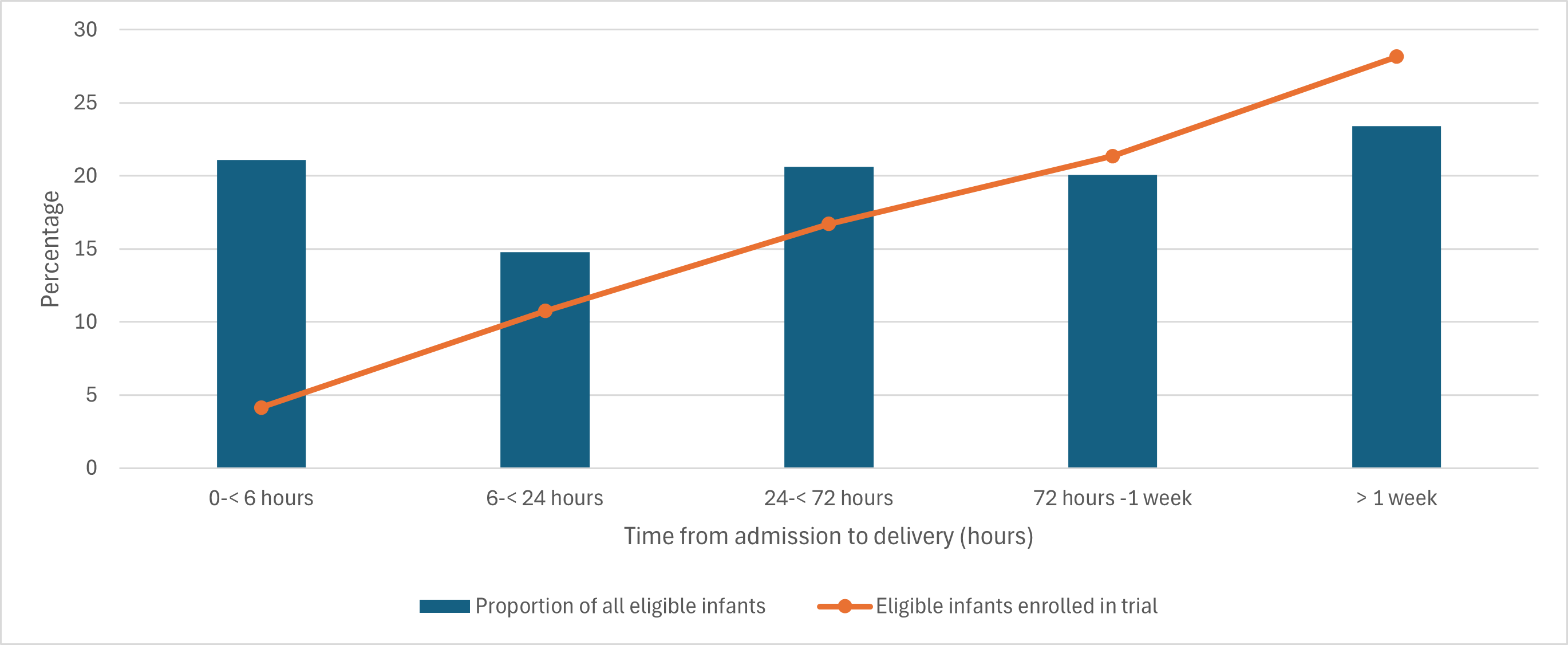
Background: The NICHD Neonatal Research Network Budesonide in Babies (BiB) trial randomized extremely preterm infants receiving intratracheal surfactant to surfactant mixed with budesonide or surfactant alone shortly after birth. This registry-embedded trial provides an opportunity to explore the impact of time-sensitive factors with infant enrollment, which are common in studies of urgent neonatal interventions. Objective: To compare characteristics and clinical outcomes of eligible infants enrolled and not enrolled in the BiB trial, with a focus on factors related to the available time window for enrollment. Design/Methods: Using prospectively collected clinical trial and registry data, we compared characteristics and outcomes of infants eligible non-enrolled and enrolled infants in the BiB trial at all participating sites. The study was conducted March 2021-June 2024. Results: Among 3802 eligible infants, 635 (17%) were enrolled. Mothers of enrolled infants had longer admission-to-delivery intervals (median 119 vs 47 hours, p< 0.001), were less likely to deliver within 6 hours of admission (5% vs 24% of non-enrolled, p< 0.01) and were more likely to deliver during 8 am-5 pm on weekdays (45% vs 38%, p< 0.01) (Table 1 and Figure). Enrolled infants were more likely to receive a complete antenatal steroid course (90% vs. 73%, p < 0.01) and magnesium sulfate (96% vs 88%, p < 0.01) (Table 1). Despite similar median gestational age at birth (26 weeks) and birthweight (798 vs 780 g), enrolled infants had lower mortality (14% vs 18%, p=0.03), less physiological bronchopulmonary dysplasia or death (68% vs 82%, p< 0.01) and less physiologic bronchopulmonary dysplasia among survivors (63% vs 78%, p< 0.01) compared to non-enrolled infants (Table 2).
Conclusion(s): Infants enrolled in BiB were of similar gestational ages and birth weights compared to eligible non-enrolled infants but differed in duration of antepartum hospitalization, timing of delivery, antenatal interventions, and neonatal outcomes. These findings highlight potential impacts of time-sensitive challenges in enrolling relevant subgroups of eligible patients in a randomized trial of urgent intervention. They underscore the need for innovative strategies to support broad enrollment across diverse clinical presentations.