206 - Experiences with Vaccine Preventable Diseases Among US Pediatric Residents Graduating in 2025
Saturday, April 25, 2026
3:30pm - 5:45pm ET
Publication Number: 2198.206
Elizabeth A. Gottschlich, American Academy of Pediatrics, Itasca, IL, United States; Tylar Kist, American Academy of Pediatrics, Itasca, IL, United States; Melissa Stockwell, Columbia University Vagelos College of Physicians and Surgeons, New York, NY, United States
Senior Research Associate American Academy of Pediatrics Itasca, Illinois, United States
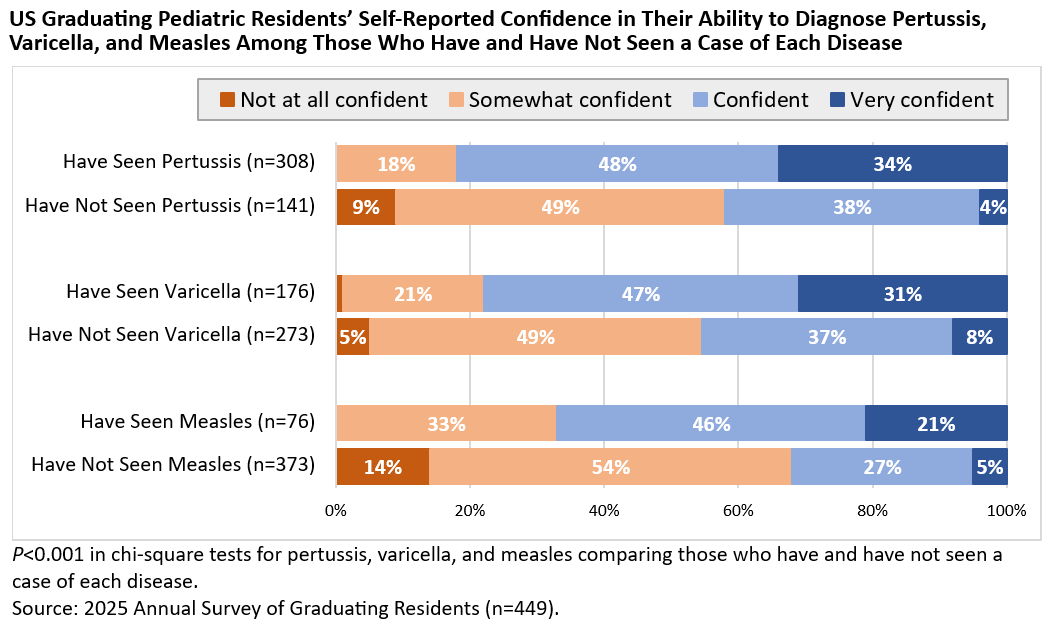
Background: The US has seen a resurgence in vaccine preventable diseases over the past few years. Little is known about graduating pediatric residents' experiences with and preparedness to identify such cases. Objective: Examine recent graduating pediatric residents' a) experiences seeing cases of pertussis, varicella, and measles and b) confidence in their ability to diagnose these 3 diseases. Design/Methods: We utilized data from a national random sample of 1,200 US pediatric residency graduates from the 2025 American Academy of Pediatrics Annual Survey of Graduating Residents. Residents were asked if they have ever seen a case of pertussis, varicella, and measles (yes or no for each) and how confident they were in their ability to diagnose each of the 3 diseases. McNemar tests assessed differences in confidence (not at all confident or somewhat confident vs confident or very confident) diagnosing pertussis, varicella, and measles (3 paired comparisons: pertussis vs varicella; pertussis vs measles; varicella vs measles). Chi-square tests assessed differences in confidence diagnosing each of the 3 diseases among those who have and have not seen a case of the disease. Results: Response rate in 2025 was 38% (analytic n=450). In all, 69% of graduating pediatric residents have ever seen a case of pertussis, 39% varicella, and 17% measles. One in 5 residents have not seen any of these diseases, while 6% have seen all three. Overall, residents reported the highest confidence in their ability to diagnose pertussis (69%), followed by varicella (58%), and measles (38%); p<.001 for all 3 paired comparisons.
For each of the 3 diseases, confidence varied significantly among residents who have and have not seen a case (Figure). For example, the largest difference was seen in pertussis: residents who have seen a case were much more likely to report confidence in diagnosing the disease than those who have not (82% vs 42%; p<.001).
Conclusion(s): Three in 10 graduating pediatric residents have never seen a case of pertussis, and most have never seen varicella or measles. Residents were significantly less confident in their ability to diagnose the respective diseases if they have never seen a case. These findings are potentially problematic if vaccination rates continue to decline and these diseases become more prevalent.
US Graduating Pediatric Residents' Self-Reported Confidence in Their Ability to Diagnose Pertussis, Varicella, and Measles Among Those Who Have and Have Not Seen a Case of Each Disease