383 - Changes over Time in Parent Report of Following Doctor’s Advice on Child Vaccination
Saturday, April 25, 2026
3:30pm - 5:45pm ET
Publication Number: 2372.383
Sarah J. Clark, University of Michigan Medical School, Ann Arbor, MI, United States; Susan Woolford, University of Michigan Medical School, Ann Arbor, MI, United States
Research Scientist University of Michigan Medical School Ann Arbor, Michigan, United States
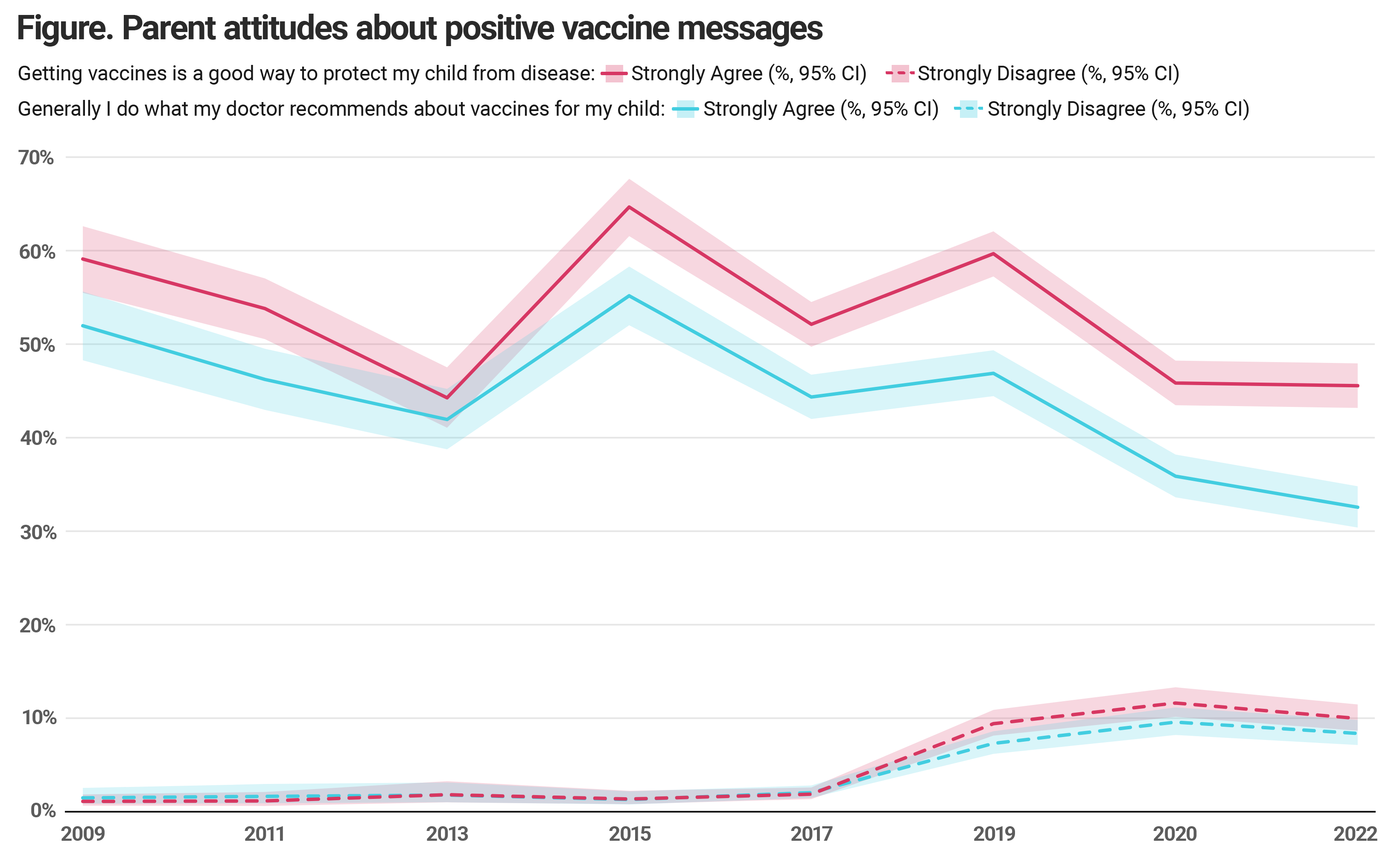
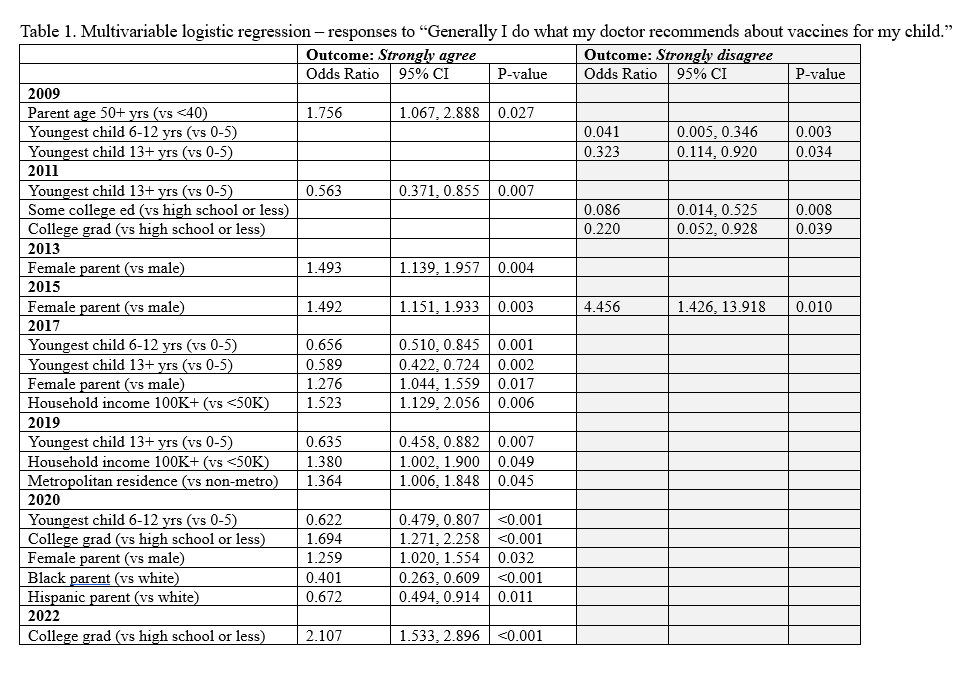
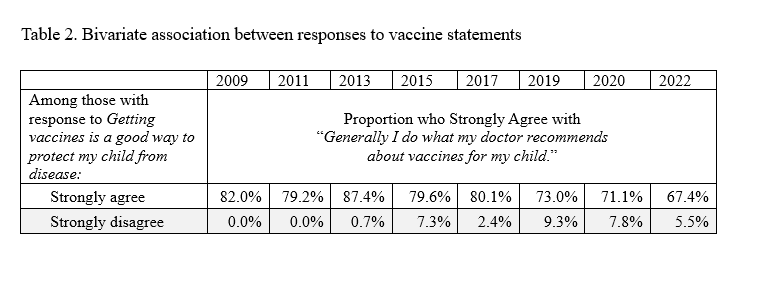
Background: Provider recommendation is an established predictor of parent decisions about child vaccination. Given declining childhood vaccination rates, it may be informative to explore parent views in this area. Objective: To track and describe parent attitudes about following provider vaccine recommendations over time. Design/Methods: Serial cross-sectional online surveys of a national sample of parents fielded with consistent methodology through the KnowledgePanel (Ipsos LLC) in Jan 2009 (N=1,552, participation rate 64%), Sept 2011 (N=1,626, 64%), Jan 2013 (N=1,620, 61%), May 2015 (N=1,413, 60%), Jan 2017 (N=2,001, 60%), Feb 2019 (N=2,032, 60%), Aug 2020 (N=2,027, 63%), and Aug 2022 (N=2,023, 61%). Each year's survey addressed different vaccination topics; all included two Likert-scale agreement items: "Getting vaccines is a good way to protect my child from disease" and "Generally I do what my doctor recommends about vaccines." The survey vendor provided response data, demographic characteristics, and Census-based sampling weights. For each survey year, we generated univariate results of strongly agree and strongly disagree responses, multivariable logistic regression analyses to assess the relationship with parent demographic characteristics, and bivariate associations between the two statements. Results: The percent selecting strongly agree declined for 2009 to 2022 for both statements, but more steeply for following doctor recommendation; the percent strongly disagree increased starting in 2017 with a similar pattern for both statements (Figure). Multivariable analyses over time found inconsistent demographic associations for strongly agree, and almost no associations for strongly disagree, for following doctor recommendations (Table 1). Among parents who strongly agree that vaccines protect from disease, the percent who strongly agree with following doctor recommendation decreased over time; conversely, among parents who strongly disagree that vaccines protect from disease, the percent who strongly agree with following doctor recommendation increased starting in 2015 (Table 2).
Conclusion(s): Parent agreement with following provider vaccination advice has declined; by 2022, only one-third of parents strongly agreed that they generally follow their doctor's recommendations. A small but increasing proportion of parents who strongly disagree that vaccines protect against disease also strongly agree that they follow provider recommendations; in this respect, what was thought to be a pro-vaccination attitude may instead represent provider non-recommendation of vaccination.
Parent attitudes about vaccine statements over time
Multivariable logistic regression results
Association between parent attitudes toward the two statements